Mount Prospect Epoxy Flooring has spent more than 20 years on epoxy flooring in Winnetka and across the north suburbs, and the most useful thing we can tell a building owner here is where resin belongs and where it does not. A coating is a strong answer for a lot of floors. It is the wrong answer for some, and saying so before a proposal is written saves everyone a failed floor.
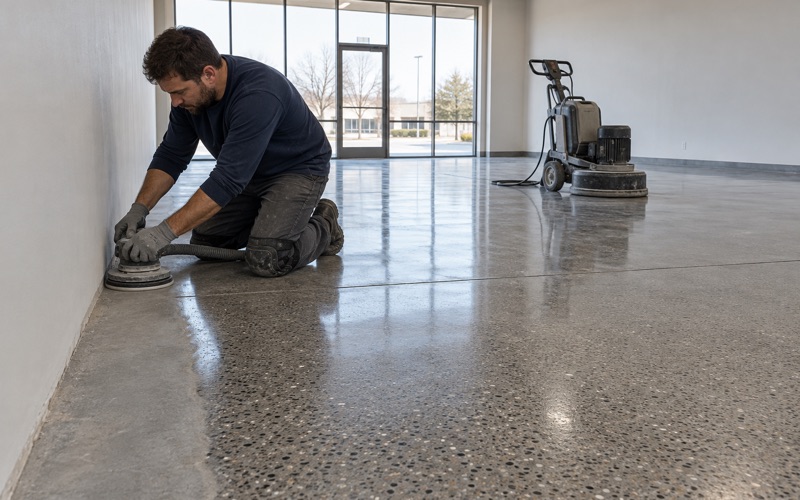
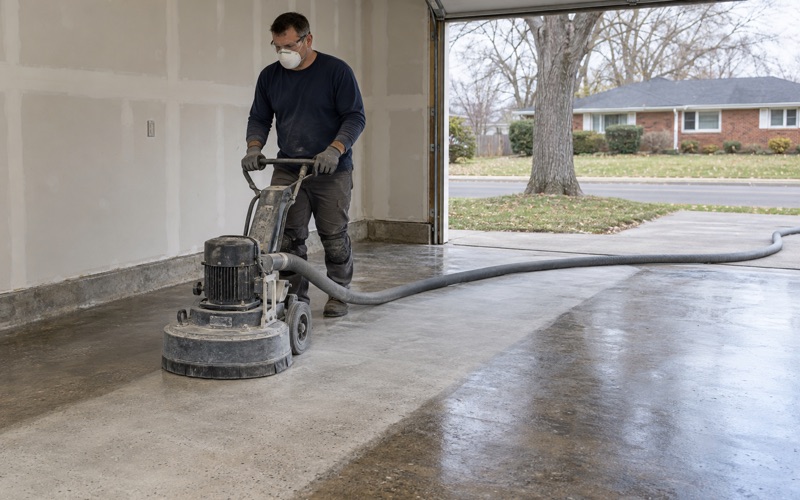
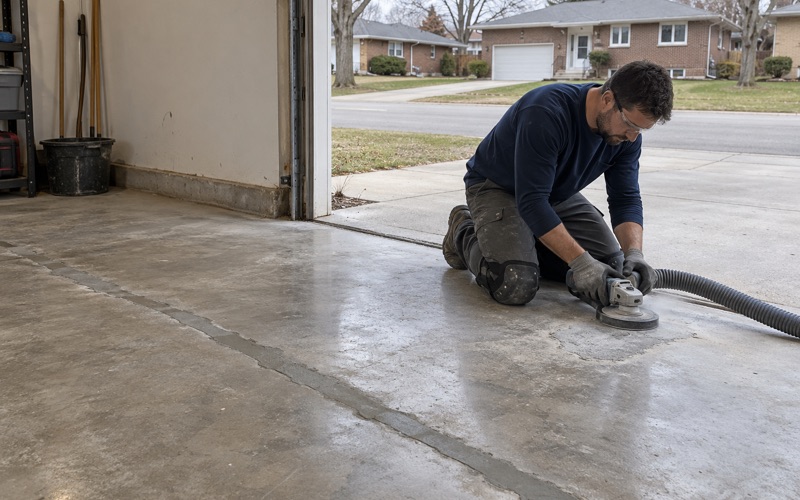
Every slab we take on is opened mechanically, with a diamond grinder or a shot blaster, so the resin has a real profile to grip; we do not acid etch. Before a price is final we test the slab for moisture, and the written proposal names the product line, the number of coats and the finished thickness. Cracks, spalls and old coatings get mapped first, and if a slab needs repair before it should be coated, we say that plainly.
That habit of drawing a line around the right floor matters on ordinary garages and basements. It matters even more in a building where one kind of foot traffic would cut a resin floor to pieces, and Winnetka has one of those.
A 1972 Rink on Hibbard Road and What a Blade Does to a Floor
The Winnetka Ice Arena at 490 Hibbard Road was completed in 1972, the same year the Winnetka Hockey Club was founded, and the club donated the building to the Winnetka Park District. It holds one indoor sheet with bleachers, skate rental and a party room, and the park district keeps it open year-round, day and night, for hockey and skating. The address sits inside the village, in New Trier Township.
We have never worked in that building and have not seen its floors. We use it here because a rink is the clearest local example of a floor plan that has to be drawn around one tool, and that tool is the skate blade.
A hardened edge on a few square millimeters
A skate puts the full weight of a player onto a narrow steel edge that is sharpened on purpose. On ice that edge glides. On a hard floor it scratches, gouges and, under a hockey player stepping off the bench, can slice. Every skater who walks from a locker room to the ice is dragging that edge across whatever floor sits between them.
Epoxy and polyaspartic coatings are hard, thin films bonded to concrete. A blade does not bounce off them; it cuts a line through the film, and that line becomes the place where water, grit and cleaning chemicals get under the coating. A scored resin floor in a skater path does not wear evenly. It fails along the scratches.
Cold and humid by design
A rink building is kept cold and damp on purpose, because the ice demands it. Mondo, a rubber flooring maker, writes that arena floors in locker rooms and high-traffic transit areas need to withstand abrasions and cuts from skate blades as well as the humidity and temperature changes of an ice arena. That is manufacturer copy, not a standard, but it describes the problem accurately.
For a coating, cold and humidity are a cure problem before they are a wear problem. A slab sitting near the dew point of the air above it collects a film of moisture the eye cannot see, and resin laid over it can develop amine blush or lose adhesion. We read the dew point spread at the slab surface, not the calendar, before any coat goes down.
Looking for epoxy-flooring closer to Northlake? See Northlake Epoxy-Flooring.
Rubber Where Skaters Walk, Resin Where They Never Do
The honest floor plan for an arena starts with a map of where blades touch the floor. Locker rooms, the corridors that lead to the ice, the benches and the rinkside walkway all carry skaters on steel. Those areas belong to cut-resistant rubber, the kind sold for rinksides, transitional spaces and locker rooms. Resin is not a substitute there, and we will not quote it as one.
Finding the line between the two
The boundary is usually a doorway or a bench line: the point where a skater sits down and laces up, or unlaces and puts shoes back on. On the street-shoe side of that line, a resin system can do its job. On the blade side, it cannot. Drawing that line on a plan, room by room, is the first page of any proposal we would write for a rink-type building.
Where rubber meets a coated slab, the transition needs a clean termination. We grind a keyway at the edge of the coated area so the resin ends in a locked edge instead of a thin feather that a cart wheel or a dropped skate bag can peel. The flooring installer laying the rubber then has a flat, square edge to meet.
Service rooms behind the ice
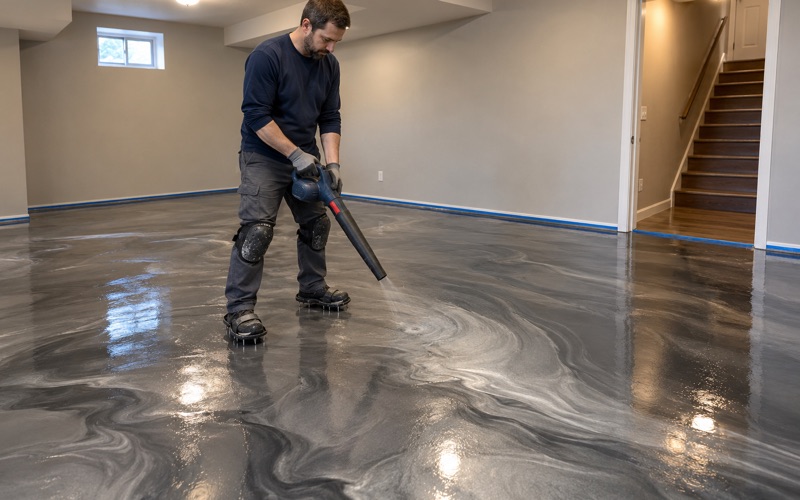
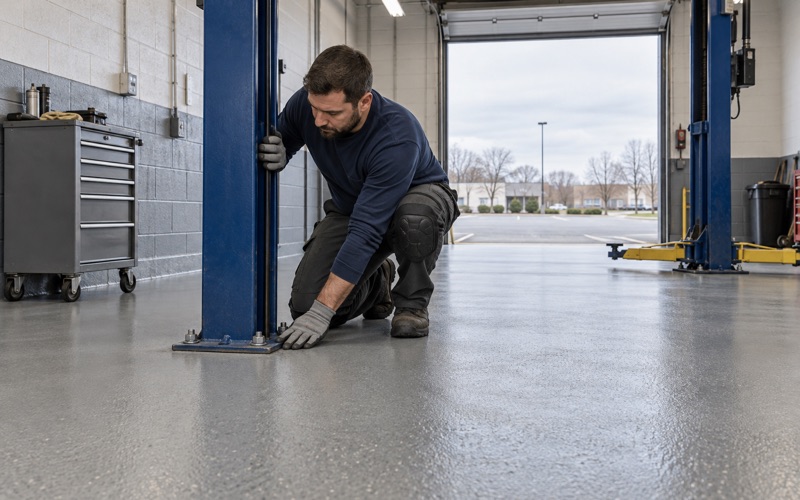
Arenas generally have mechanical rooms, storage and maintenance spaces where staff work in boots rather than skates. These are often the best candidates for resin in the whole building: a 100% solids epoxy base with a quartz aggregate broadcast gives traction on a wet floor, and a polyaspartic or polyurea topcoat holds up to cleaning. We would confirm what each room actually holds before specifying anything, because we have not seen this building’s rooms.
Urethane cement is worth a look for any of these spaces that see hot-water washdowns or cold-to-warm swings, since it tolerates thermal shock better than standard epoxy. The choice depends on the room, which is why the proposal names the product line rather than a generic coating.
Street Shoes Only: The Lobby, Skate Rental and Party Room
The rooms where resin earns its place in a rink are the ones skaters cross before they lace up and after they take the skates off. In a building like the one on Hibbard Road, that means the lobby, the skate-rental counter, the party room and the service spaces. Visitors there wear street shoes, track in grit, spill drinks, and expect a floor that looks clean.
The lobby and rental counter
A lobby takes the heaviest street-shoe traffic and the most dropped gear. A flake system, with vinyl flake broadcast into an epoxy base and sealed under a clear topcoat, hides scuffs and gives some grip when the floor is wet. At a rental counter, where skates are handed across and set down, we would hold the resin to the customer side of the counter and leave the fitting benches to rubber.
Skates in hand are not skates on feet, but a rental area is where blades get dropped. The finish there should be one that tolerates a nick and can be recoated locally rather than one that needs a full-room repair.
A party room that doubles as a lounge
Party and lounge rooms see food, cake, juice and birthday traffic more than sport. A smooth, easy-to-mop epoxy with a polyaspartic topcoat suits that use, and a solid color or light flake reads as finished rather than industrial. If the room has a floor drain or sits next to a kitchenette, we would cove the base where the floor meets the wall so mopping water does not sit in the joint.
Moisture under a cold building
A slab inside a cold, humid building can carry more moisture than the surface suggests. Our tests use ASTM F2170 in-situ relative humidity probes where we can drill and an ASTM F1869 calcium chloride test where we cannot. If the readings run high, a moisture-mitigation primer goes into the scope, and the warranty exclusions for moisture are explained before anyone signs.
An Expansion Proposal and When Floor Work Makes Sense
On May 28, 2026, the Winnetka Hockey Club and its design team presented the park district with a proposal to remodel and expand the arena, with an initial budget of $47.5 million. The club cited the building’s age, high maintenance costs, a lack of adequate space for female players and too little ice time. The concept includes two rinks, a grand lobby, food and beverage areas and a rooftop section.
It is a proposal, not a project. The Park Board responded by adding staff meeting time with the club, naming President Elise Gibson and Commissioner David Seaman as liaisons and setting a recurring agenda item; no decision to build was reported.
Why timing matters for any public building
When a building might be remodeled, spending on a long-life floor in a room that could be demolished or reconfigured is hard to justify. The sensible move in that window is usually maintenance: cleaning and recoating a sound existing finish, or a thin-film system on a high-traffic lobby that buys a few years. A full grind-and-build with a heavy broadcast makes more sense once the plan is settled.
The same logic applies to a club room or any commercial space in the village waiting on a larger decision. Winnetka’s Fire Prevention Bureau reviews plans for remodeled structures and inspects business buildings annually, so floor work in a public assembly building fits into that review rather than around it.
What we would ask before quoting
For any rink, club or recreation building, we start with a walk-through and a marked-up plan: which rooms see blades, which see street shoes, which see boots and equipment. We check with the Village of Winnetka Department of Community Development on whether the coating needs a permit rather than assuming either answer. Grinding dust is captured at the machine by vacuum, never rinsed toward a floor drain.
A building that cannot close gets phased work, with overnight and weekend windows where the village’s rules and the schedule allow. And if the honest answer for a room is rubber, the proposal says so and leaves that floor to the people who install it.
- 20+ Years on Concrete
- Moisture Tested Before Pricing
- Written Itemized Proposals