Mount Prospect Epoxy Flooring has spent more than 20 years on epoxy-flooring in Westchester and across the western suburbs, and the floors that teach the most are the ones that meet fuel. A garage slab that only sees parked cars forgives a lot. A slab where gasoline drips and diesel gets walked in from a pump does not, and the coating has to be picked for that chemistry before anyone talks about color.
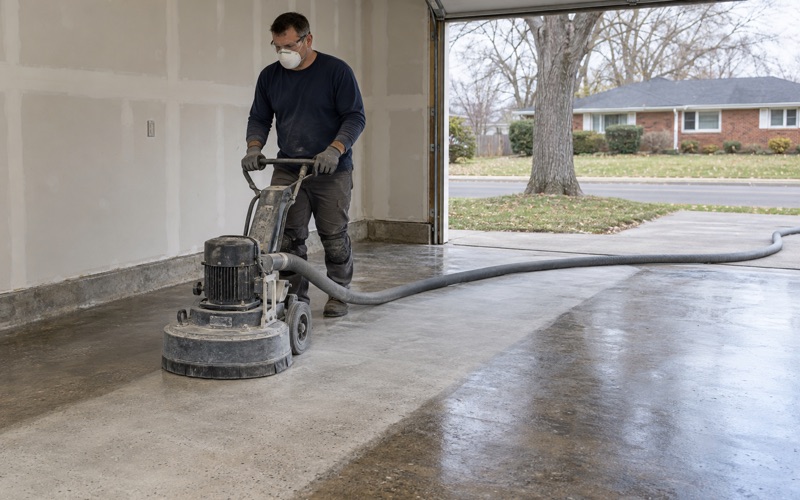
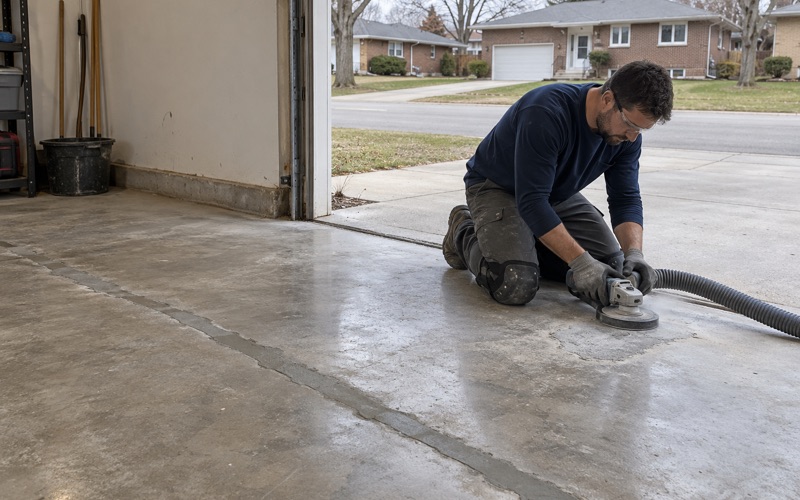
Our approach starts at the concrete. We open every slab with a diamond grinder or a shot blaster rather than an acid wash, test it for moisture before the price is settled, and map the cracks, spalls and old coatings so the quote reflects what the floor actually needs. If a slab should be repaired or replaced before it is coated, we say so in plain terms.
What you get on paper is just as specific. The written proposal names the product line, the number of coats and the finished thickness, so you can hold the finished floor up against the quote. That matters most on a shop or fleet floor, where the difference between a system rated for fuel and one that merely looks tough shows up within a season.
A Fleet Fueling Site on Roosevelt Road
Westchester keeps its own fuel close to home. The Illinois State Fire Marshal’s underground storage tank database lists a facility named Street Garage at 10240 Roosevelt Road, owned by the Village of Westchester, with three underground fuel tanks shown as currently in use. Tank 1 holds 10,000 gallons of regular gasoline, Tank 2 holds 8,000 gallons of gasoline, and Tank 3 holds 8,000 gallons of diesel.
That same address is the Westchester Fire Department’s, according to the Cook County hazard mitigation plan, which lists the Fire Chief at 10240 W. Roosevelt Road and the Public Works Supervisor at 10300 W. Roosevelt Road, Village Hall. So the village’s fire, public works and administrative operations sit side by side on one stretch of road, with a fueling facility among them.
Why this matters to anyone with a fleet floor
We have not worked on the village’s garage, and we are not describing its floor; we have not seen it, and where the pumps sit relative to the bays is not on the public record. The tanks themselves are underground. What the listing shows is a pattern every fleet owner in town shares: when vehicles are fueled on site, gasoline and diesel become part of the floor’s daily diet.
The same is true for a contractor’s yard with a fuel tank, a landscaping company that fills mowers and trucks, or a homeowner who tops off equipment in the garage. The volume differs, but the chemistry reaching the concrete is identical, and the coating decision should start there.
Looking for epoxy-flooring closer to La Grange Park? See Epoxy-Flooring in La Grange Park.
What Gasoline and Diesel Do to the Wrong Floor
Fuel is a solvent. Gasoline in particular is aggressive toward many single-component and water-based garage paints, and a drip left to sit can soften the film, lift its edges or leave a dull, tacky patch that never recovers. Diesel evaporates far more slowly, so it lingers on the surface, darkens porous areas and works its way into anything that is not chemically tight.
Softening, staining and loss of bond
The failures we see on the wrong system come in three forms. The first is softening, where the coating goes gummy under a drip and then scuffs away under tire traffic. The second is staining, where diesel and oil migrate into a thin or porous film and leave a permanent shadow. The third is bond loss, where fuel finds a crack or a poorly prepared edge and creeps under the coating from below.
Bond loss is the one most tied to preparation. A slab that was etched instead of ground, or coated over old paint, gives fuel an easy path along the interface. That is why we profile the concrete mechanically to the ICRI CSP range the primer calls for, so the first coat locks into open concrete rather than sitting on top of a smooth skin.
The pump-to-bay path
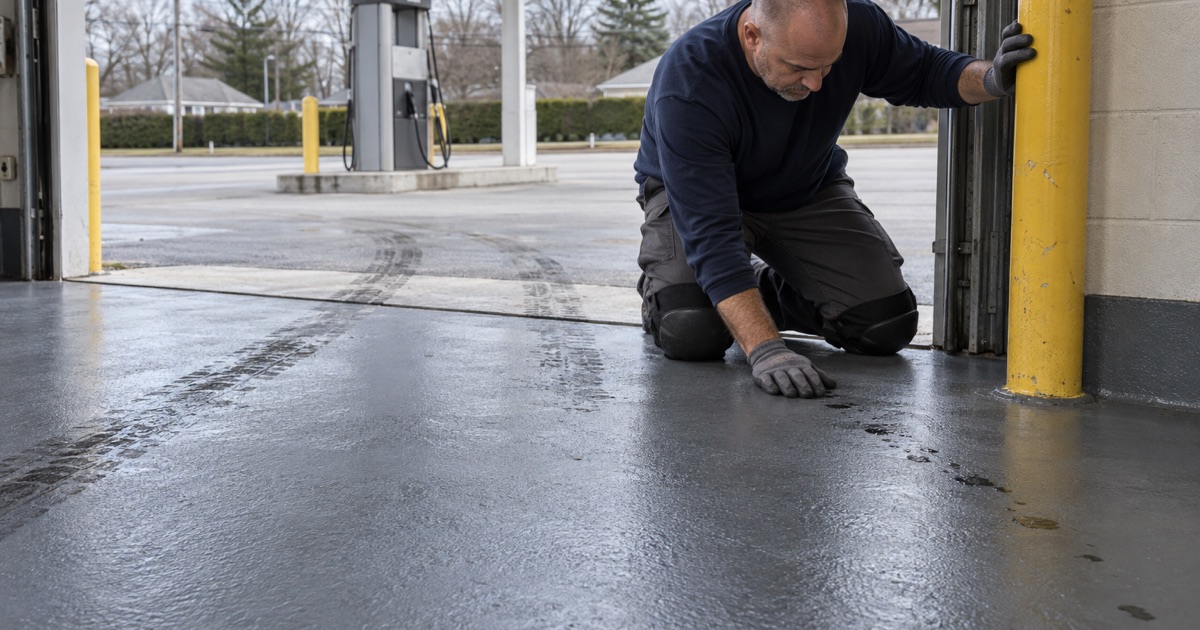
On any site with fueling, drips land in predictable places: near the fill point, along the route a vehicle takes back to its stall, and under the fuel filler on the parked vehicle itself. Tires and boots pick up what falls and carry it inside, so the floor nearest the door and the first few feet of each bay take most of the exposure.
We plan the system around that path rather than treating the whole floor as one zone. The entry and the bay aprons may get added thickness or a more chemical-resistant topcoat, while storage and office areas can take a lighter build. Drip trays and spill kits at the pump do far more for the floor than any coating can, and we encourage both.
Choosing a System by Chemical Resistance, Not Gloss
A showroom shine says nothing about how a floor handles fuel. When gasoline and diesel are part of the picture, we start with the manufacturer’s published chemical-resistance data and work backward to a system, then confirm the build with you in writing.
100% solids epoxy as the body
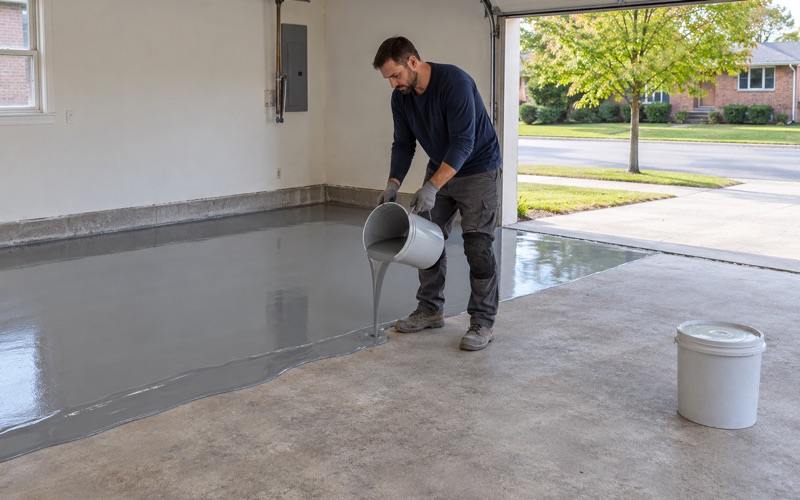
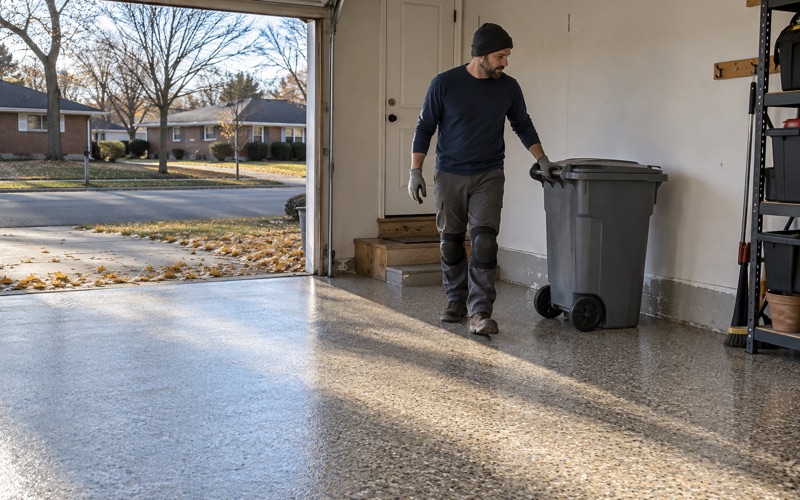
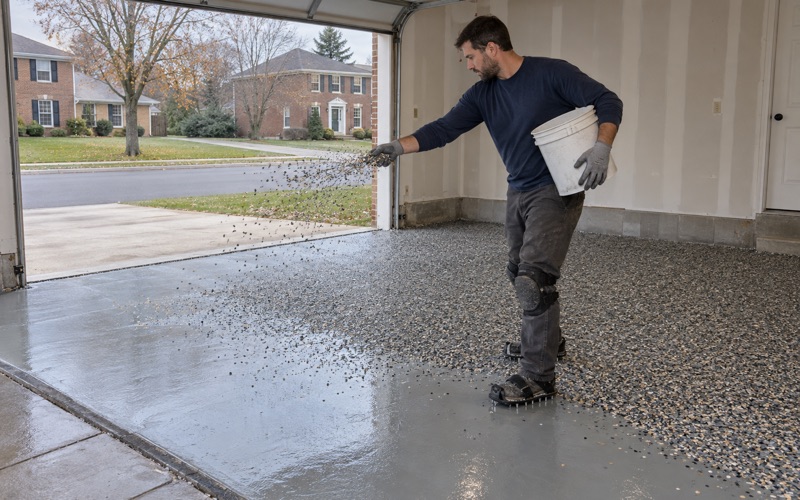
For most fuel-exposed garages, the base is a 100% solids epoxy applied over a properly ground slab. It builds real thickness in each coat, bonds hard to profiled concrete and stands up to gasoline, diesel and motor oil far better than a thin, solvent-borne paint. A broadcast of vinyl flake or quartz aggregate adds texture for footing and hides the wear of daily traffic.
Topcoats and harder service
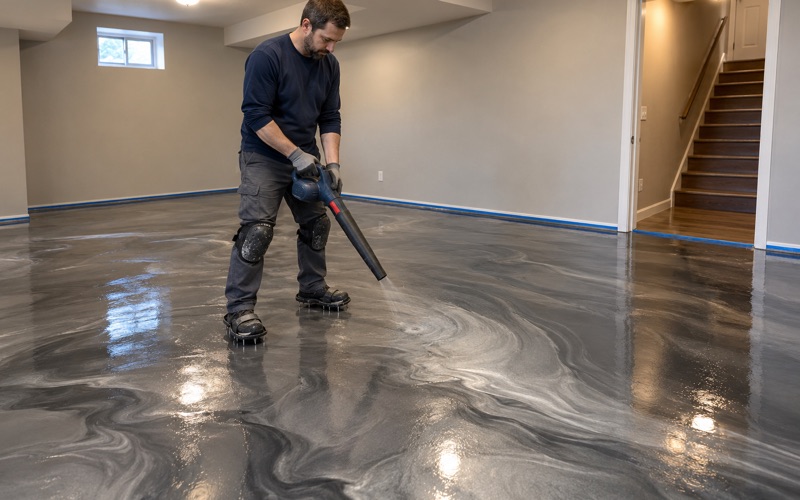
The topcoat carries much of the chemical load. Polyaspartic and polyurea topcoats resist hot tire pickup, hold color and cure quickly, and many are rated well for fuel splash; we check each product’s sheet rather than assume. Where floors see heavy solvent use, hot washdown or constant spills, urethane cement can be the better answer, and we will tell you when the conditions point that way.
We also select every product inside the Illinois VOC limits for floor and industrial coatings, which bind the applicator as well as the manufacturer. Be clear about one limit: a floor coating is not spill containment and it is not a substitute for underground tank compliance. It protects the concrete from what lands on it; the fuel system’s own safeguards are a separate matter.
Moisture, curing and the warranty
Before committing to a system, we test the slab for moisture with methods such as ASTM F1869 calcium chloride kits or ASTM F2170 in-situ probes, because moisture coming up through a slab is a common reason coatings let go and the first thing a warranty excludes. We explain those exclusions before the job is sold. Cure times follow slab temperature and dew point, so the schedule is set by the concrete, not by the calendar.
Renovating Municipal Buildings While They Keep Running
Westchester’s leadership recently settled a long question about its public buildings. A 2026 village newsletter reports a $15 million state appropriation in the FY2027 budget through the Build Illinois Bond Fund, and says the village weighed relocating Village Hall and other facilities before concluding that renovating and modernizing existing facilities is the most responsible and cost-effective approach. The planned uses named are HVAC replacements, roof repairs, critical infrastructure upgrades and workspace renovations; no floor work is named.
That decision followed an earlier plan to move. Around 2021 the village board voted to borrow roughly $4.6 million to buy two buildings on Enterprise Drive for a new municipal campus, and by 2023 projected move costs had climbed sharply. The village now plans to stay on Roosevelt Road and improve what it has.
Working around operations that cannot stop
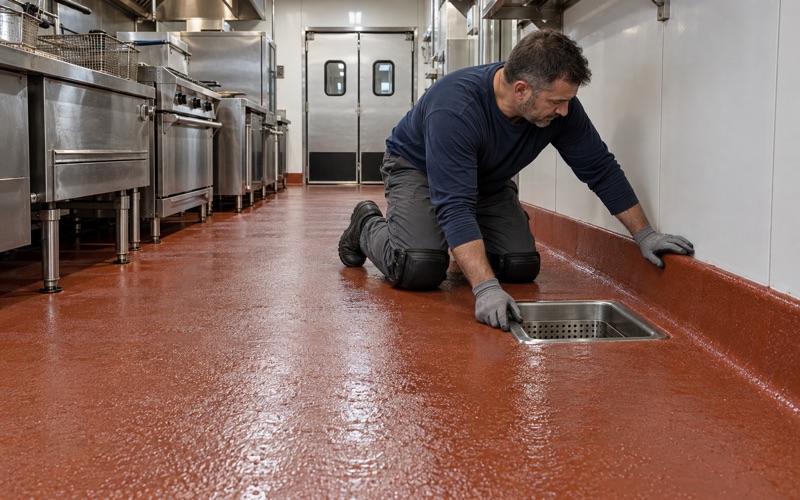
Renovating in place means the buildings keep doing their jobs during the work. That is the same constraint any business with a working garage or shop faces, and we plan for it. Shop, warehouse and fleet floors are phased around shifts, with overnight and weekend windows when the building cannot close, and bays are done in sections so vehicles always have somewhere to go.
Grinding dust is collected by vacuum at the machine instead of being washed toward a floor drain or out to the street, which keeps a working building cleaner and keeps fine concrete dust out of the storm system. Coating schedules account for cure time before vehicles return, and we mark which bays are open and which are curing.
Permits and paperwork in Westchester
Illinois has no state flooring license, so we check each village’s own requirements before booking. The Village of Westchester’s Community Development and Building Department administers local rules, and its garage sheet requires anyone building for hire to be licensed and bonded with the village and to show proof of insurance. Whether coating an existing floor needs a permit is not stated, so we ask the department directly rather than guess.
For homeowners, any job over the state threshold comes with a written contract and the Illinois consumer-rights pamphlet before grinding starts. For a commercial or fleet client, the proposal spells out the system, the thickness, the moisture results and the phasing plan, so the people running the building know exactly what will happen and when.
- 20+ Years on Concrete
- Moisture Tested Before Pricing
- Written Itemized Proposals