Mount Prospect Epoxy Flooring has handled epoxy-flooring in Wauconda and the surrounding suburbs for more than 20 years, and on a maintenance floor we start with an unusual question: what is this floor supposed to tell you? In a shop where heavy vehicles are serviced, the concrete is a diagnostic surface as much as a working one. A drip, a weeping seal or a bolt that rolled under a tire should be obvious from the doorway, and the right coating makes that happen.
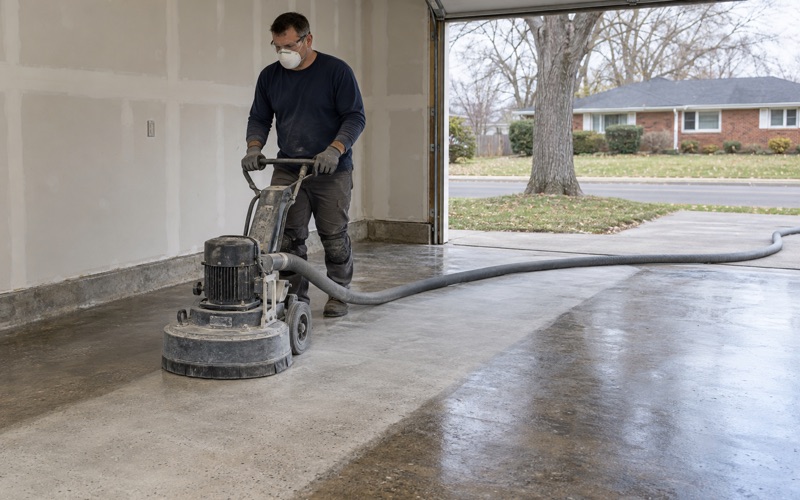
Getting there starts below the color. We open every slab mechanically, with a diamond grinder or a shot blaster and never an acid etch, so the primer has a real profile to grab. A moisture test is part of the scope before any price is final, and cracks, spalls and old coatings are mapped so the quote matches the slab you actually have.
You get the plan in writing. The proposal names the product line, the number of coats and the finished thickness, which means the floor can be measured against the paper once it is down. If the concrete needs repair or replacement before a coating makes sense, we tell you that plainly rather than sell a finish it cannot hold.
A District Bus Garage on Jamie Lane
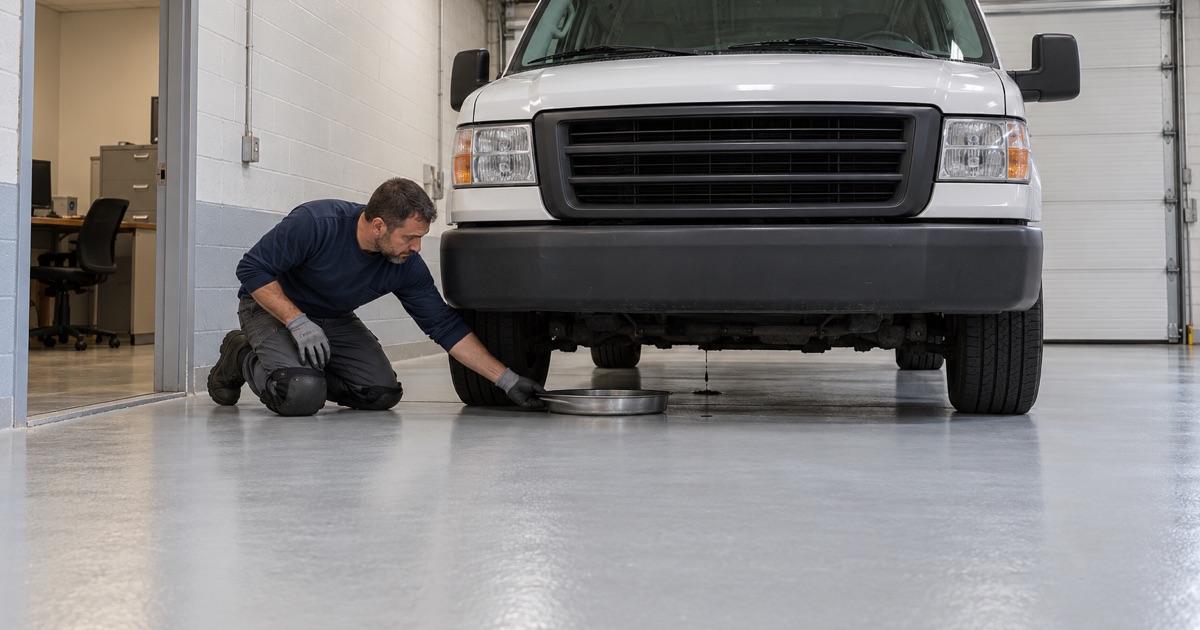
Wauconda has a clear example of a floor that works as part of a maintenance routine. Wauconda CUSD 118 operates its own fleet of school buses, and its Transportation page says each bus is maintained at the district’s Transportation Center. The District Transportation Offices are listed at 264 Jamie Lane, an address that sits inside the village, in Wauconda Township, Lake County.
The scale of the job shows in the district’s own numbers. The page cites more than 4,000 students who need to get to school each day and over 1,200 high school students eligible for bus service. Late activity routes add two buses at each middle school and three at the high school, so keeping buses ready does not end with the morning run.
Twice-yearly inspections and the days between them
According to the district, all buses are inspected twice yearly by the State of Illinois to make sure each vehicle complies with state and federal regulations. Those inspections look at the buses. What keeps a bus ready for them is the maintenance done in town the rest of the year, and that work happens on concrete.
Between inspections, a shop crew is watching for small changes: a fresh spot under an axle, a seal starting to weep, a fastener on the floor that came from somewhere. The sooner those show up, the sooner a bus is pulled and checked instead of sent back out on a route.
Any operation that services its own vehicles in-house carries the same burden. The shop is where problems are caught early or missed, and the floor under the vehicles is part of that shop whether anyone thinks of it that way or not.
What we are and are not saying
We have not worked at the Transportation Center, and we have not seen its floor. The district does not publish its fleet size, its shop layout or how its bays are equipped, so we make no claims about any of them. What follows is the trade practice that applies to any heavy-vehicle maintenance floor in Wauconda, whether it belongs to a public agency, a contractor or a private fleet.
Looking for epoxy-flooring closer to La Grange? See Epoxy-Flooring Services in La Grange.
A Floor That Shows a Leak
In a vehicle shop, a dark gray floor hides almost everything. Motor oil, transmission fluid, coolant and brake fluid each leave a different mark, and on a dark or busy surface they blend into the background until someone steps in them. A light, even-colored floor does the opposite: a new drip under a parked vehicle stands out, and a technician can read the color and position of a spot before reaching for a rag.
Choosing a light color that stays light
The body of the system is usually a 100% solids epoxy in a light gray or similar tone, built thick enough over a profiled slab to carry daily traffic. The topcoat matters as much as the base. A polyaspartic or polyurea topcoat holds its color, resists hot tire pickup from tires that roll in warm off a route, and gives a surface that wipes clean instead of absorbing stains.
Some epoxies amber with sunlight and age, which works against a floor whose job is to stay readable. We choose topcoats with that in mind, and the proposal names the exact product so you can check its data sheet yourself.
Light from below
A light floor also changes how a bay is lit. A pale, glossy coating bounces overhead light back up toward the underside of a vehicle, where a technician is often working with a hand lamp in tight space. Brighter undercarriages make a wet fitting or a cracked boot easier to catch, which is the same goal as a readable floor, just pointed upward.
How much pattern to allow
A broadcast of vinyl flake or quartz aggregate adds texture for footing, and footing matters on a floor that gets wet. The trade-off is visibility: a dense, multicolored flake does what a dark floor does and camouflages small drips and loose parts. On a maintenance floor we usually recommend a light, low-contrast broadcast or a fine quartz texture in the topcoat, enough for grip without hiding what lands on the surface.
Fluids that sit under a parked vehicle
Under a heavy vehicle, fluids rarely splash; they drip and then sit, sometimes overnight. That is a different exposure from a quick spill wiped up in minutes. We check each product’s chemical-resistance data against the oils, coolants, cleaners and degreasers the shop actually uses, and pick a system that can take prolonged contact without softening or staining.
The point is not to make a leak harmless. It is to make a leak visible, so the vehicle gets fixed, while the coating survives the spot long enough for someone to clean it up.
Heavy Vehicles, Lifts and the Cleaning Routine
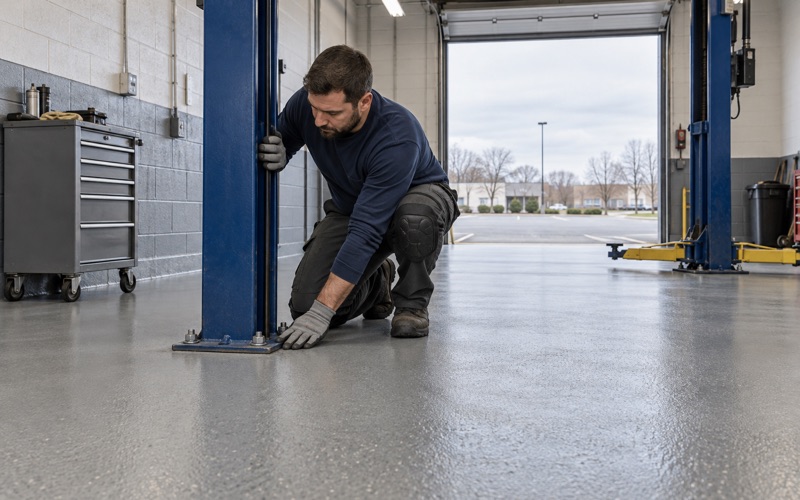
A maintenance bay puts loads on concrete that a home garage never sees. Jack stands, wheel dollies and the bases of vehicle lifts concentrate weight onto small footprints, and a dropped tool or brake drum lands hard. A thin paint film over a smooth slab tends to chip and dent at exactly those points.
Thickness where the load lands
We answer point loads with preparation and build. Grinding or shot blasting to the ICRI CSP range the primer specifies gives the first coat a profile to lock into, and a full-thickness 100% solids system spreads load far better than a thin coating. Where a bay sees constant stand and lift traffic, we may add thickness locally or recommend urethane cement, and the proposal says which areas get which build.
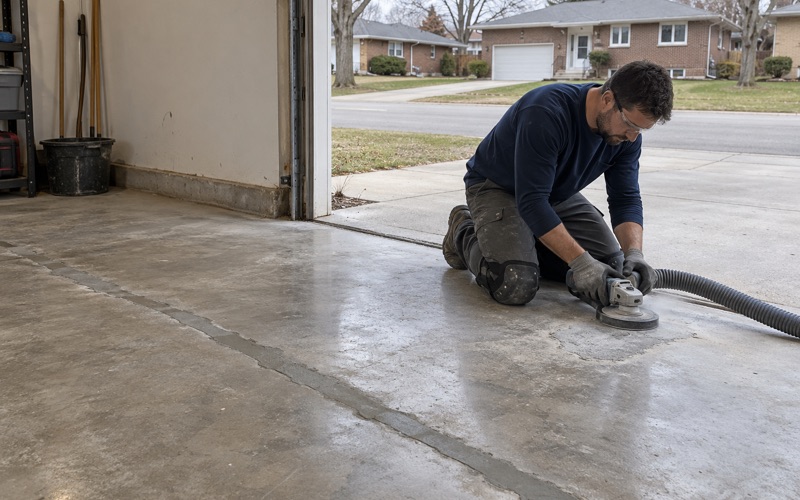
Existing damage is part of the same conversation. Cracks and spalls under a lift base or along a bay’s centerline are mapped and repaired before coating, because a coating does not bridge a moving crack for long. When a slab is too far gone, we say so before anything is sold.
Cleaning that keeps the floor readable
A light floor only shows a new leak if yesterday’s spots are gone. That means a cleaning routine built for the coating: absorbent on fresh spills, a coating-compatible degreaser, an auto scrubber or a soft deck brush, and a clean-water rinse so detergent film does not dull the surface. Harsh solvents and wire brushes can scuff a topcoat and leave it looking dirty even when it is clean.
We leave a written care sheet with every commercial floor, naming which cleaners the topcoat tolerates and which to avoid. A steady routine also stretches the time before a recoat, because the wear layer stays intact instead of being scrubbed away.
Phasing Floor Work Bay by Bay
A working garage cannot close for a week while its floor is redone. Shop, warehouse and garage floors are phased around shifts, with overnight and weekend windows when the building cannot stop, and we plan the work one bay at a time so vehicles always have somewhere to go.
A sequence the shop can live with
A typical plan takes one or two bays out of service, grinds and vacuums them, repairs cracks, primes and builds the system, and returns them to use once the coating has cured enough for traffic. The next bays follow. Barriers and signs mark which bays are open, which are curing and where tools and parts should be staged in the meantime.
Grinding dust is captured by vacuum at the machine, not rinsed toward a floor drain or out the door. In a building with technicians working one bay over, that keeps the air and the open bays cleaner too.
Matching the scope to the room
Not every room in a maintenance building needs the bay system. A parts room, an office corridor or a storage area with light foot traffic can take a thinner build, and bare concrete in a low-use space can be ground and treated with a lithium silicate densifier instead of coated. Scoping it room by room keeps the budget on the floors that work hardest and shortens the shutdown for the rest.
Cure follows the slab, not the schedule
Cure times depend on slab temperature and the dew point spread at the surface, so we measure both before each coat. A slab that is too cold or too close to dew point can cure slowly or develop amine blush, and the schedule moves to match. Moisture readings from ASTM F2170 in-situ probes or ASTM F1869 calcium chloride tests go into the proposal, along with what the warranty excludes, starting with moisture.
Local paperwork
Illinois has no state flooring license, so we check the Village of Wauconda’s own registration, bond and insurance requirements before booking. We also ask the village’s building and community development staff whether a given coating job needs a permit rather than assume either way. Every product is selected inside the Illinois VOC limits for floor and industrial coatings, and homeowners on a job over the state threshold get a written contract and the Illinois consumer-rights pamphlet before any grinding begins.
- 20+ Years on Concrete
- Moisture Tested Before Pricing
- Written Itemized Proposals