Mount Prospect Epoxy Flooring has been installing epoxy flooring in Schiller Park and the surrounding suburbs for more than 20 years, and the floors that teach us the most are the ones asked to do two opposite jobs at once. One end of the room takes grease, residue and grit. The other end has to stay clean enough to assemble precision parts on. A single coating chosen for the average of those two conditions usually ends up wrong for both.
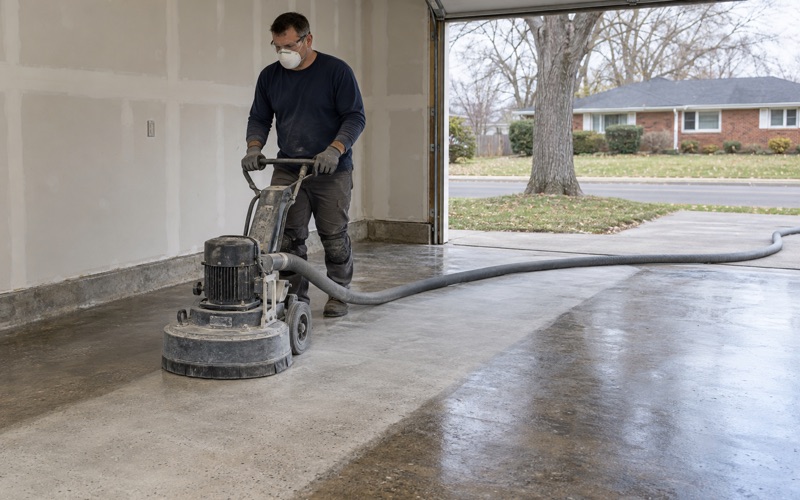
So we treat that kind of floor as two systems sharing one slab. The concrete is opened with a diamond grinder or a shot blaster rather than an acid etch, it is tested for moisture before the price is settled, and the written proposal names the product line, the coat count and the finished thickness for each zone separately. That way an owner can check every area of the finished floor against its own line of the quote.
Below, we walk through one of the village’s longest-running industrial processes, what its two halves ask of a floor in general terms, and how we draw the line between them in a shop of any size.
Soreng Avenue: Carburetors Torn Down and Rebuilt Since 1979
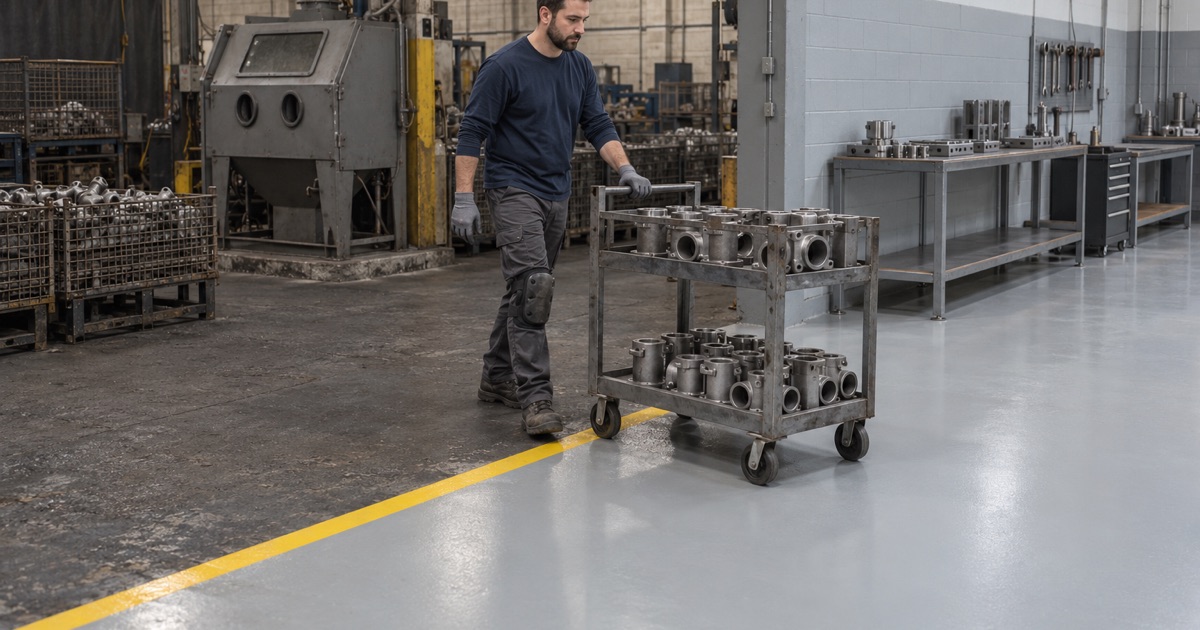
United Remanufacturing Co., known as UREMCO, traces its start to 1948 and a small garage in the Chicagoland area. In 1979 the company outgrew its location on Lawrence Avenue and built a 33,000-square-foot manufacturing facility at 9550 Soreng Avenue, inside Schiller Park in Leyden Township, Cook County. It now lists more than 1,000 carburetor part numbers and more than 900 in fuel injection for gasoline cars and light trucks.
To be plain about it: UREMCO is not a customer of ours, and we have never worked inside that plant. We describe it because its published process is the clearest local picture of a building whose floor has two jobs, and because the same split shows up in far smaller shops all over the village.
The teardown and cleaning end
According to the company, remanufacturing starts by disassembling a carburetor’s base, body and air horn. All zinc and steel castings are chemically processed to restore the factory finish, and all aluminum castings are sandblasted. Fuel injectors have the dirt, grease and carbon deposits removed from the outside of the body before O-rings, pintles and filter baskets are replaced.
UREMCO does not name the chemicals it uses, and we would not guess. What we can say is general: in any rebuilding operation, the teardown end of the building sees cores that arrive caked in old fuel residue and carbon, cleaning steps that wet the floor, and blast media that escapes the cabinet no matter how good the seals are.
What grit and residue do to a coating
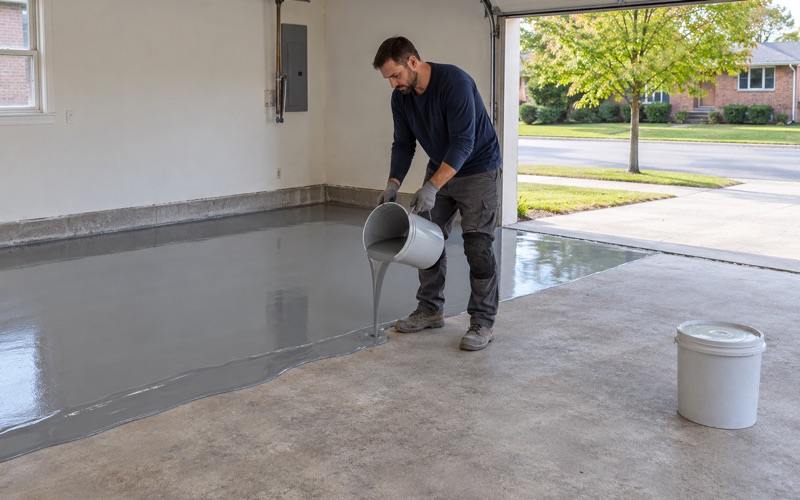
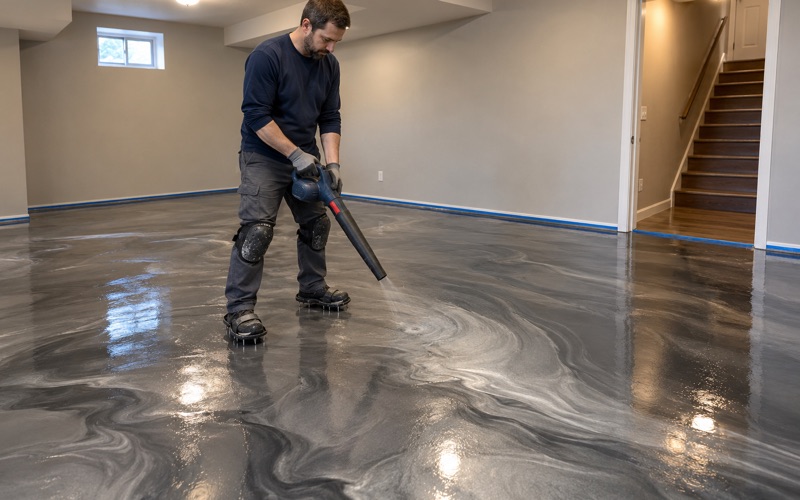
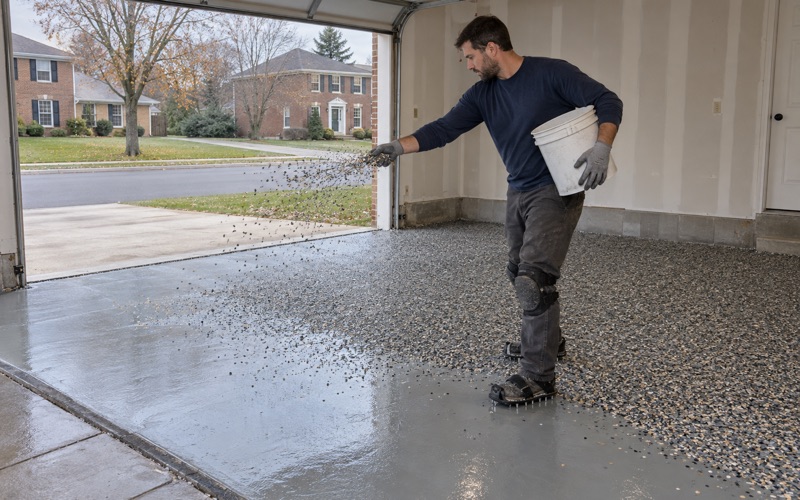
Loose blast grit under cart wheels and boot soles acts like sandpaper on a thin film, and a coating that is not rated for a shop’s cleaning chemistry will soften, stain or lift. On that end of a floor we look at a thicker build of 100% solids epoxy with a quartz aggregate broadcast, finished with a topcoat matched to the actual chemicals on the shop’s safety data sheets. Epoxy tolerates some chemistries far better than others, so the data sheets drive the choice, not the brochure.
Blast cabinets and parts washers also sit in one place for years. Where we can, we run the dirty-end system continuously under them, because a coating that stops at an equipment footprint leaves a raw edge where residue collects and the film starts to peel.
Drains and edges at the dirty end
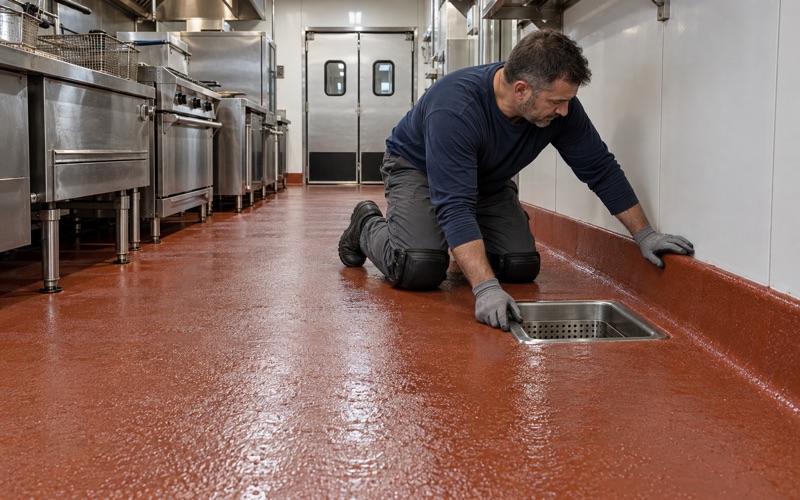
Where the cleaning end has a floor drain, we carry the coating down into it rather than stopping short, and we terminate the system in a sawn keyway at the drain rim and at the open edges, so a hose-down cannot get under the film. At the clean end, a drain is often better covered or kept outside the zone entirely, since standing water is the last thing an assembly area wants. That choice belongs to the owner; our part is to lay out what each option means for the coating.
MWRD’s October 2025 list of significant industrial users carries the Soreng Avenue plant under CFR 433, a reminder that what an industrial user sends down a drain is regulated. That is one reason our grinding dust is captured by a vacuum at the machine instead of being rinsed toward a drain.
Looking for epoxy-flooring closer to Deerfield? See Epoxy-Flooring Services in Deerfield.
The Clean End: Assembly and Flow-Bench Testing
At the other end of the same process, UREMCO’s assemblers adjust each part to original factory settings, and every carburetor is tested on the company’s flow-bench engine simulator for quality control. Injectors are tested for leaks, resistance, spray pattern and flow rate. The test fluid is not named in anything we have read.
Work like that only makes sense if the floor around it is not quietly feeding contamination back into the parts. A single grain of blast media carried in on a cart wheel is exactly the kind of thing an assembly area is trying to keep out.
A surface that shows debris and sweeps clean
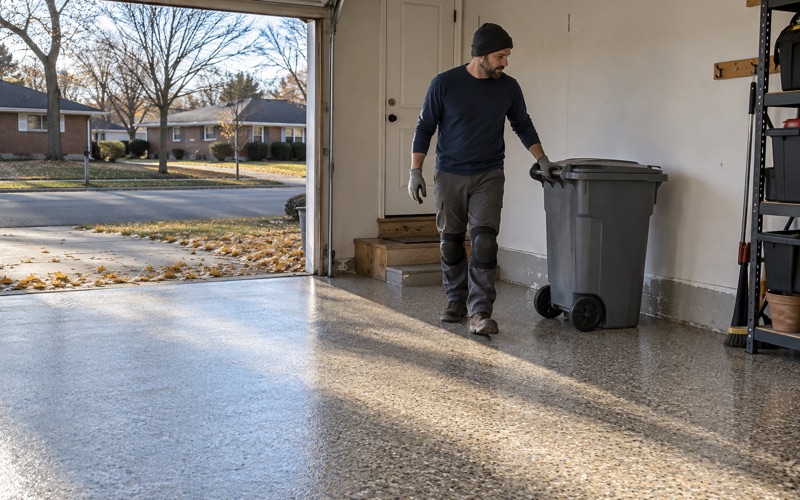
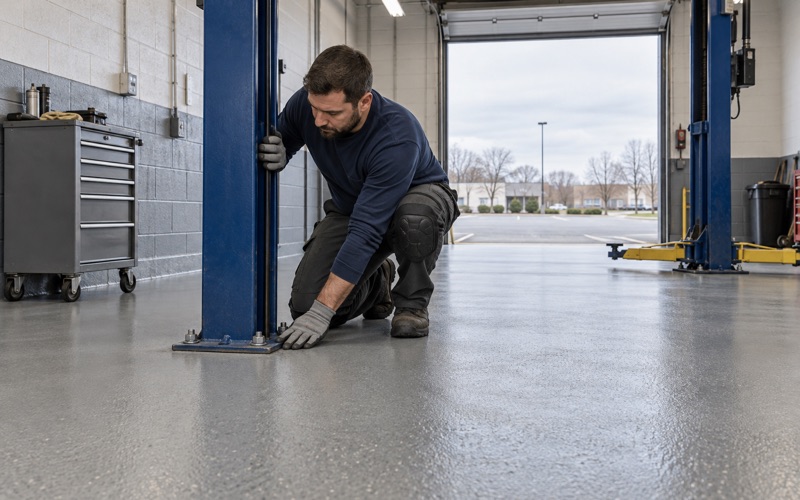
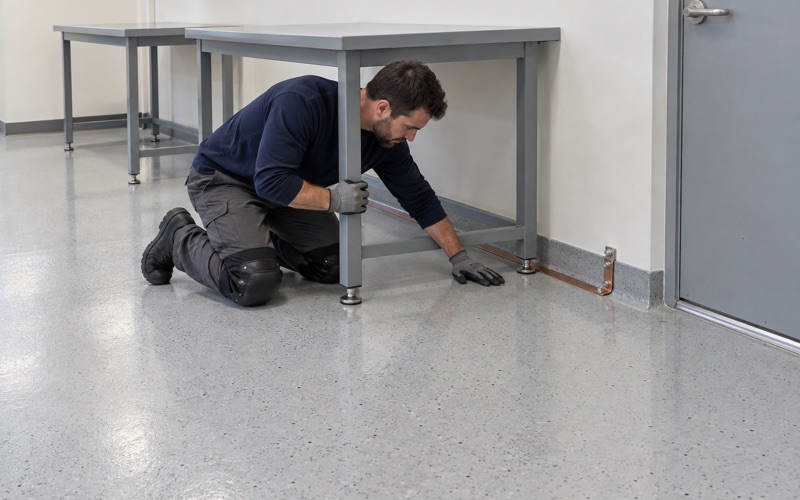
For an assembly or test zone, we generally recommend a smoother, tighter finish than the dirty end gets: a lighter color so stray grit is visible, a fine texture rather than a coarse broadcast, and as few seams and open joints as the slab allows. A floor that a broom clears in one pass gets swept; a floor that hides debris in its texture does not.
Planning for spills at a test stand
Whatever fluid a test bench runs, we ask for its safety data sheet before choosing a topcoat. A polyurethane or polyaspartic topcoat over an epoxy base is a common pairing where drips and wipe-downs are routine, but resistance is checked against the real product, not assumed. A topcoat that dulls or softens under a daily drip is a maintenance problem on day ninety.
Flatness for benches and test stands
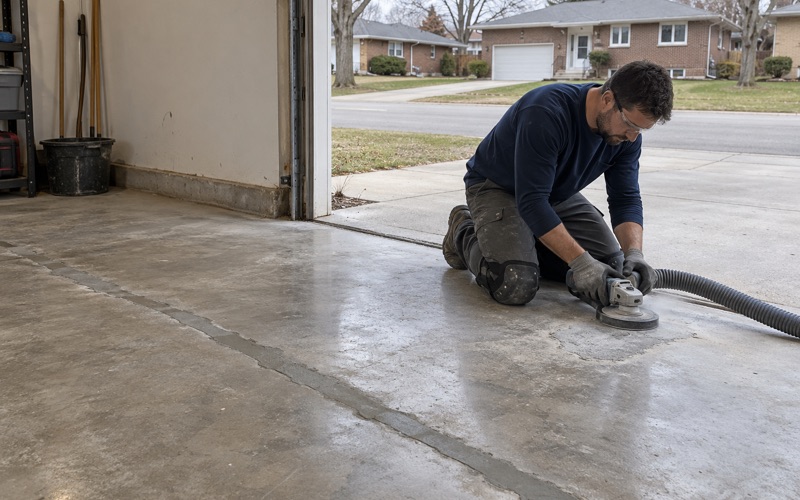
Flatness matters more at the clean end than people expect. Test stands, parts carts and assembly benches get moved and leveled, and a coating that telegraphs every old patch and pop-out in the slab makes that harder. We grind high spots and fill low ones with a repair mortar before the base coat, so the finished surface follows a flatter plane than the bare concrete did.
Drawing the Line: Zoning One Slab for Two Jobs
A floor that serves both a dirty end and a clean end is laid out by zone, with a defined line between them. That is general practice in remanufacturing and rebuilding work, and it is how we plan any floor where one area makes the mess the other area must not receive.
A different build on each side
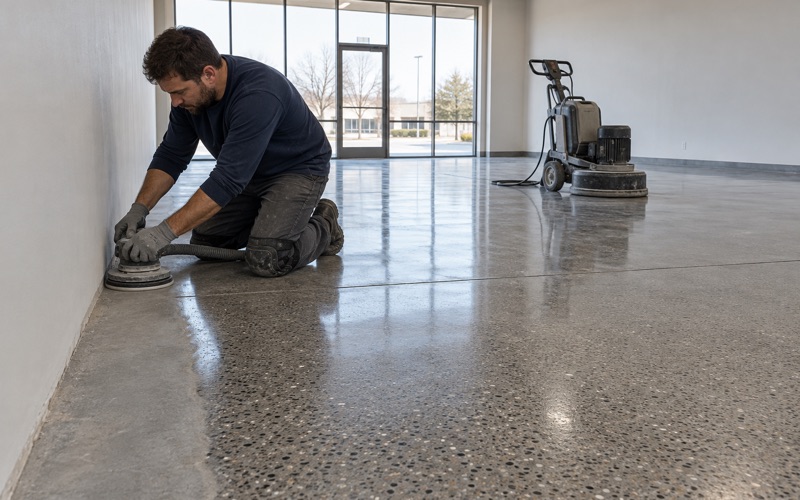
Both zones usually share the same mechanical preparation and primer, so the slab is bonded uniformly. Above the primer the systems diverge. The dirty end gets more thickness, more aggregate and the more chemical-resistant topcoat; the clean end gets a smoother, easier-to-clean finish. We profile the whole slab to a measured ICRI concrete surface profile with diamond grinding or shot blasting, because an acid etch leaves no dependable profile and adds its own residue.
Marking the transition
The line between zones should be visible and deliberate: a change in floor color, a painted stripe or a contrasting band wide enough that nobody crosses it without noticing. Where carts and pallet jacks roll across, we detail the joint between the two systems so it does not become a lip that catches wheels or traps grit. Some shops add a short walk-off area on the clean side of the line.
Moisture and cure across both zones
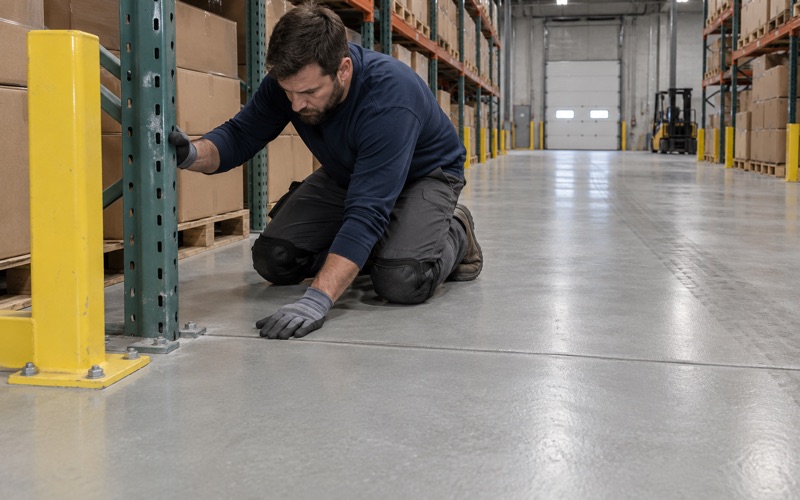
An older industrial slab is rarely uniform, so we test more than one spot. A plastic sheet test under ASTM D4263 is a quick screen, but it is not a number we price from. ASTM F2170 in-situ relative humidity probes or ASTM F1869 calcium chloride testing tells us whether a moisture-mitigation primer belongs in the scope, and what the warranty will and will not cover is explained before the job is sold. Cure times follow slab temperature and the dew point spread at the surface, not a calendar promise.
Cracks, spalls and failing old coatings are mapped before we price anything. If a section of slab needs repair or replacement before it should be coated, we say so in writing rather than burying the problem under a fresh film.
Smaller Shops With a Dirty Side and a Clean Side
The village describes its business base as ranging from hospitality-related travel businesses to machine shops, with more than 400 businesses on 2.77 square miles, and commercial property makes up 55 percent of its 2023 equalized assessed value. Many repair and rebuilding shops run a small version of the same split: a teardown bench where parts come in dirty and an assembly bench where they go back out.
Scaling the zoning down
When we walk a smaller shop, the first question is where the parts actually travel: in at the door, to the teardown bench, through the washer, then back across the floor to assembly. That path, not the floor plan on paper, decides where the line goes, and it often lands a few feet from where an owner first sketches it.
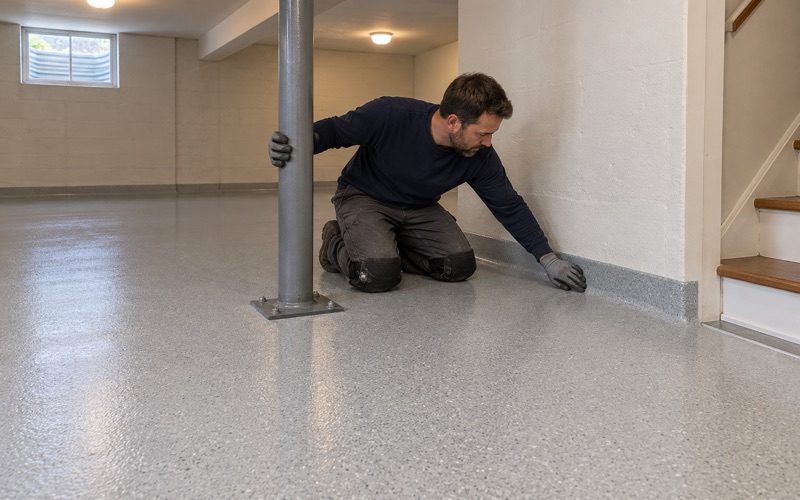
In a repair or rebuilding shop of a few bays, zoning may be as simple as a rougher, aggregate-broadcast finish around the cleaning sink and parts washer, a smoother finish around the assembly benches, and a stripe at the boundary. The principle is the same as in a 33,000-square-foot plant: the mess has a place, and the floor tells everyone where that place ends.
Working around the shop’s hours
Shops that cannot shut down are phased. We can coat the clean zone over a weekend while the dirty end keeps running, then swap, or schedule overnight windows section by section. Grinding is the loud, dusty step, so it is the one most worth putting on a night or a Sunday. Each phase is cured to the point the system calls for before anyone drives on it.
Before a Schiller Park job is booked
The village requires contractors to be licensed with it before construction starts, registering through its Community Core system with scope, cost, insurance, bond and workers’ compensation as applicable, on a license year that runs May 1 to April 30. Illinois has no state flooring license, so we check the village’s current requirements for each job before it goes on the calendar, and we ask the Community Development Department whether the coating work needs a permit rather than assuming the answer either way.
- 20+ Years on Concrete
- Moisture Tested Before Pricing
- Written Itemized Proposals