Mount Prospect Epoxy Flooring has spent more than 20 years on epoxy-flooring in River Grove and the communities around our home base, and the floors we think hardest about here are the ones people stand on while they eat. A kitchen or service-counter floor that takes grease, water and a mop every night asks a different question than a garage does. The question is how much grip a floor can carry before it stops coming clean.
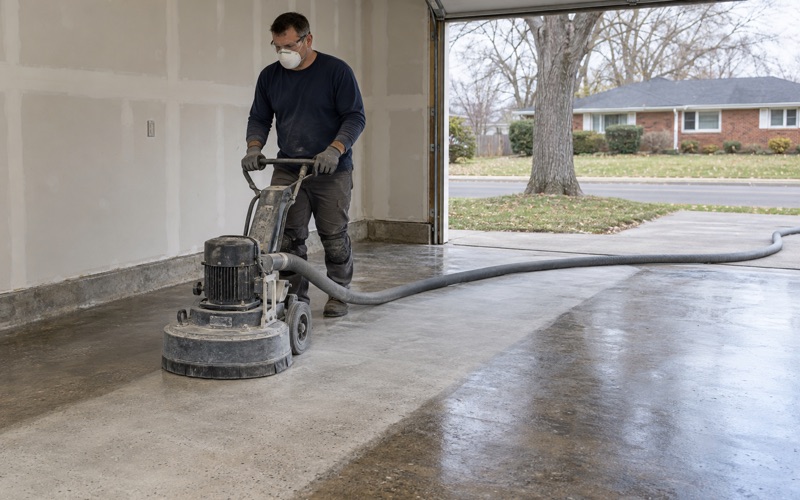
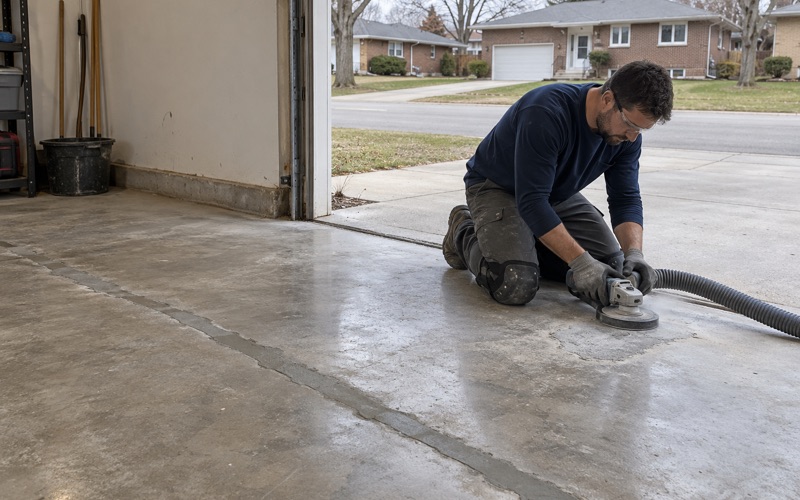
Our answer always starts with the concrete. We open the slab with a diamond grinder or a shot blaster rather than an acid etch, so the coating has a real profile to bond to, and we test moisture before the price is final. Cracks, spalls and old coatings are mapped first, and if the slab should be repaired or replaced before it is coated, we tell you that up front.
The written proposal names the product line, the coat count and the finished thickness, so the floor that goes down can be checked against the paper. On a food floor we also say plainly what the coating warranty excludes, starting with moisture, before the job is sold.
A River Road hot dog stand that has never had seats
Gene & Jude’s has been selling hot dogs at 2720 N. River Road since 1950. The stand began in 1946, when Chicago city worker Gene Mormino opened it at Polk and Western in Chicago, and he moved operations to River Grove four years later. The address sits inside the Village of River Grove, in Leyden Township of Cook County.
In the 1950s the stand was a frame building with a takeout window under a sign that read ‘Vienna Red Hots’. It is still family owned and operated, and its signature order puts fresh-cut French fries on top of the hot dog rather than beside it. Its motto, ‘No Seats No Ketchup No Pretense No Nonsense’, is not a line about decor: customers eat standing up or take their food to go.
We have never worked at Gene & Jude’s and have never seen its floor. We do not know the current building’s age, what its floor is made of or how its kitchen is laid out. We name the stand because it is the clearest example in River Grove of a floor type we are asked about, a food floor where every customer is on their feet and the fryer never really rests.
Why a standing-room floor is its own problem
A dining room with tables spreads foot traffic across the room and gives a spill somewhere to land away from the walkway. A counter with no seats does the opposite. Every customer lines up, orders, waits and eats in the same few square feet, so the floor in front of the counter takes concentrated wear and any spill lands exactly where people are standing.
That concentration matters for a coating. The traffic lane wears through a thin topcoat faster than the corners do, and grip has to hold in that lane at the busiest hour of the day, when the floor has had the least time to be wiped.
Looking for epoxy-flooring closer to Lincolnwood? See Epoxy-Flooring Services in Lincolnwood.
Fresh-cut fries put oil, starch and water on one floor
In any kitchen that cuts its own fries, potatoes are peeled, cut and rinsed on site, and the rinse water carries potato starch. Then the same potatoes go into hot oil, and fryer oil reaches the floor the way it always does: on boots, on baskets and as fine spray around the fryer. A stand that does both all day puts two very different soils on one surface.
Oil and starch together
Oil alone makes a floor slick. Starchy water alone dries to a thin film. Mixed and walked on, they leave a residue that is slippery when wet, tacky as it dries and stubborn in any pore or low spot that a mop head skips, so a floor that looks clean after mopping can still hold a film in its texture. Fryer oil also thickens as it ages and cools, leaving a varnish-like layer that ordinary detergent struggles to lift.
What that does to a coating
Grease and hot water work on soft finishes over time, and a coating that is not fully bonded lets liquid creep under its edges. That is why the profile matters on a food floor: a ground slab at the right ICRI concrete surface profile gives a 100% solids epoxy something to grip, and a chemical-resistant topcoat takes the daily washing. Where hot water and heat run heavy, urethane cement is often the better system because it tolerates thermal shock better than a standard epoxy.
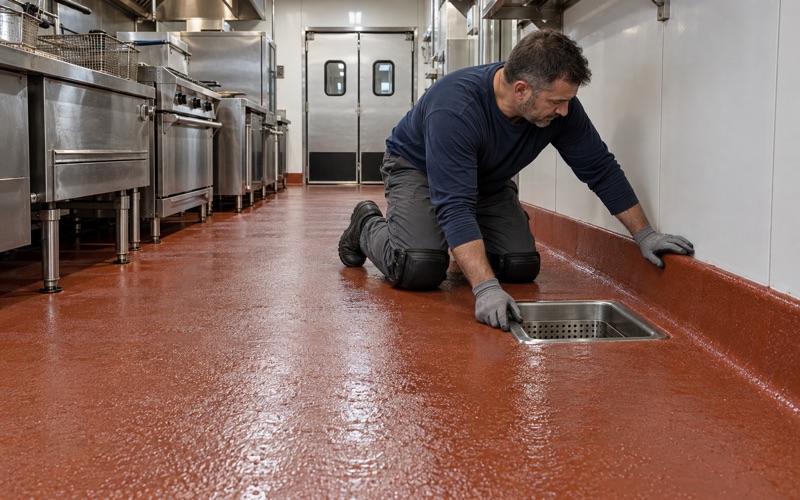
We also watch where the walls meet the floor. FDA Food Code 6-201.13 addresses coved floor and wall junctures, and a cove base carried up the wall keeps oily water from sitting in a corner seam where no mop reaches. Floor drains get the same attention, with the coating turned down into the drain body rather than stopped short at its rim.
The slab under the coating
An older building often brings an older slab, and concrete that has been mopped and hosed for years can hold moisture and oil well below its surface. In River Grove, 44.0 percent of housing units predate 1960, a fair signal of how much older concrete the village carries. We test before pricing, with ASTM F2170 in-situ relative humidity probes or ASTM F1869 calcium chloride tests, and an oil-soaked slab is ground until clean concrete shows or flagged for repair before any coat goes down.
Smooth and cleanable, or textured and safe: the food code allows both
Illinois does not write its floor standard from scratch. The Illinois Food Code, at 77 Ill. Adm. Code 750.100, references the FDA 2022 Food Code, and Section 6-201.11 of that code governs how floors are built. It requires floors, floor coverings, walls and ceilings to be designed, constructed and installed so they are ‘smooth and easily cleanable’, and in the same sentence it makes an exception ‘for antislip floor coverings or applications that may be used for safety reasons’.
That one sentence holds the whole tension on a fry-stand floor. Smooth is easy to clean but slippery once oil and water land on it. Texture gives a shoe something to bite, but every grain of texture is also a place for grease and starch to sit, and the code accepts both while leaving the balance to the people who build and run the floor.
How the choice usually lands
In practice, the deciding factor is the cleaning routine rather than the code. A crew that scrubs with a deck brush and hot water every night can live with more texture than one that runs a string mop once at close. We ask how the floor is cleaned now, with what and how often, before we recommend a grain size.
What the code does not say
The food code does not require epoxy, and it does not set a slip-resistance number for a floor. Anyone who quotes you a required rating out of it is quoting something that is not there. What it asks is that the floor be easily cleanable unless texture is added for safety, and that judgment belongs to the operator.
Who answers for your establishment
Food inspection in suburban Cook County, River Grove included, runs through the Cook County Department of Public Health, and the village code also carries its own food sanitation chapter. We hold no health-department approval or food-facility license and do not claim one. For questions about what your own establishment needs, those offices are the ones to ask, and we will build to what they tell you.
Picking a texture that still mops clean
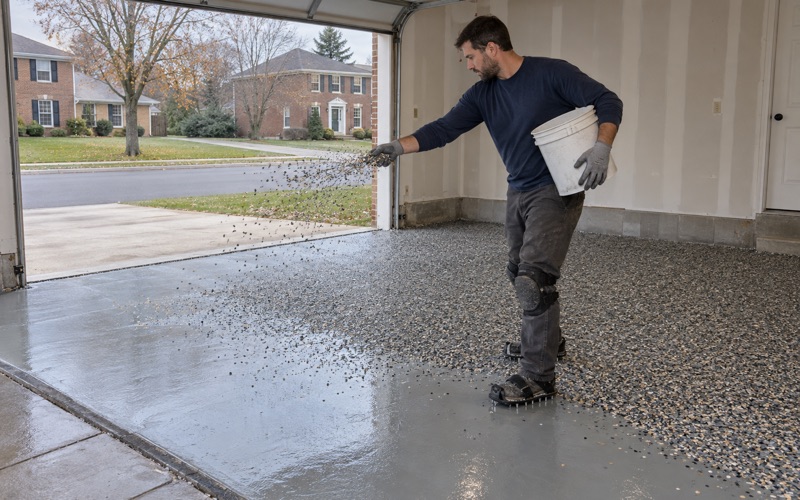
On a food floor the texture usually comes from a broadcast. We seed quartz aggregate into a wet coat of epoxy, sweep off the excess and lock the grain in with a topcoat. The grain size and the thickness of the topcoat over it decide the result: a heavy topcoat rounds the peaks and mops almost like a smooth floor, while a thin one leaves sharp grain that grips hard and holds grime.
Zoning the grip
Not every square foot needs the same texture. Around a fryer, at a dish area and in the lane in front of a counter, we usually recommend more grip, because that is where oil and water land and where people stand. In dry storage and behind equipment, a smoother finish is easier to keep clean, and a vinyl flake broadcast adds color without adding much grip unless aggregate goes into the topcoat.
Testing the choice before it covers the room
A sample is the honest way to settle this. We make test panels at two texture levels and ask the staff to clean them with their own mop and cleaner, then walk them wet. A texture that grips but holds a gray film after mopping is the wrong choice for a floor that is cleaned every night.
Once the floor is down, its texture also changes how it should be cleaned. A deck brush or an auto-scrubber gets into the grain where a string mop slides over the top, so we hand over a cleaning method along with the floor to keep the finish gripping and clean.
Working on a River Grove commercial floor
Any remodeling in River Grove valued over $100 needs a building permit, and we ask the Village of River Grove Building Department on Thatcher Avenue whether a coating job needs one rather than assuming either answer. Contractor licenses there run January 1 to December 31 no matter when you apply, with a $10,000 trade-specific bond and a certificate of insurance naming the village, so we confirm registration before a job is booked.
Cure is the last piece. We set cure times by slab temperature and dew point rather than the calendar, because a food floor that opens before the topcoat has cured picks up grease into a finish that is still soft. For a counter that cannot close, that usually means grinding and coating in sections across overnight and weekend windows, so part of the floor stays in service while the rest cures.
- 20+ Years on Concrete
- Moisture Tested Before Pricing
- Written Itemized Proposals