Mount Prospect Epoxy Flooring brings more than 20 years of epoxy flooring work to Northlake, and some of the most demanding floors we look at here are in the small metal-finishing shops. In that kind of room the floor is not judged on color. It is judged on whether a person stays upright when small, hard, round objects are underfoot, whether it can be swept clean at the end of a shift, and whether it outlasts the scuffing and the cleaners that the process brings with it.
Those three demands pull against each other. A coarse texture grips a boot but holds onto grit, while a smooth, glossy coat sweeps easily and turns treacherous the moment anything loose lands on it. Our job is to find the point between them for each zone of a building, and then to write it down so you can hold us to it.
That written record is specific. Every proposal names the product line, the number of coats and the finished thickness, and it says what the warranty does not cover before anyone signs. The slab is opened mechanically and tested for moisture first, because no texture choice rescues a coating that lets go of the concrete underneath it.
A Mechanical Plating and Deburring Shop on Lake Street
Dynaburr at 65 E. Lake Street
Dynaburr Chicago, Inc. sits at 65 E. Lake Street, an address that geocodes inside Northlake on the Proviso Township side of the city. The company describes itself as founded in the early 1970s as a Chicago-area deburring provider, and it now offers mechanical plating, mechanical galvanizing, E-Tec lubricating and metal deburring. The Metropolitan Water Reclamation District lists Dyna-Burr Chicago at that address among its significant industrial users. We have never worked inside the building and know nothing about its floor; we use its published process because it shows plainly what this kind of work puts in motion.
Mechanical plating is not electroplating
The distinction matters for the floor. Dynaburr’s mechanical plating page describes lined octagon barrel tanks loaded with parts, glass impact beads, water, chemical cleaning and metal powder, followed by a rinse and a water polish. The tumbling beads hammer the metal coating onto the parts instead of depositing it with electric current, which is why the company says the process eliminates hydrogen embrittlement and needs no post-baking. Loads run from 2 to 20 cubic feet, with parts up to 1 lb and up to 1 ft long, and coatings up to 5 mil.
What leaves the barrel
The deburring side tumbles small steel, stainless, spring steel, brass and powdered metal parts in ceramic, stone and corncob media. In any shop that tumbles loads like these and then separates and rinses them, some of the media, powder and water ends up on the floor around the barrels and separators. That is general practice in barrel finishing rather than anything we have seen at Dynaburr, but it sets the specification: a floor that has to cope with loose round media, wet metal fines and rinse water at the same time.
Rinse water does its own damage. It carries fine metal powder outward in a thin sheet, and when the water dries the powder stays behind as a gray film that a mop tends to smear rather than lift. Corncob and other light media add a dry, dusty layer on top, so the floor near a deburring line can be wet in one spot and powdery a few feet away.
Looking for epoxy-flooring closer to River Grove? See Epoxy-Flooring in River Grove.
Ball Bearings Underfoot: Texture That Grips and Still Sweeps
Why loose beads are worse than a puddle
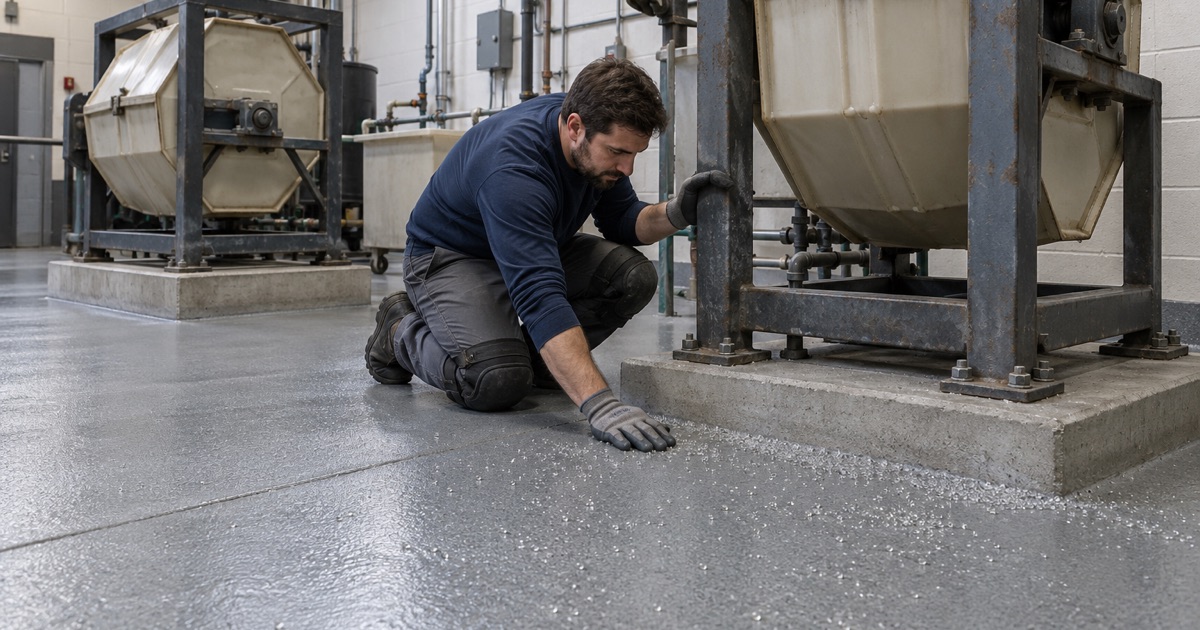
Water on a smooth coating is a known hazard, and most shops manage it with mats and squeegees. Glass impact beads are a different problem. A scattering of small, hard spheres under a boot acts like a set of ball bearings, and on a glossy epoxy there is nothing for the sole to bite through. Add a film of wet powder and the surface can get slicker than either one alone.
Choosing the broadcast
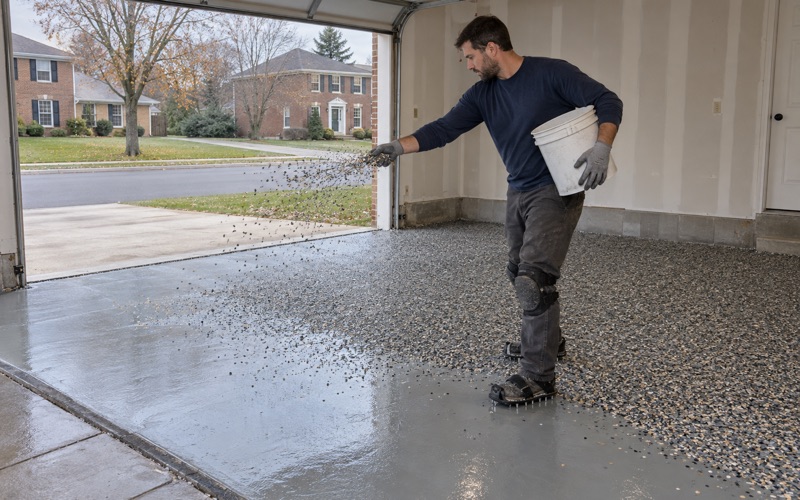
The usual answer is a quartz aggregate broadcast locked into a 100% solids epoxy body coat, then sealed with a topcoat that rounds the peaks without burying them. The grain size and the topcoat thickness decide where the floor lands. Too fine and the beads still roll; too coarse and the texture holds powder and media in its valleys, so a broom pushes them around instead of collecting them. A decorative vinyl flake broadcast reads well in a garage, but it is the wrong choice for a process floor where grip is the point.
We do not settle the texture from a catalog photo. Before the full install we make sample boards at two or three grit sizes, scatter loose media and a little wet powder across them, then walk them and sweep them with the shop’s own broom and squeegee. The board that grips and still comes clean in one pass is the one that goes on the floor, and its grit size goes into the proposal.
Zones, not one floor
We rarely put one texture across a whole shop. The ring around barrels, separators and rinse stations gets the heavier profile, while aisles, packing benches and office edges can run smoother so carts roll and cleanup is quick. Each zone is drawn on the plan and listed in the proposal with its own aggregate, coat count and finished thickness. When the floor goes down, you can measure it against that page rather than against a memory of what was promised.
Abrasion From Media and the Chemistry of Cleaning
Abrasion that never stops
Ceramic and stone media are made to wear metal, and a floor that sees them every day loses its topcoat first. Bins of parts are dragged, pallet jacks turn on the same spot, and grit caught under a wheel works like sandpaper. For these areas we build thickness into the body coat instead of relying on a thin film, and we specify a polyaspartic or polyurea topcoat chosen for abrasion resistance. Where wet process areas also see hot rinse water or heavy splash, urethane cement is often the better system than a straight epoxy.
A textured floor wears unevenly, and the peaks go before the valleys. We tell owners to watch the high-traffic lanes around the barrels and plan a fresh topcoat while the body coat is still intact. Recoating a worn topcoat is a short job; letting media grind through to bare concrete turns it into a full repair.
Cleaners, degreasers and splash
Finishing shops descale and degrease parts before plating, and the cleaners used for that, plus whatever the crew mops with, eventually reach the floor. Before we pick a topcoat, we ask for the safety data sheets for the chemicals actually in use and check them against the coating maker’s resistance tables. If a product is borderline, we test a patch rather than guess. The answer goes in writing too, because chemical attack is one of the first things a coating warranty excludes.
The cleaning method matters as much as the cleaner. A floor that will be scrubbed with an auto-scrubber can carry a somewhat sharper texture than one cleaned with a string mop, which snags and sheds fibers on coarse grit. We ask how the crew actually cleans now and design the surface around that habit instead of around an ideal routine nobody will follow.
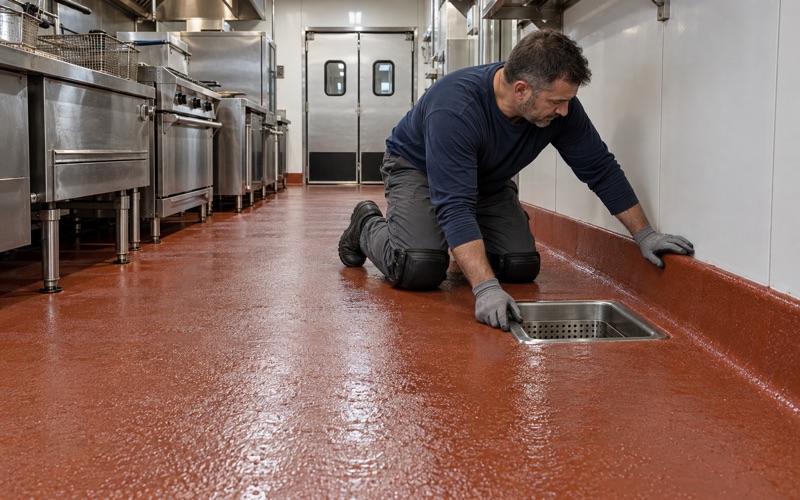
Where rinse water collects against walls and equipment bases, we run a coved base up the wall and a low curb around the wettest stations. That keeps water and powder inside an area that can be squeegeed to a drain, rather than letting it creep under racks and into the joint between floor and wall.
Preparation and moisture on an industrial slab
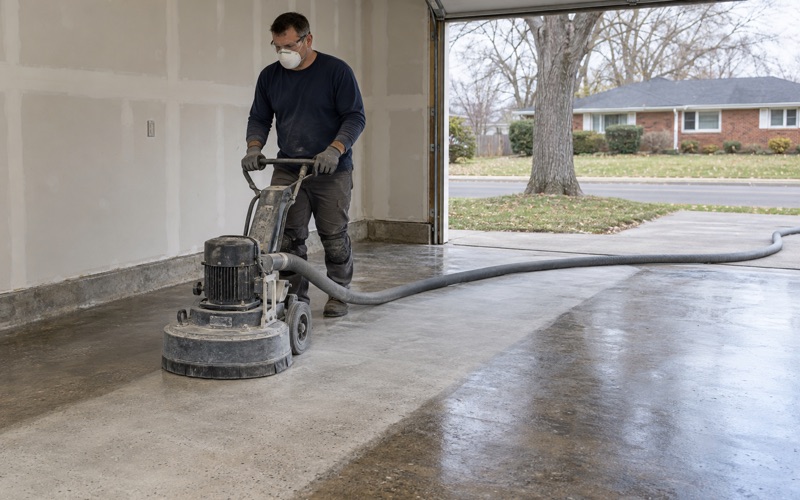
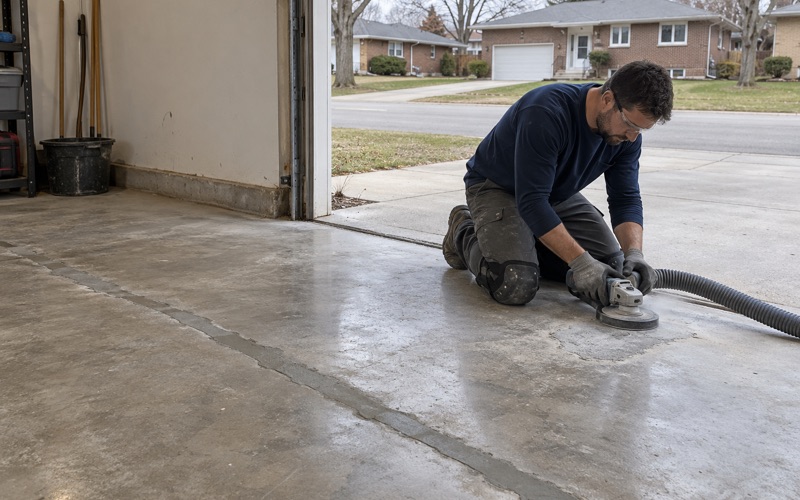
Old shop slabs carry oil, coolant and earlier coatings, and none of that is cured by acid etching. We grind with diamonds or shot blast to an ICRI concrete surface profile that suits the system, and we map cracks, spalls and failed coatings first. If a section of slab needs repair or replacement before it can be coated, we say so plainly. A moisture reading, by ASTM F2170 relative humidity probes or ASTM F1869 calcium chloride testing, comes before the price is final.
Wet process rooms add one more risk during the install. Humid air over a cool slab can shrink the dew point spread at the slab surface, and an epoxy that cures in those conditions can develop amine blush, a waxy film that keeps the next coat from bonding. We read the slab temperature and the air before each coat and wait when the numbers say to.
Finishing Shops Along Lake Street With the Same Problem
More than one shop on the street
Dynaburr is not alone. The same district list places All-Anodizing Company at 100 West Lake Street under the federal metal finishing category, and anodizing brings its own mix of rinse water, cleaners and wet floors. Northlake takes its name from North Avenue and Lake Street, which meet at the city’s western border, and the stretch of Lake Street on the Proviso Township side holds a cluster of these process buildings. Each one is a variation on the same floor question: grip, cleanup and chemical resistance in one coating.
Dust, drains and the work schedule
In a building whose wastewater is already regulated, grinding dust is the last thing that should go down a floor drain. We vacuum it at the machine as we grind, so the slurry and fines never reach the drain or the parking lot. Production rarely stops for a floor, so we phase the job around shifts and use overnight and weekend windows, coating one zone while the next stays in service. Cure times are set by the slab temperature and the dew point, not by a calendar date someone hoped to hit.
For short windows, a fast-curing polyaspartic topcoat can let a zone return to foot traffic the next morning. It is not always the right call, since some chemistries handle shop cleaners better with a longer cure, and we explain that trade before the schedule is set.
Codes and who signs off
The coatings we specify stay within the Illinois VOC limits for floor and industrial coatings under 35 Ill. Adm. Code Part 223, which bind whoever applies them. We ask the City of Northlake Building Department whether a given floor needs a permit rather than assuming either answer. Fire protection here is a separate body, the Northlake Fire Protection District, so a commercial fire-code question goes to the district and not to City Hall.
- 20+ Years on Concrete
- Moisture Tested Before Pricing
- Written Itemized Proposals