Mount Prospect Epoxy Flooring brings more than 20 years in the trade to epoxy-flooring in Lyons, and the floors we think hardest about here are the ones that never get a dry day. A pump room, a meter room or a mechanical closet with cold-water lines overhead is a different job from a clean, empty garage. The slab may be damp when we arrive, damp while we work and damp again the next morning, and the room usually has to keep doing its job the whole time.
That changes the order of everything. We test the slab for moisture before a price is final, we plan the work in sections around whatever equipment has to stay running, and we pick a coating class that is meant to bond to concrete that will not be bone dry. Our written proposal names the product line, the number of coats and the finished thickness, so whoever signs off can hold the finished floor up against the quote.
It also changes what we promise. A floor coating does not fix condensation and it is not waterproofing. What it can do is give a wet working floor a surface that sheds water, resists wear and can be cleaned, and we say plainly when a slab needs repair before it should be coated at all.
A 1948 Pump House on Ogden Avenue
What the record shows
The Village of Lyons runs its own waterworks. The Village of Lyons Waterworks building at 7824 Ogden Avenue was put up in 1948 in brick with stone, with a flat roof, a deep overhanging eave and fixed windows with horizontal panes. A Landmarks Illinois survey dated November 12, 2012 lists it as government waterworks, both in its historic use and in its use at the time of the survey, and notes a slight hill, a flag pole and a military cannon on the site.
That survey is an exterior record. It names no architect and describes no equipment, rooms or floors, and we have not been inside, so we make no claim about the building’s interior or the condition of anything in it. We use it here for a simpler reason: Lyons is a village where a working pump house sits on a main street, and the floor problems that come with that kind of building are worth explaining to anyone who manages one.
Why pump-room floors stay wet
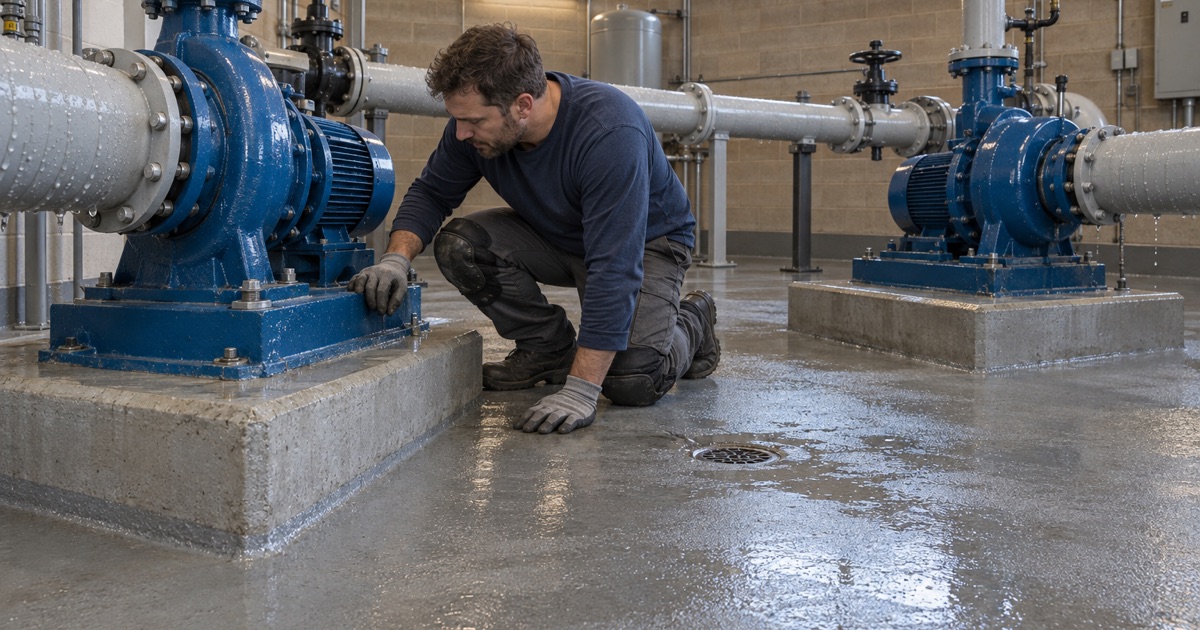
Water plants pump water that comes in very cold, and the pipes carrying it run colder than the air around them. A coatings maker that works on treatment plants describes the result as constant moisture from the very cold source water, which shows up as sweating and corrosion on the piping. Sweating pipes do not keep that water to themselves. It beads, runs to the low point of the line and drips onto the slab below, day after day, wherever the cold run passes overhead.
The floor under a line like that rarely gets the dry spell an ordinary coating schedule assumes. Drip lines leave stained paths, standing water collects at the low spots, and an old coating that was laid on a dry day in an empty room tends to lift first along the routes where water lands. We read those paths as a map: they show where the floor sees the most water and where the edges of each work section belong.
Looking for epoxy-flooring closer to Cary? See Cary Epoxy-Flooring.
Coating Around Equipment That Cannot Stop
Working a room in sections
A station that stays in service cannot be emptied for a week so the whole floor can be ground, coated and cured at once. The same coatings maker describes plants that had to remain in operation while all repairs and recoating were completed, which made blasting and recoating in the ordinary way impossible. A pump-room floor is handled the same way: a phased installation, one section at a time, with the rest of the room left open for the people who run it.
We lay out the sections before any grinding starts. Each one is sized so that a path to every pump, valve and panel stays open, and so that a finished section can carry foot traffic before the next one is closed off. Equipment bases, pipe supports and anchor bolts get their own detailing, because the edge of a coating around a running machine is where water and vibration find a way under it.
Phasing also shapes the coating choice. A system that reaches foot-traffic strength the same day lets a section go back to the operators before the shift ends, while a slower epoxy may mean a section stays roped off overnight. We write the sequence, the section boundaries and the return-to-service time for each one into the proposal, so the staff know in advance which part of the room they lose and for how long.
Dust, water and cure windows
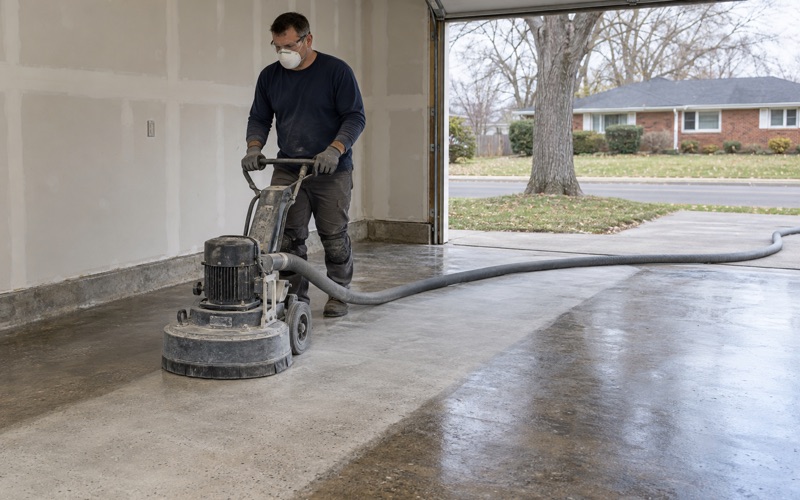
Every slab is opened with a diamond grinder or a shot blaster, never an acid etch, and in an occupied mechanical room that matters twice. Acid and rinse water have no business near a running pump, and a dry mechanical profile gives the coating something to grip without adding water to a room that already has too much. Grinding dust is pulled into a vacuum at the machine instead of being washed toward a floor drain.
Cure times are set by what the slab is doing, not by the calendar. A section that sits under a dripping line may need to be shielded or the drip caught and routed while the coating cures, and that arrangement is agreed with the people who run the room before the job is scheduled. Shop and plant floors like this are often booked for overnight or weekend windows, when the fewest people need to walk through.
Surface-Tolerant Systems for a Slab That Is Never Dry
Testing before choosing a product
A moisture test is part of our scope on every floor, and on a damp mechanical slab it decides the product. An ASTM D4263 plastic sheet test is a quick first read of whether moisture is coming up through the concrete. ASTM F2170 in-situ relative humidity probes and ASTM F1869 calcium chloride testing give numbers that can be compared with the limits a manufacturer sets under ASTM F710, which is the point where an ordinary floor epoxy stops being a reasonable choice.
Those tests also separate two different problems. Water rising through the slab is a vapor problem that calls for a moisture-mitigation primer or a different system altogether. Water landing on top of the slab from sweating pipes is a surface problem, and a test reading taken in a dry corner says nothing about the patch under the cold line. We test both places and write down which is which.
What a damp-tolerant system looks like
For a floor that cannot be dried, the answer the water-plant write-up points to is a surface-tolerant epoxy, a class of coating made to go on damp surfaces. From there we build up with a primer chosen for the moisture reading, a body coat of the right thickness and a topcoat that resists standing water and cleaning chemicals. Urethane cement is another option where a slab stays wet and sees heavy wear, since it tolerates more moisture in the concrete than a standard epoxy.
Where water runs along a wall or collects at a pipe support, the edge matters as much as the field. We end the coating in a ground keyway at its edges and around equipment pads, so it stops against a shoulder rather than a thin feathered line that water can creep under. Cracks and spalls in the path of a drip are repaired first, because water that reaches raw concrete through a crack works on the bond from below.
A wet floor also needs grip. We broadcast quartz aggregate into the coat that will take traffic, so the finish holds a texture under a film of water instead of turning slick. Then we explain what the warranty leaves out before the job is sold, starting with moisture: a coating that is asked to sit under a constant drip is covered for what it can actually do, not for the condensation above it.
Small Utility Rooms Elsewhere in Lyons
The same problem on a smaller scale
The pump house is the largest example of a room built around cold water, but Lyons has plenty of small ones. The village counts 360 homes in buildings of 5 to 9 units and 379 in buildings of 10 to 19, and buildings of that size often have a shared basement room where the water service, meters and water heaters live. A cold-water service line entering a basement can sweat onto the floor under it in the same way, just on a smaller scale.
About 35.8 percent of occupied homes in Lyons are rented, so a mechanical-room floor in one of those buildings is usually an owner’s or a manager’s decision. We put the same things in writing for them: where the drip lands, what the moisture test showed, which sections can be done while the room stays open, and whether the slab needs repair first. A floor in a room the tenants rely on for hot water cannot simply be closed for days.
Permits, insulation and what comes first
The Village of Lyons Building Department at 4200 Lawndale Avenue handles plan review, permits and inspections and publishes a contractor license application of its own. We ask the department whether a given coating job needs a permit rather than assuming either answer, and we check the village’s current contractor requirements before a Lyons job is booked.
Before any floor is coated under a sweating line, the owner should look at the pipe itself. Insulating or rerouting a cold line is plumbing work, and it is often what makes a new floor last, because a coating only protects the concrete from the water that reaches it. The village planned water main and road work along Ogden Avenue in a final phase running from 2015 through the end of 2016, a reminder that the pipes feeding these rooms are themselves maintained and replaced over time. A floor under them should be planned the same way, as one part of a room that keeps working.
- 20+ Years on Concrete
- Moisture Tested Before Pricing
- Written Itemized Proposals