Mount Prospect Epoxy Flooring has spent more than 20 years on epoxy flooring in Lincolnwood and across the north suburbs, and the floors that ask the most of a coating are the ones people cross barefoot and dripping. A locker room, a shower corridor or a changing area needs a surface that grips a wet heel, sheds water instead of soaking it up, and lets that water run to a drain. Miss any one of the three and the floor fails, however good it looks the day we leave.
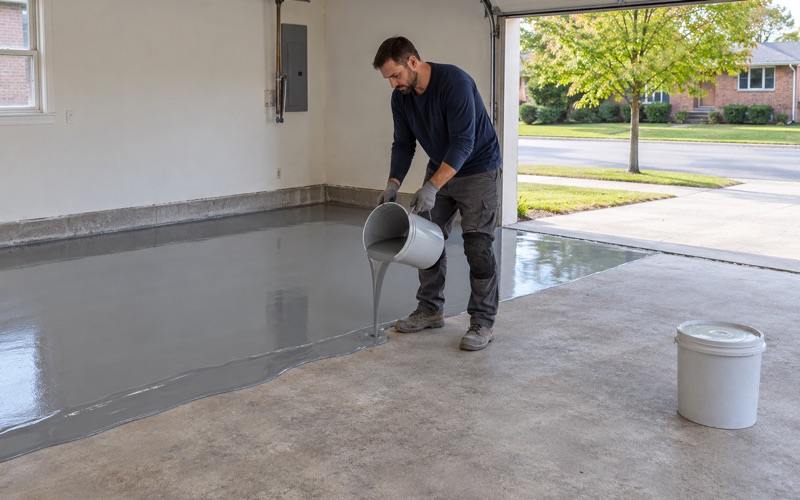
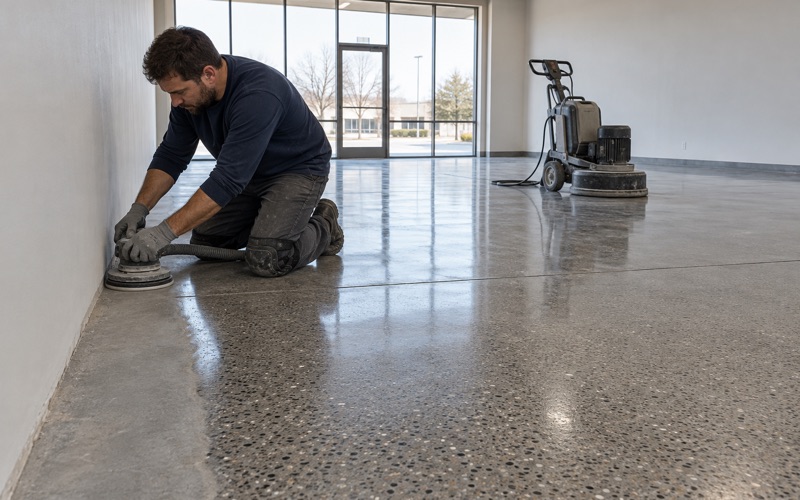
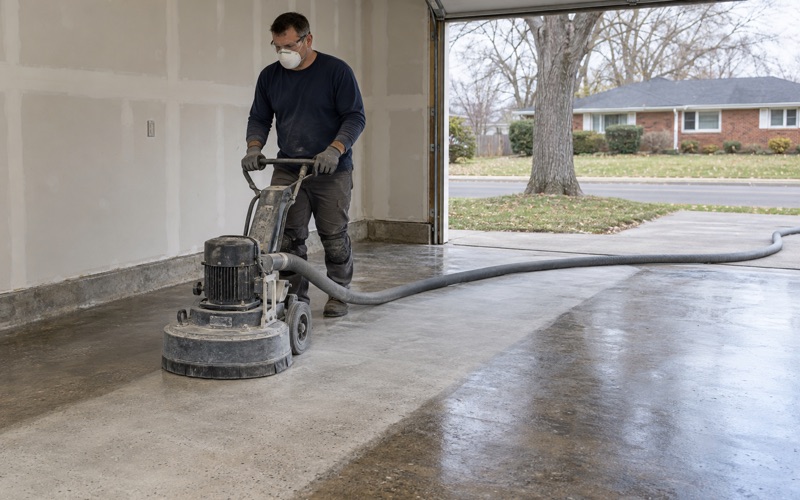
Our approach does not change with the room. We open the concrete with a diamond grinder or a shot blaster rather than an acid etch, so the resin has a real profile to hold, and we map cracks, spalls and old coatings before anything is priced. A moisture test is part of that scope, because a wet-area slab that is releasing vapor will lift a coating from underneath.
The proposal you receive names the product line, the number of coats and the finished thickness, so the floor can be checked against the quote. Below, we use the state’s own wording for public pool bathhouse floors to explain what a wet-room coating can and cannot do.
The Village Pool at Proesel Park and One Sentence of State Code
A village-run facility in Niles Township
Lincolnwood, a village of 13,463 residents at the 2020 census, runs its own pool. The Proesel Park Family Aquatic Center at 7055 N. Kostner Avenue, inside the village and in Niles Township, is listed by the village as a membership facility with an Olympic-size competition pool, diving boards, a zero-depth activity pool and a kiddie pool for children seven and younger.
We have done no work there, and we have not seen its bathhouse floor, so nothing on this page describes it. We bring the facility up because the floor rules governing it apply to every swimmer who walks from a shower to the deck, and they are the clearest statement we know of what a wet-room floor has to do.
One sentence in the Illinois Swimming Facility Code
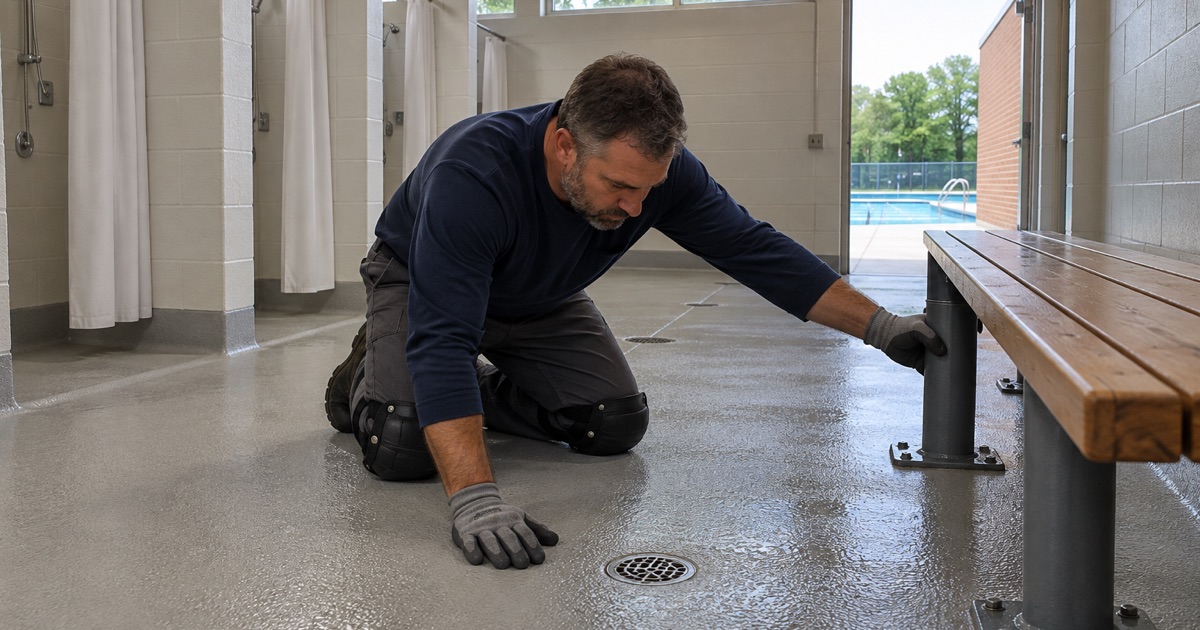
The Illinois Swimming Facility Code, at 77 Ill. Adm. Code 820.220(b)(2), covers the floors of what it calls bather preparation facilities: showers, restrooms, dressing and locker rooms, and the connecting walkways between them. It says those floors shall be slip-resistant, impervious to moisture, and sloped to drain at least 1 inch in 10 feet. That is the whole requirement, and it fits in one sentence.
Notice what it leaves out. The code does not name epoxy, urethane cement or any other product; it sets three performance tests and leaves the material to the designer. Summaries of the same section mention that other floor coverings in locker or dressing areas may be used with prior Department approval, though we have not read that clause directly.
We are not a licensed or approved swimming-facility contractor, and we do not approve plans; that review belongs to the state. What we can do is read those three tests the way an inspector would and tell an owner honestly which ones a coating helps with and which one it cannot touch.
Looking for epoxy-flooring closer to Barrington? See Barrington Epoxy-Flooring.
Slip-Resistant and Impervious: Bare Feet and Standing Water
Texture that works under a wet foot
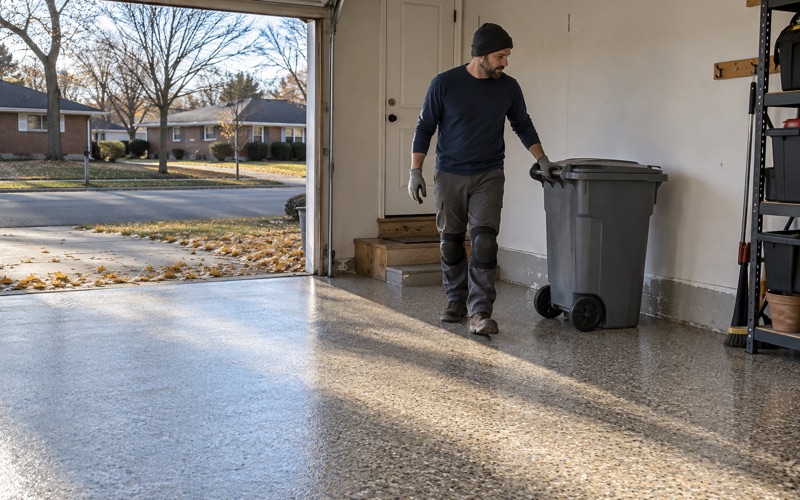
A smooth, glossy epoxy is a fine garage floor and a poor shower floor. Bare skin on a wet resin film has very little to hold, so a wet-area system gets a broadcast aggregate locked between coats, usually quartz aggregate broadcast to refusal and then sealed with a clear topcoat.
The grade of the quartz and the thickness of that final coat decide the feel. Too much topcoat buries the grit and the floor turns slick again; too little leaves a surface rough enough to scrape a heel and hard to mop. We make a sample board so the owner can test it wet, by hand and underfoot, before the full floor is built.
Vinyl flake broadcast, the look most people know from garages, can work in a locker room when it is capped with a textured topcoat. On its own it is not the slip answer; the texture has to be in the top layer, where the foot actually lands.
Impervious means the edges too
A cured 100% solids epoxy or urethane cement film does not absorb water, so the field of a coated floor is the easy part of imperviousness. Water finds its way in at the edges: where the floor meets a wall, around a drain body, at a doorway threshold and along any crack that was coated over instead of repaired.
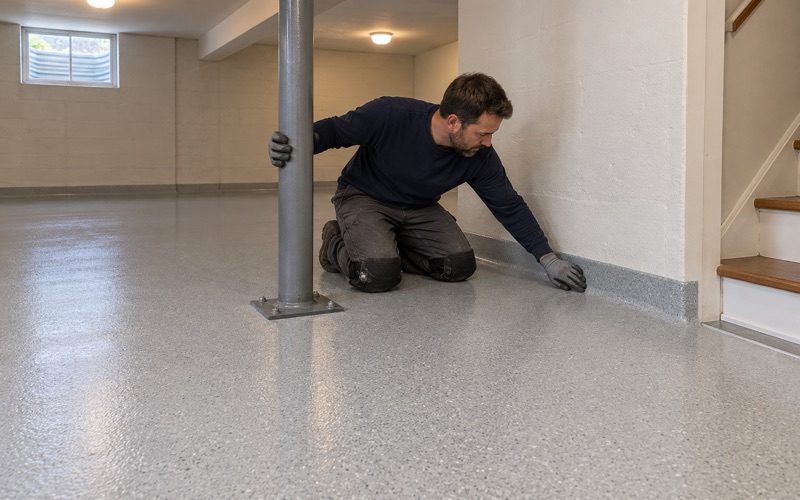
In shower rooms we usually carry the resin up the wall as a cove base, so there is no seam at the corner for water to sit in. Each drain gets the coating terminated into a keyed edge cut around it rather than feathered thin, because a thin edge is where peeling starts once mop water has worked under it for a season.
The slab underneath has to cooperate
A floor that is impervious on top still fails if moisture is pushing up from below. Locker rooms are often on grade, and an older slab may have no vapor retarder under it at all, so we test before we price: ASTM F2170 in-situ relative humidity probes, or ASTM F1869 calcium chloride tests where that method fits. When the readings run high, a moisture-mitigation primer goes into the scope, and we explain that moisture is the first thing a coating warranty excludes.
One Inch in Ten Feet: The Slope Is in the Concrete
The third test is the one people most often expect a coating to solve, and it is the one a coating cannot. Sloped to drain at least 1 inch in 10 feet means the concrete itself falls toward the drain by that much; a resin system a fraction of an inch thick follows the slab it is laid on, high spots and low spots included.
Measuring the fall before we quote
On any wet-room job we check the existing slope before writing a number down. A long level and a straightedge show the fall from the far wall to each drain, and a bucket of water poured on the bare concrete shows where it actually goes. Ponding that stands after a few minutes marks a low spot, and we circle every one on the floor map.
What a coating can and cannot change
A shallow birdbath, a dip of an eighth of an inch or so, can sometimes be filled with an epoxy mortar or a sloped urethane cement screed before the finish coats. That is real repair work priced as its own line, and it only works where the surrounding floor already falls the right way.
A floor that is flat, or that falls away from its drain, is a different job. Building an entire room’s slope out of resin is costly and rarely sound, and no topcoat will make water run uphill. When the concrete is wrong, we say plainly that the slab needs to be reworked or the drain moved before a coating should go down.
Why ponding matters on a coated floor
Standing water on a textured coating is both a slip hazard and a cleaning problem. Chemicals and body oils settle where the water sits, the grit in that spot wears faster under scrubbing, and the low area becomes the first part of the floor to look worn. Getting the slope right before coating is cheaper than recoating one corner every year.
Scheduling Wet-Room Work Around Open Hours and Cure Time
A public pool, a club locker room or a building’s shared shower room cannot close for long, and that shapes the job as much as the materials do. We phase wet-area floors so one section stays in use while the next is prepared, coated and left to cure.
Cure time is set by the slab, not the calendar
Resin cures on the slab’s temperature and the dew point spread at its surface, not on a fixed number of hours. A cool, humid locker room can leave an epoxy coat tacky and invite amine blush, a greasy film that weakens the bond of the next coat. We take readings on site, choose faster polyaspartic topcoats where the conditions allow it, and tell an owner when the room needs heat or dehumidification before we start.
Light foot traffic usually returns well before full cure, but standing water and cleaning chemicals should wait until the system has hardened through. We give the reopening date in writing and explain what a too-early mop bucket does to a fresh surface.
Village rules and working hours
Illinois licenses no flooring or coatings contractor, so in Lincolnwood the village’s own license is the one that binds. Every contractor on a job needs a current Village of Lincolnwood contractor license, valid for one year, and no permit is issued until every contractor is identified and registered. We confirm that registration before booking, and we ask the village building department whether a coating needs a permit rather than guessing either way.
Village construction hours run Monday through Friday from 7:00 a.m. to 6:00 p.m. and Saturday from 7:00 a.m. to noon, and construction is prohibited on Sunday. A facility that cannot close on weekdays has less room to maneuver here than it might expect, which is one more reason to phase the floor in sections.
Keeping the building clean while we work
Grinding dust is vacuumed at the machine, never rinsed toward a floor drain, which matters more than usual in a room built around drains. Products are chosen inside the Illinois VOC limits for floor coatings, and in an occupied building we plan ventilation and the order of rooms so nobody walks through wet resin to reach a shower.
None of this depends on the size of the room. A home’s basement shower, a fitness studio’s changing area and a village bathhouse face the same three tests in practice, and we would rather tell you up front which of them your concrete can meet.
- 20+ Years on Concrete
- Moisture Tested Before Pricing
- Written Itemized Proposals