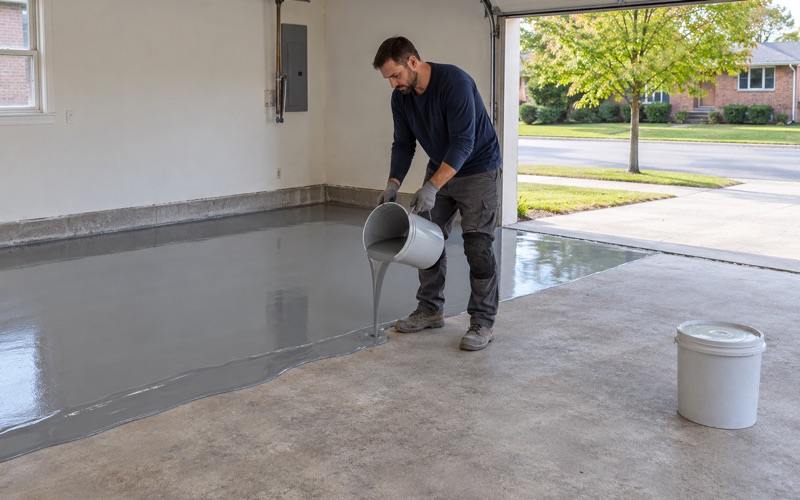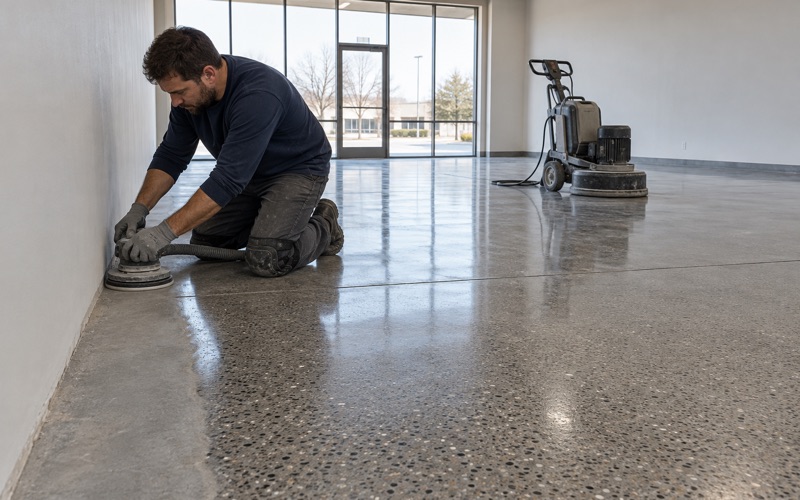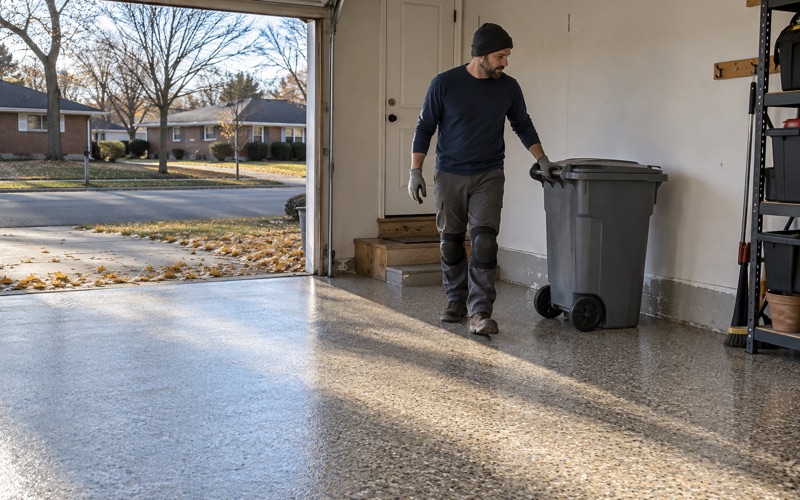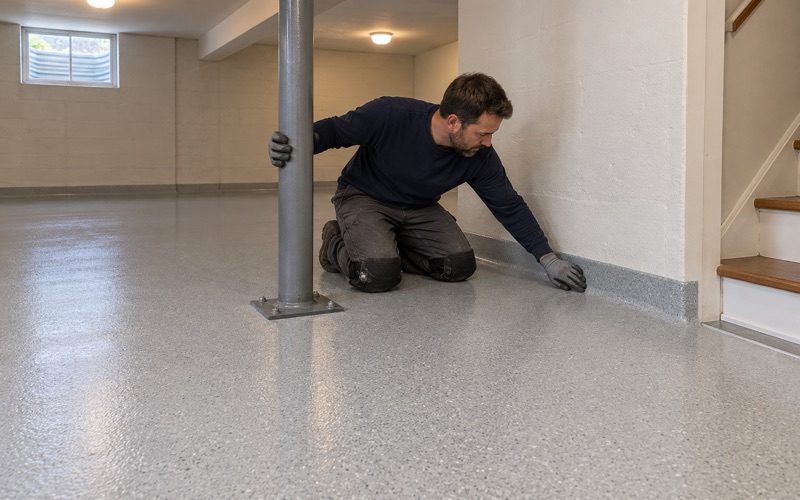
Mount Prospect Epoxy Flooring brings more than 20 years of epoxy-flooring work to La Grange Park, and on this page we focus on one question most quotes skip: how much light will hit the floor once it is finished? A resin floor that sits in a dim basement and one that sits behind a wall of glass can start from the same slab and end up looking very different a few years later. The difference is chemistry, and it is decided when the topcoat is chosen, not after the floor starts to change color.
Our proposals are written so you can hold the finished floor up against them. Each one names the product line, the number of coats and the finished thickness, so the topcoat we recommend for a sunny room is on paper rather than implied. Before the price is final, the slab is tested for moisture, and the cracks, spalls and any old coating are mapped so we can tell you plainly whether the concrete is ready to coat.
That approach matters here because daylight is part of the brief on more floors than people expect. Glazed entries, sunrooms, storefronts and garages with a door that faces the afternoon all put ultraviolet light on a coating every day. The sections below explain what that light does to epoxy, why the damage shows up in uneven bands, and how we specify a floor that holds its color longer.
A Library Rebuilt Around Three Stories of Glass
The clearest local example of how much light a building can let in is the La Grange Park Public Library at 555 N. La Grange Road. The library went through a $5.1 million renovation that began in late August 2023, and it soft-reopened on May 6, 2024. While the work was underway, the library operated out of First Baptist Church in La Grange.
What the renovation replaced
The general contractor describes the job as a 30,000-square-foot full interior and exterior renovation. The scope included replacing a three-story curtain wall system, the storefront doors and 93 punched window openings, along with upgraded building controls, family restrooms, study rooms and a replaced ADA ramp. The architect was 845 Design Group, and the project was named the 2025 CISCO Rehab Project of the Year.
The library’s own project newsletter tracked the glass work in stages. The west curtain wall windows came out in October 2023, when the project reached 35 percent completion, and the east curtain wall windows came out in January 2024, at roughly 70 percent. The cover photo of that newsletter shows the building’s tall arched glass entrance wall, which is the kind of facade that throws sunlight deep into a lobby.
Why we point to it
We are not claiming any work at the library, and nothing we read names an epoxy or resin floor inside it; the newsletter lists new carpeting, lighting and paint. We use the building because it shows, at public scale, what a glass wall does to an interior. Light from a curtain wall reaches the floor in long, defined patches that move through the day, and any finish on that floor gets a very different dose of ultraviolet from one spot to the next.
The same thing happens on a smaller scale in houses and businesses across the village. A glass entry door, a bank of storefront windows or a garage door left open on sunny afternoons puts a strip of daylight across the floor in the same place day after day. That repeated exposure is what turns an ordinary epoxy color question into a chemistry question.
Looking for epoxy-flooring closer to Winfield? See Epoxy-Flooring Services in Winfield.
What Sunlight Does to Epoxy, and How the Layers Answer It
Ultraviolet light, whether it comes from the sun or from high-intensity artificial lighting, breaks polymer chains in a resin through a process called photo-oxidation. In epoxy, the visible result is yellowing, sometimes called ambering. It is a surface change in the binder itself, so it cannot be scrubbed off or cleaned away.
Aromatic base coats
Most epoxy used on floors is aromatic, and aromatic epoxies are the most susceptible to this kind of yellowing. That does not make them a poor choice. A 100% solids epoxy base coat is still the workhorse layer for build, adhesion and chemical resistance, and it bonds well to concrete that has been opened up with a diamond grinder or a shot blaster to the right ICRI concrete surface profile.
We never acid etch a slab to prepare it. Grinding and blasting give the coating a mechanical profile to hold, and the dust is vacuumed at the machine rather than washed toward a floor drain. That base coat, properly bonded, does its job; the problem is only what happens when it is the top layer and the sun reaches it.
Aliphatic and polyaspartic topcoats
Aliphatic and cycloaliphatic chemistries are more stable under ultraviolet light. That is why the usual answer in a sunlit room is a UV-resistant aliphatic polyurethane or polyaspartic topcoat over the epoxy. The epoxy below supplies the body and the bond, and the topcoat carries the exposure.
A polyaspartic or polyurea topcoat also seals a vinyl flake broadcast or quartz aggregate broadcast, which locks the decorative layer under a clear surface that resists ambering better than plain epoxy. We want to be straightforward about the limit, though. A UV-stable topcoat slows yellowing considerably; it does not make a floor permanently color-stable, and a floor under heavy light will still age.
Why the topcoat is written into the quote
Because the base coat and topcoat are different products, we name both in the proposal along with the coat count and thickness. If a quote for a bright room lists only epoxy, you can see that from the page before any work starts. That same paperwork lets you check the floor afterward against what was promised.
Yellow Stripes Where the Light Falls
The frustrating thing about ultraviolet damage on epoxy is that it rarely shows up evenly. A floor yellows where the light falls and stays close to its original color where it does not. On a gray or light-colored floor, the contrast between those areas becomes the most noticeable thing in the room.
How the pattern forms
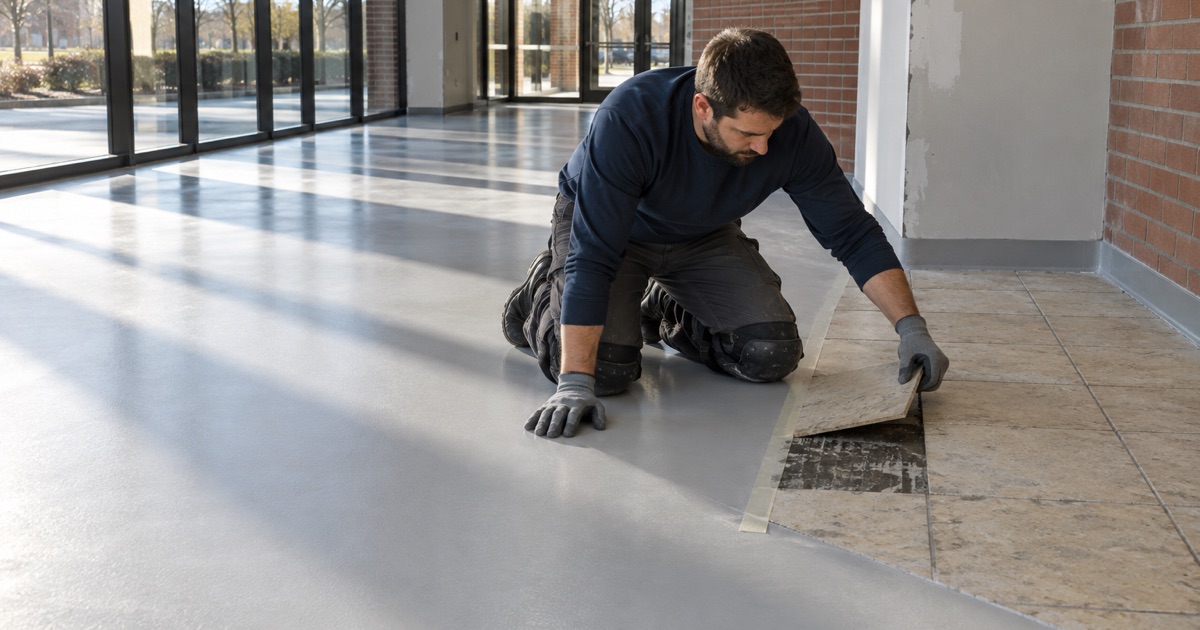
Think about the shape of the light coming through a curtain wall, a row of punched windows or a glazed entry. Mullions, frames and door rails cast shadows, and the open glass between them lets ultraviolet light land in bands. Over months and years, a plain aromatic epoxy surface in that room can develop stripes that trace the window layout, with clean strips beside amber ones.
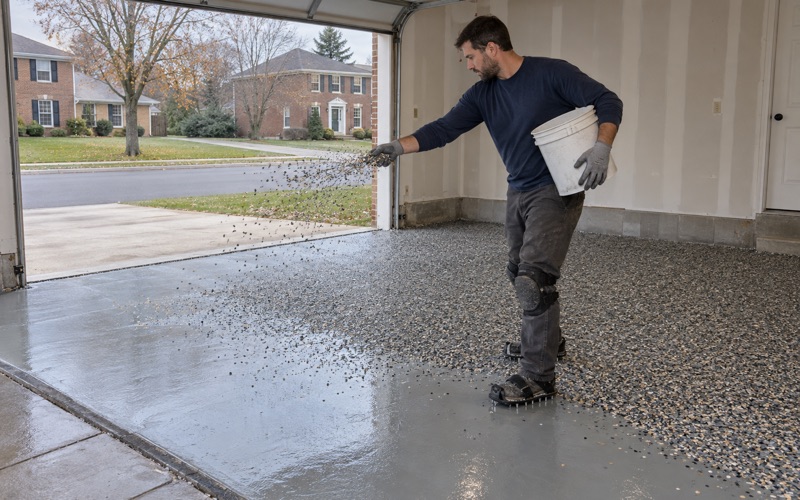
The same pattern shows up at home. A garage door that faces the sun and stays open while you work in the driveway lets light fall across the front few feet of the slab, while the back of the garage stays shaded. A sliding glass door onto a coated sunroom or three-season porch does the same thing across a smaller area.
Why it is hard to fix later
Once uneven yellowing has set in, the floor cannot be evened out by cleaning, and recoating only the sunny part rarely matches the rest. The usual fix is to abrade the whole surface and apply a new UV-stable topcoat across the full floor. That is more work than choosing the right topcoat at the start.
Color choice affects how visible the problem is. A busy flake blend hides a slight shift better than a solid light gray or white, and darker solids show it less than pale ones. We talk through that tradeoff with you rather than assuming everyone wants the same look.
Choosing a Finish for Lobbies, Sunrooms and Window-Lit Garages
The decision starts with an honest look at how the room is lit. We ask where the glass is, which way it faces, whether a garage door stays open on bright days, and whether any high-intensity lighting sits close to the floor. A room with no daylight may not need the extra UV-stable layer at all; a lobby or sunroom almost always does.
Garages with a sun-facing door
For a house garage where the door faces south or west, we typically recommend a 100% solids epoxy base, a flake broadcast if you want texture and hide, and an aliphatic polyurethane or polyaspartic topcoat. That combination handles hot tire pickup and everyday wear while giving the front of the floor better protection from light. If the garage is unheated, cure times follow slab temperature and dew point rather than the calendar, so a January job may be asked to wait.
Entries, lobbies and sunrooms
A glazed entry or lobby in a commercial building often needs the work scheduled around business hours. We phase those floors around shifts and offer overnight and weekend windows when a building cannot close. In a sunroom or porch, the same base-and-topcoat approach applies, along with a moisture test, because a slab poured for a porch does not always have a vapor retarder underneath.
Permits, paperwork and what the warranty covers
La Grange Park is a non-home-rule village, and its Department of Building and Inspectional Services contracts building code services to an outside consultant. Rather than assuming a coating does or does not need a permit, we ask the Building Department what a given scope requires before we commit to a schedule. Home jobs above the state threshold get a written contract and the Illinois Home Repair: Know Your Consumer Rights pamphlet before any grinding begins.
We also explain what a coating warranty excludes before the job is sold. Moisture is the first exclusion on almost every system, and sunlight-related color change is worth asking about too, since even a UV-stable topcoat ages under heavy light. If you have a glass entry, a bright sunroom or a garage door that faces the afternoon sun, we will walk the room with you and specify the topcoat that fits the light it actually gets.
- 20+ Years on Concrete
- Moisture Tested Before Pricing
- Written Itemized Proposals