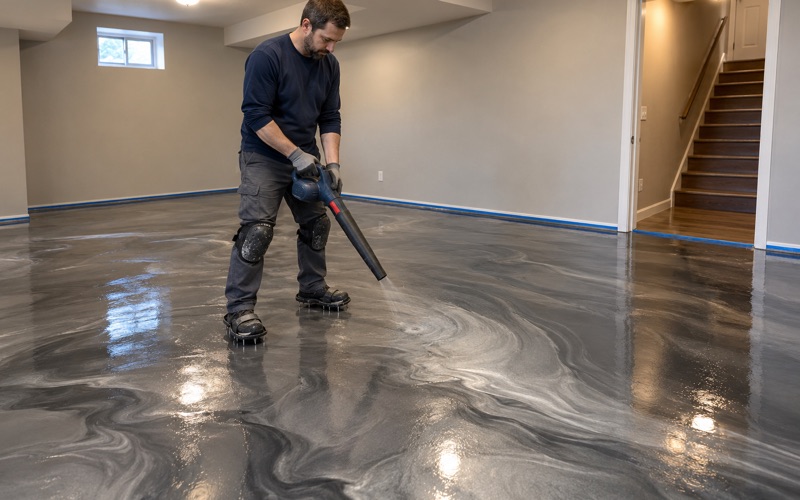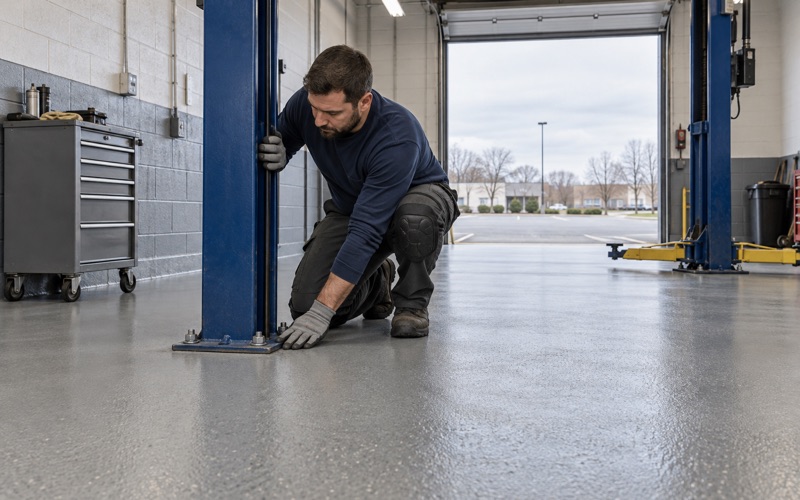
Mount Prospect Epoxy Flooring has spent more than 20 years on epoxy flooring in Justice and across the region, and the floors we think hardest about here are the ones that work for a living. A service bay where trailers sit with their refrigeration units running, leaking and getting repaired is a different job from a basement or a showroom. The coating has to shrug off fuel and oil, clean up with a squeegee and a degreaser, and keep its bond where a heavy trailer rests on two small steel feet.
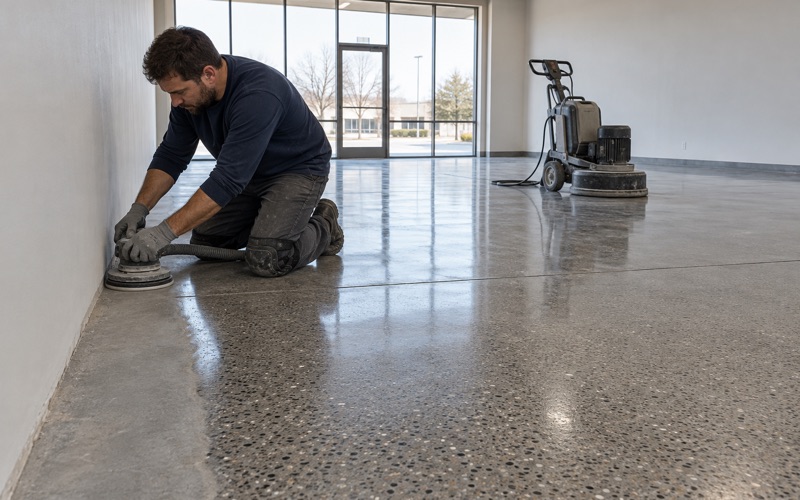
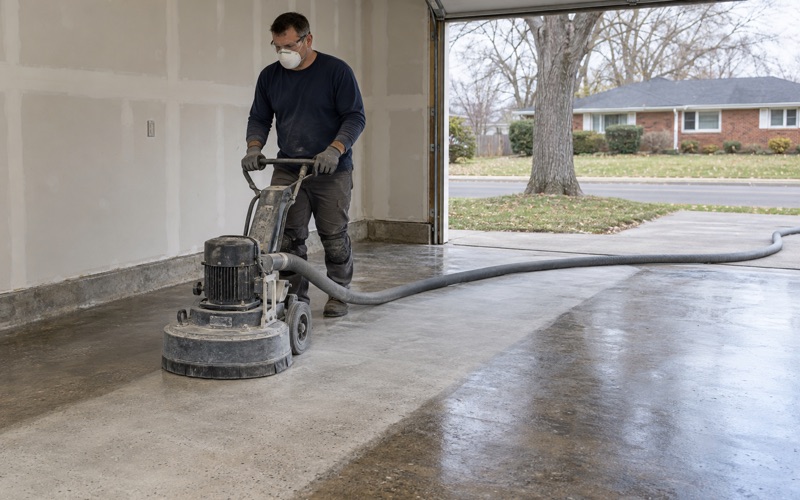
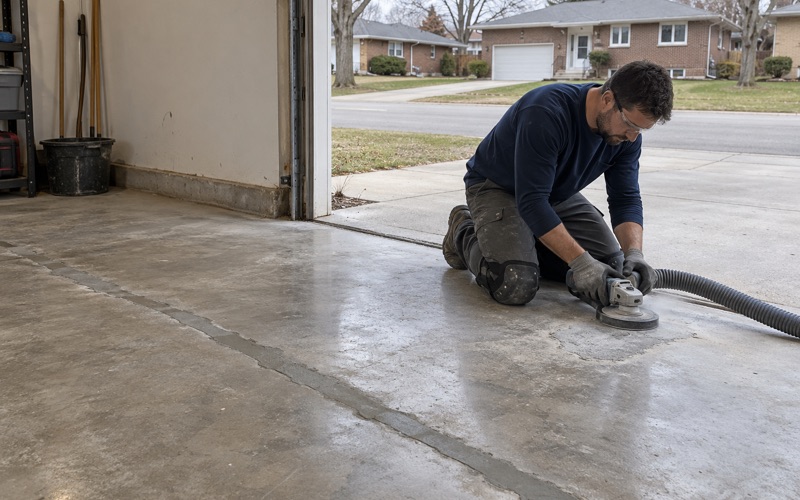
That kind of floor starts with honest prep. We open every slab with a diamond grinder or a shot blaster rather than an acid wash, test it for moisture before the price is settled, and map the cracks, spalls and old coatings so nobody is surprised halfway through. When a slab is too far gone to coat, we say so and recommend repair or replacement first.
What follows is how we think about epoxy flooring in Justice for the truck and trailer shops along 82nd Place, from the oil that drips under a reefer to the point loads under a parked trailer. The same thinking carries to any bay in the village where diesel equipment comes in for service.
Reefer Service on 82nd Place
Justice describes itself plainly: a village of small businesses with no major industries, but with several truck repair shops and body shops in its industrial park. One of the clearest examples of that work sits at 8745 82nd Place, where Gateway Truck & Refrigeration lists Carrier refrigeration sales, refrigeration service, and refrigeration parts and parts delivery. Its posted hours run weekdays from 7:00 a.m. to midnight, which tells you something about how much the region’s cold chain leans on that kind of shop.
We have not been inside that building and we make no claim about its bays or its floor. We are not a Carrier contractor, and we hold no approval or certification from the manufacturer or the dealer. We name the business because it shows exactly what kind of floor the village’s industrial park asks for, and because a shop owner on the same street will recognize the work.
What transport refrigeration means for a floor
Transport refrigeration is the equipment that keeps food and other perishables cold, or warm, while they move by trailer. The California Air Resources Board describes these units as refrigeration systems powered by diesel internal combustion engines, built for semi-trailers, truck vans, shipping containers and rail cars. Put simply, every unit that rolls into a service bay brings an engine with it.
That changes the floor brief. A dealer showroom wants gloss and a clean look under display lights. A refrigeration service bay wants a surface that sheds diesel, holds up to a dropped wrench and a rolling creeper, and can be mopped back to clean at the end of a long shift.
Long hours and phased work
A shop open from early morning to midnight has a narrow window for flooring work. We phase shop floors around shifts, working overnight or across a weekend when the building cannot stop, and we coat one section at a time so service can continue in the rest. Cure schedules follow slab temperature and dew point rather than a calendar date, so a bay that sits cold through January may be told to wait.
Looking for epoxy-flooring closer to Prospect Heights? See Epoxy-Flooring in Prospect Heights.
A Diesel Engine and a Compressor on the Trailer’s Nose
A reefer unit hangs on the front wall of a trailer, above the kingpin. Inside the housing are two machines that leak in two different ways: a small diesel engine and a refrigeration compressor. When a trailer backs into a bay for service, that front wall, and everything dripping from it, ends up over the same few square feet of concrete every time.
Diesel and engine oil
The engine side brings the familiar shop fluids. Diesel fuel spills during filter changes and line repairs, and engine oil drips from drain plugs, seals and the oil filter. Both soak into bare concrete, darken it permanently and leave it slick underfoot.
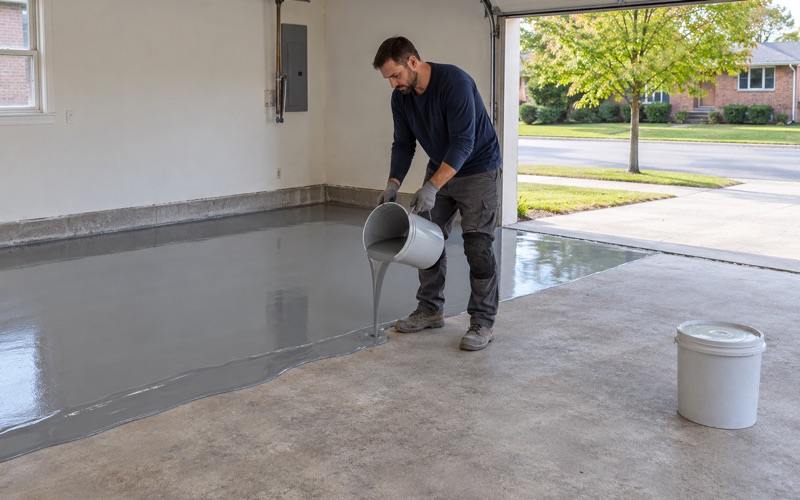
A 100% solids epoxy base coat seals the pores so those fluids sit on top instead of soaking in. Over that, we usually recommend a chemical-resistant topcoat, such as a polyaspartic or polyurea, chosen on its resistance data rather than its color chart. A light gray or tan finish makes a fresh leak easier to spot before it spreads.
Compressor oil is not engine oil
The refrigeration side adds a fluid most garages never see. Transport refrigeration compressors commonly run on polyolester, or POE, lubricant with R-404A refrigerant, and POE oil is a synthetic ester that behaves differently from motor oil on a floor. It turns up when a technician opens the refrigerant circuit, swaps a compressor or chases a leak at a fitting.
Because POE oil is a different chemistry, we check the topcoat’s chemical resistance against esters as well as hydrocarbons before we write a proposal. If a product sheet does not list the exposure, we treat that as an open question and do not assume the answer. The point is a floor that tolerates every fluid the unit can put on it, not just the common ones.
The Drip Zone and the Landing-Gear Feet
Every reefer bay has a spot that takes most of the abuse. It sits right under where the unit hangs when the trailer is parked, and on a busy floor it gets diesel, engine oil and compressor oil in the same few feet, day after day. We plan that zone as its own part of the floor rather than hoping a uniform coat will hold up there.
Building a cleanable drip zone
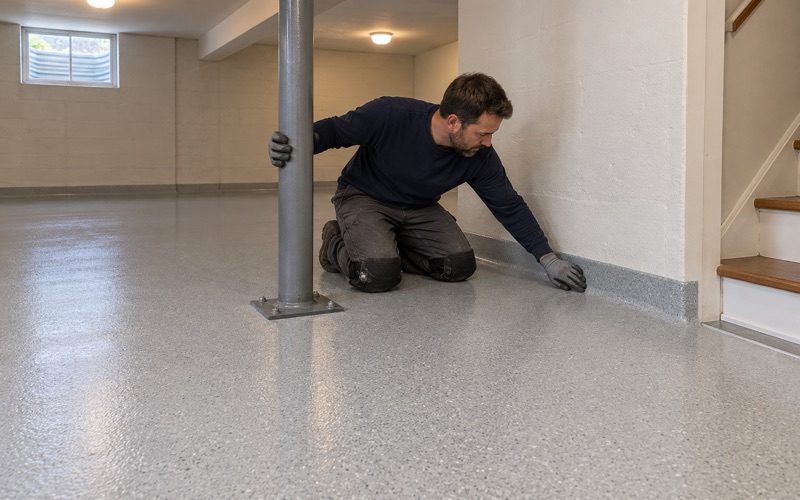
In the drip zone we favor a slightly textured finish. A broadcast of quartz aggregate or a fine anti-slip additive in the topcoat gives boots something to grip when a film of oil is on the floor, while staying smooth enough to squeegee. A heavy vinyl flake broadcast looks good in a home garage, but in a bay that gets wiped down with degreaser every night, simpler and tighter usually cleans better.
Thickness is where the drip zone earns its keep. Our written proposal names the product line, the number of coats and the finished thickness, so the owner can check the floor against the quote. Where a bay sees constant fluids and hot-water washdowns, we may suggest urethane cement in that zone and a standard epoxy system elsewhere.
Landing gear and point loads
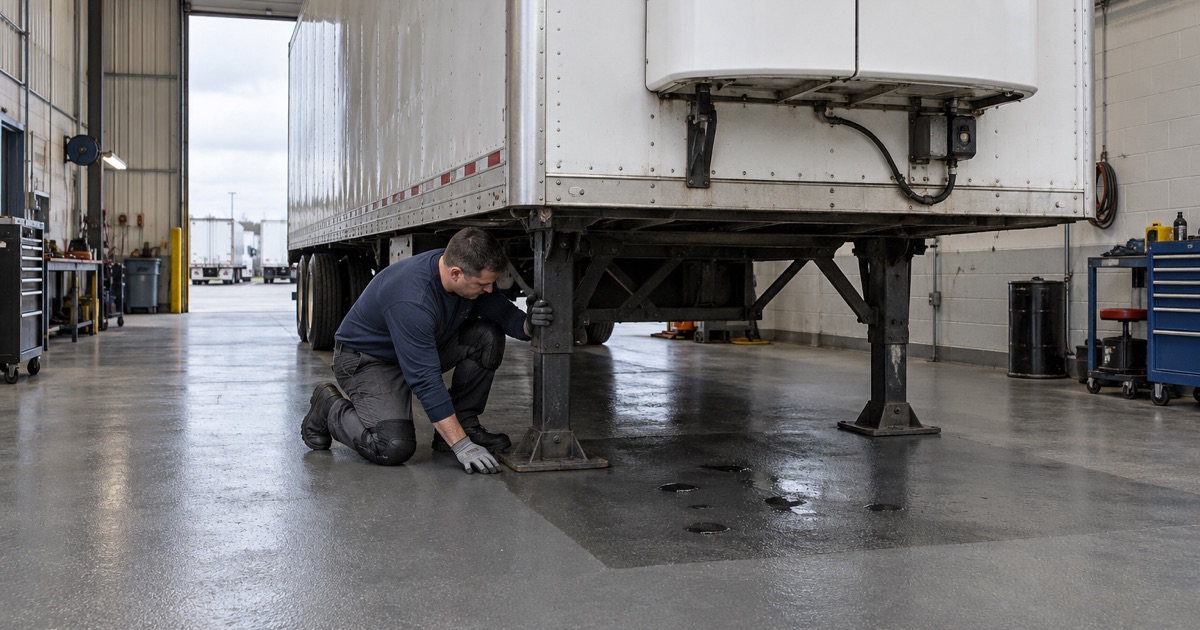
When a trailer comes off the tractor, it rests on its landing gear: two legs with flat steel feet carrying the whole front of the trailer. On a bare or thin-coated slab, those feet concentrate the load on a small footprint and can crush, chip or scrape a coating as the trailer settles or is dragged a few inches. Crank handles, jack stands and tool carts add more of the same.
We handle that with concrete prep first and coating second. A proper ICRI concrete surface profile from grinding or shot blasting gives the base coat something to grip, and filling cracks and spalls before coating keeps a landing-gear foot from finding a weak edge. For bays that park loaded trailers, a thicker build or a steel plate under the feet is worth discussing.
Moisture under a shop slab
An older industrial slab may have been poured with no vapor retarder underneath. Before we commit to a system, we test the slab, typically with ASTM F2170 in-situ relative humidity probes or ASTM F1869 calcium chloride tests. If moisture is high, a moisture-mitigation primer goes in the scope, and the warranty limits on moisture are explained before anything is signed.
Truck and Trailer Shops Across the Industrial Park
Gateway is not alone on its street. Classic Truck & Trailer Repair lists its address at 8650 W. 82nd Place, and the village’s own description of its industrial park counts several truck repair and body shops. Each of those floors takes some mix of diesel, hydraulic fluid, coolant, jacks and creepers rather than forklift traffic in high bays.
Permits and village registration
Illinois has no state license for flooring or coating contractors, so in Justice the binding credential is local. The Village of Justice Building Department, at 8748 W. 82nd Place on the same street as the industrial park, runs a Contractor’s Work Permit Program requiring every contractor to be insured, licensed and registered with the village. Contractors working under a permit must also post a bond, $10,000 for most trades, on a licensing year that runs from February 1 to January 31.
Concrete work is a listed permit item in Justice and requires a plat of survey. Whether a coating over existing concrete needs a permit is a question we put to the building department directly rather than assuming either answer. Fire protection in the village comes from the Roberts Park Fire Protection District, not a village fire department, which matters when a shop’s plans raise questions about flammable coatings or storage.
Dust, solvents and the rules that bind us
Diamond grinding a shop slab throws off fine concrete dust, so we vacuum at the machine instead of rinsing slurry toward a drain or out the bay door. Our products are chosen within the Illinois VOC limits for floor and industrial coatings under 35 Ill. Adm. Code Part 223, which apply to the applicator as well as the maker. In a shop where engines run and technicians work late, a low-odor system is easier to live with during cure.
Getting a bay back in service
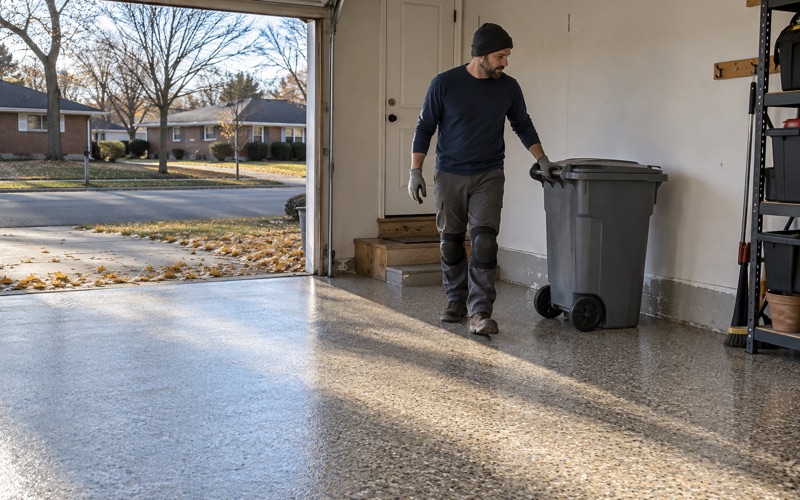
The finished floor has to go back to work, often the next morning. We plan cure times around slab temperature and the dew point spread at the surface, because a coating laid on a cold, damp slab can cloud, blush or lose its bond. When we hand a bay back, the owner gets a floor that sheds what a reefer drips, holds up under landing gear, and matches the proposal they signed.
- 20+ Years on Concrete
- Moisture Tested Before Pricing
- Written Itemized Proposals