
Mount Prospect Epoxy Flooring installs industrial epoxy flooring in Mount Prospect, IL, serving surrounding cities including Prospect Heights, Wood Dale, Bensenville, Schiller Park and Deerfield. Over more than 20 years on concrete, we have found that industrial floors fail in predictable places: forklift turns, dock plates, rack baseplates and wherever a chemical sits too long. We build each floor around those points rather than coating the whole slab the same way.
An industrial floor is specified zone by zone. The proposal names the system, the product line, the coat count and the finished thickness for every area, so a heavy forklift lane and a quiet storage aisle each get the build they need.
The schedule matters as much as the system. We phase the work around shifts, with overnight and weekend windows when the plant or warehouse cannot stop, and every phase is written into the plan before the first grinder runs.
Systems for Industrial Use
Thick-Build Epoxy
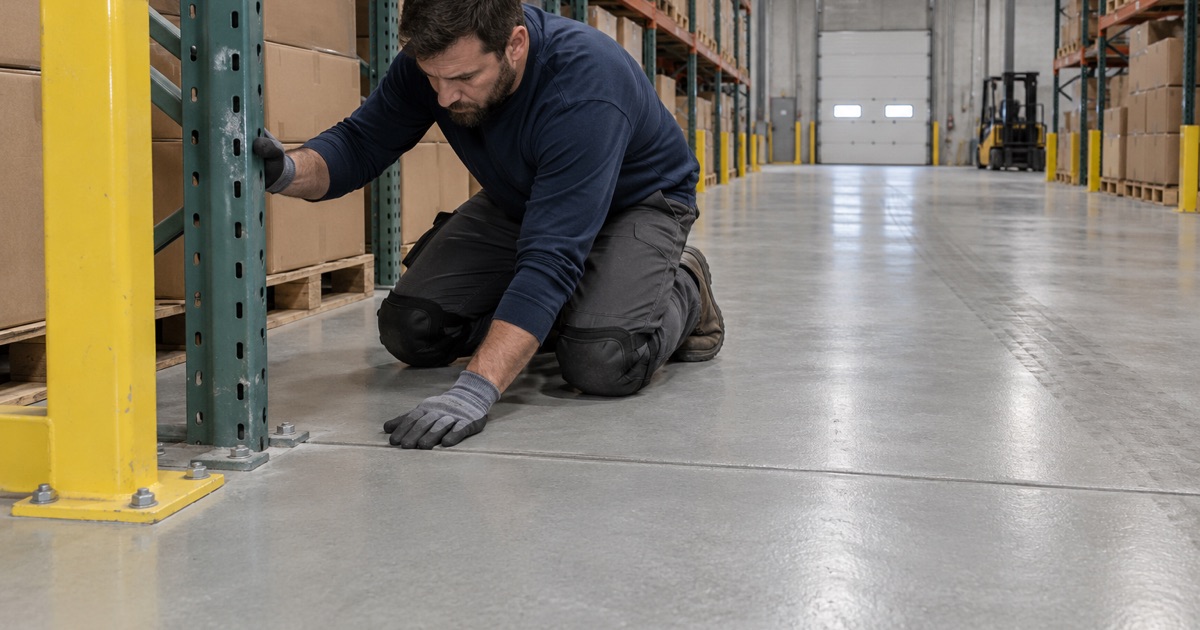
A 100% solids epoxy laid in thick coats gives a hard, chemical-resistant floor that handles steady wheel and foot traffic. It is the backbone of most warehouse and light manufacturing floors. Building thickness in multiple coats also levels minor surface irregularities and gives the floor more material to wear before the slab is exposed.
Quartz Broadcast Systems
Colored quartz aggregate broadcast into epoxy layers creates a dense, textured floor that resists abrasion and impact. It also adds slip resistance in areas that get wet or oily. We use quartz systems in forklift lanes, dock areas and production lines where a smooth coating would wear or get slick.
Urethane Cement and Chemical-Resistant Systems
Where floors see hot water, steam cleaning or aggressive chemicals, a standard epoxy may soften or etch. Urethane cement handles thermal shock and many chemicals, and novolac epoxies resist stronger acids and solvents. We ask for a list of every chemical, cleaner and temperature the floor sees before choosing the system.
Forklifts, Racking and Heavy Loads
Forklift and Pallet Jack Wheel Loads
Forklift and pallet jack wheels concentrate heavy loads on a small contact area, and turning tires grind the surface. Thin coatings wear through fastest where trucks turn and stop. We identify traffic lanes during the survey and build those lanes thicker, often with quartz, than areas that see only foot traffic.
Racking and Anchors
Pallet racking anchored through the slab leaves bolts, baseplates and shims in the way. We coat the aisles and open floor, detail carefully around uprights and leave anchors serviceable. Work is phased by rack row so inventory can move from one section to the next.
Joints and Dock Plates
Control joints under forklift traffic break down at the edges if they are left open or filled with a soft material. We fill traffic joints with a semi-rigid filler that supports wheel edges. Dock plates and door thresholds get extra attention, since impact and water both concentrate there.
Preparing an Industrial Slab
Shot Blasting and Grinding
Large industrial floors are usually prepared with a shot blaster for an even profile, with edges and tight areas diamond ground. Every machine runs with dust collection at the head. Oil-soaked areas may need degreasing and extra passes before a coating will bond.
Moisture Testing
Industrial slabs on grade can carry significant moisture, especially without an effective vapor retarder underneath. We test with calcium chloride kits or in-situ relative humidity probes before the price is final.
High readings call for a moisture-mitigation primer. Coating warranties almost always exclude moisture failure, so the test protects the owner.
Repairs Before Coating
Spalled joints, cracks, failed patches and pitted surfaces are repaired before coating. A thick system over a broken slab only hides damage that will come through later. If part of the slab needs replacement rather than repair, we say so plainly.
Safety Markings and Compliance
Aisle Lines and Zone Markings
Once the main system cures, we add aisle lines, pedestrian walkways, forklift lanes and hazard zones in contrasting coatings. The layout is planned with your safety lead beforehand. Markings laid in a compatible coating last far longer than paint or tape on bare concrete.
VOC Limits and Air Quality
Illinois limits the VOC content of floor and industrial coatings, and those limits apply to the person applying the product. We choose products inside them and plan ventilation for occupied buildings.
Registration and Permits
Illinois has no state flooring license, so we confirm each village’s registration, bond and insurance rules before booking. We ask the Building Division about permits rather than assuming either answer.
Planning the Job
What Moves the Price
Industrial pricing follows the square footage of each zone, the system and thickness chosen, the slab condition and the schedule. Night and weekend phasing, joint repair, a moisture-mitigation primer and safety markings each add their own line to the proposal.
Maintenance and Recoating
We leave cleaning and inspection guidance at handover. Heavy lanes can be recoated before traffic reaches the base layers, which costs far less than replacing a worn-through floor.
Scheduling Around Production
Most plants and warehouses cannot shut down for a week, so we divide the floor into phases that match how the building runs. One bay or rack row closes while the rest keeps shipping, and each phase is ground, repaired, coated and cured before traffic returns to it.
We coordinate access, alarms, deliveries and lift traffic with your operations lead before work begins. Overnight and weekend windows are planned in advance, with the return-to-service time for each phase written into the schedule.
Business Parks and Flex Buildings
Office and industrial parks such as Kensington Business Center on Business Center Drive hold buildings that mix offices, showrooms, light manufacturing and warehouse space. Those buildings often need an industrial build in the back and a lighter decorative finish up front. We specify both in one proposal and plan the transition between them, so the floor changes system where the use changes rather than at an arbitrary line.
Warranty Terms
We explain what the coating warranty excludes before the job is sold, starting with moisture coming up through the slab and including impact damage and chemicals beyond what the system was specified for. Knowing those terms up front is part of choosing the right system.
- 20+ Years on Concrete
- Moisture Tested Before Pricing
- Written Itemized Proposals