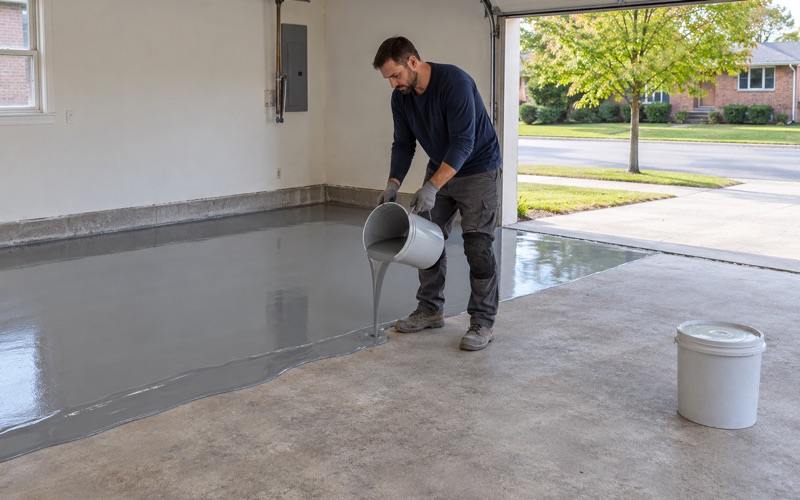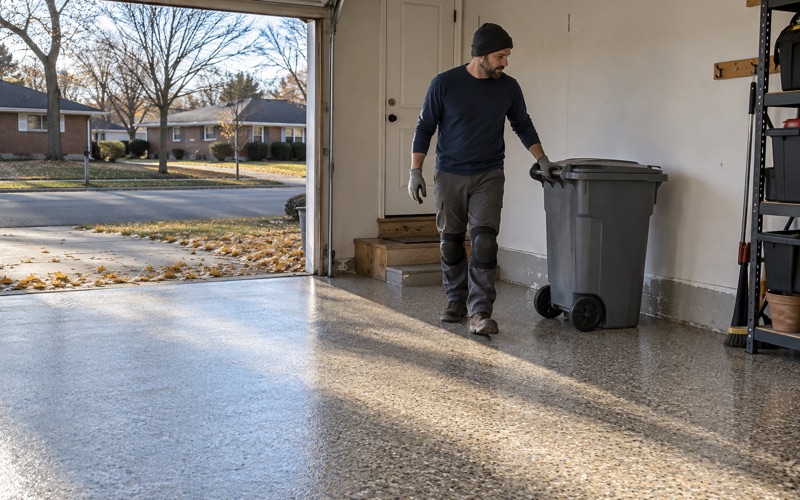
Mount Prospect Epoxy Flooring has spent more than 20 years putting epoxy flooring in Hinsdale buildings and in the rest of the western suburbs, and the floors we think hardest about are the ones that get scrubbed with harsh chemistry every single day. A kennel room, a grooming bay or a boarding run is not judged by how it looks on install day. It is judged by whether the surface is still sealed, smooth and unbroken after a year of disinfectant, hose water and claws.
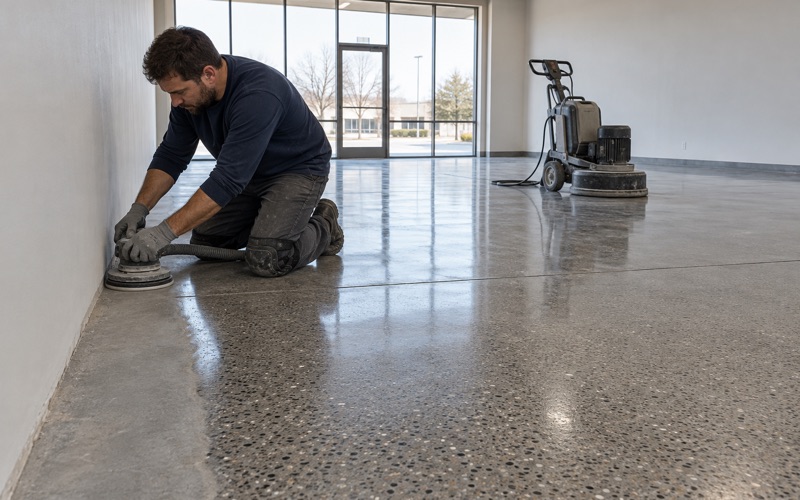
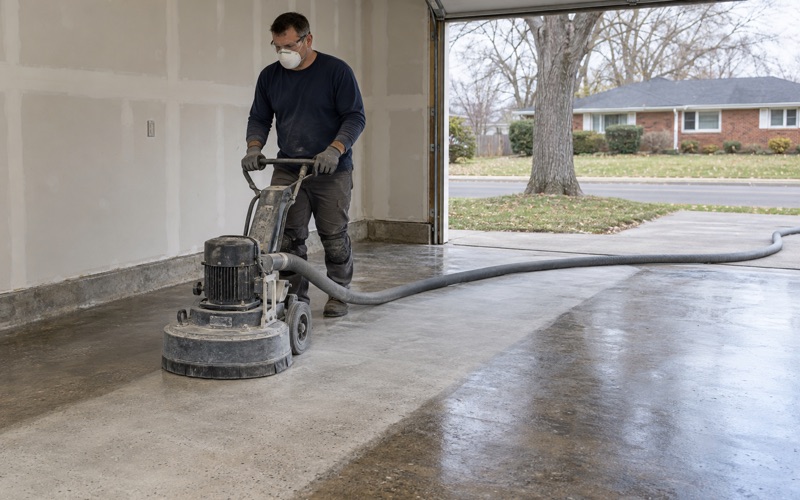
That standard changes how we scope the job. We open every slab with a diamond grinder or a shot blaster rather than an acid etch, so the resin has a real profile to grip, and we run a moisture test before the price is final. Cracks, spalls and any old coating get mapped on the first visit, and if a slab needs repair or replacement before it should carry a coating, we say so in plain words.
The written proposal names the product line, the number of coats and the finished thickness. That gives an animal-care operator, a veterinary practice or a homeowner with a dog wash in the garage something concrete to check the finished floor against.
A Rescue Center on Salt Creek Lane
The clearest local example of why cleanable floors matter is the Hinsdale Humane Society. Its Tuthill Family Pet Rescue & Resource Center sits at 21 Salt Creek Lane, an address that geocodes inside the village in the York Township part of DuPage County. The society lists dogs, cats and small animals it calls “Critters” for adoption, and its nonprofit profile also describes pet therapy and humane education programs.
The society is not our customer, and we have never worked in that building or seen its floors. We point to it because it shows the kind of facility Hinsdale already supports, and because the published guidance shelters follow is the best plain-language description we know of what a hard-working animal floor is up against.
What Illinois asks of an animal-housing floor
Illinois Animal Welfare Act rules say floors in buildings that house or display animals must be of permanent construction so they can be thoroughly cleaned and sanitized. Dirt and unfinished wood floors are unacceptable under those rules. Cages must be impervious to urine and water and able to withstand gnawing and chewing.
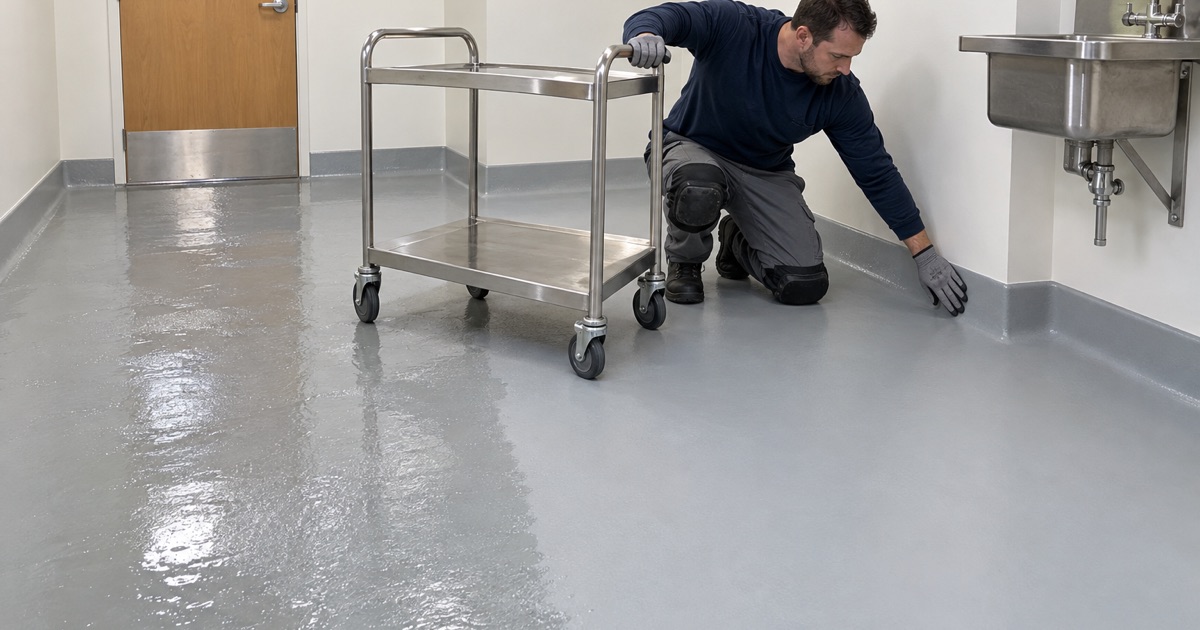
Bare concrete technically counts as permanent, but it is porous, and it absorbs whatever lands on it. A properly bonded resin system closes that pore structure off. That is the whole job of the coating in a room like this: turning a slab that soaks things up into a surface that a cleaning crew can actually get clean.
Permits and paperwork in the village
Permits in Hinsdale run through the Village of Hinsdale Community Development department, and most residential and commercial projects there take a combination permit. Whether a floor coating needs one is a question we put to the department directly instead of assuming either answer. Illinois has no state flooring license, so we also confirm the village’s own registration, bond and insurance requirements before a job goes on the calendar.
On a home project above the state threshold, the homeowner gets a written contract and the Illinois “Home Repair: Know Your Consumer Rights” pamphlet before any grinding starts. That applies to a basement dog room the same way it applies to a two-car garage.
Looking for epoxy-flooring closer to Western Springs? See Epoxy-Flooring in Western Springs.
Parvovirus and the Disinfectants That Actually Work
The Association of Shelter Veterinarians publishes guidelines for standards of care in animal shelters, and its sanitation section is blunt. Disinfectants used in animal areas must be effective against non-enveloped viruses such as parvovirus, panleukopenia and calicivirus. Those viruses are hard to kill, and the guidelines note that several studies found quaternary ammonium products do not eliminate them despite label claims.
The products the guidelines name as effective at the right concentration and contact time are accelerated hydrogen peroxide, potassium peroxymonosulfate and bleach. All three are oxidizers. Every one of them will be on the floor, often several times a day, for as long as the room is in use.
Why sealed matters more than tough
The UC Davis Koret Shelter Medicine Program’s parvovirus guidance lists animal housing of steel, sealed concrete, or another non-porous, non-scratched surface as one that can be effectively cleaned and disinfected. The key words are sealed and non-scratched. Raw concrete can be hard enough to last decades and still fail that test, because its surface is a network of tiny pores.
A densifier such as lithium silicate hardens and dustproofs concrete, but it does not close the surface the way a film-forming resin does. For a room that sees parvovirus-grade disinfection, we treat a densifier as a finish for a storage area, not for animal housing.
What that chemistry does to a floor
A floor coating does not disinfect anything, and we never sell one as if it did. What it does is give the disinfectant a nonporous surface to sit on for its full contact time, so the chemical reaches the contamination instead of soaking into the concrete. That only works if the coating itself can take repeated oxidizer exposure without softening, chalking or losing gloss in the spots that get the most traffic.
This is why we choose resin by chemical resistance first. A 100% solids epoxy base gives a dense, thick film, and a polyaspartic or polyurea topcoat adds resistance to staining and wear. In wet rooms that see hot water washdown, urethane cement is often the stronger choice because it tolerates heat and moisture swings that standard epoxy does not.
Choosing the system before the price is final
We ask what the cleaning protocol actually is before we quote. The disinfectant, the dilution, how often it goes down and whether the room is washed with hot water all change which system belongs on the slab. A proposal written without those answers is a guess.
Dry Before the Animals Come Back
The same guidelines state that dry surfaces are required before animal use. Drainage, or squeegee and towel drying, has to prevent standing water. A floor that holds puddles in low spots undercuts the whole cleaning routine, because water that sits keeps the room damp and gives contamination a place to stay.
Slope, drains and squeegee-friendly texture
A resin floor can be built with slope toward a drain, and the texture can be tuned so a squeegee clears it in a pass or two. Too smooth and a wet floor is slick underfoot for staff and animals. Too rough and the squeegee skips, leaving a film behind in every valley.
We usually set texture with a quartz aggregate broadcast locked under the topcoat, rather than relying on a loose additive. Quartz holds its shape under scrubbing, and it can be graded finer near drains where water needs to run off cleanly.
Moisture under the slab, not just on top
Water from above is only half the problem. Moisture rising through the slab can lift a coating from below, and a kennel floor that starts blistering defeats the purpose. Before we finalize scope we test with an ASTM F2170 in-situ relative humidity probe or an ASTM F1869 calcium chloride test, and where readings call for it we add a moisture-mitigation primer.
Cure schedules matter here too. We follow slab temperature and the dew point spread at the slab surface rather than the calendar, because an epoxy that cures in a cold, humid room can form amine blush that weakens the bond of the next coat.
Scratches, Pores and Seams: Where Disinfection Fails
The guidelines warn that items with scratched, damaged and porous surfaces are difficult or impossible to completely disinfect. That one sentence is the real test of an animal-care floor. A seamless coating that cracks at a joint, or a topcoat that gets cut through by claws, stops being a sealed surface at exactly the spots where contamination collects.
Nails, gnawing and daily mopping
Dog nails scratch, crates get dragged, and some animals chew at whatever edge they can reach. A thin roll-on coating will show wear lines within months in a busy run. A thicker film built to a stated mil thickness, with a hard topcoat over it, keeps a scratch from going all the way through to bare concrete.
Daily mopping adds its own abrasion. Grit carried in on paws acts like sandpaper under a mop head, and in a room cleaned several times a day that wear adds up fast. That is why finished thickness belongs in writing in our proposal, so the floor can be measured against what was promised.
Joints, cracks and the wall line
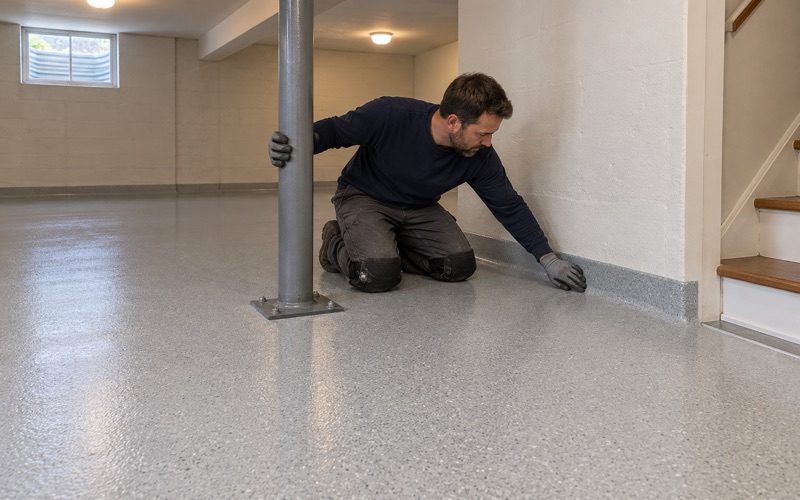
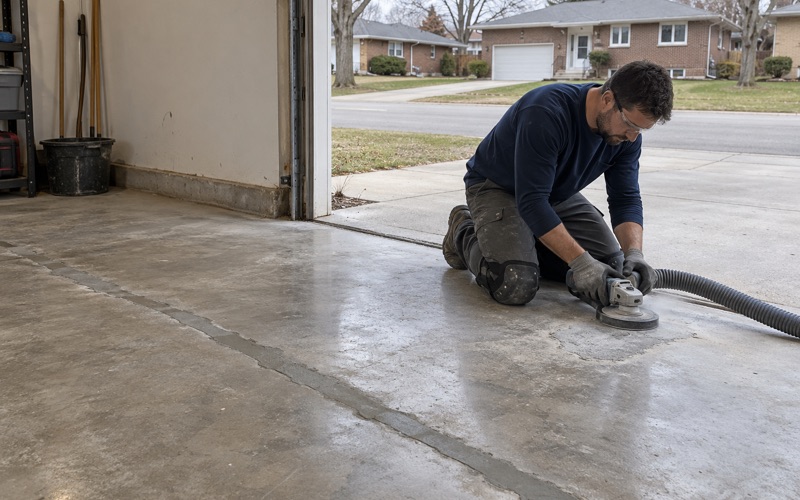
Seams are where a sealed floor usually fails first. We route and fill cracks and control joints before coating, and we can carry the resin up the wall as an integral cove so there is no open crack at the floor-wall junction for water and debris to sit in. Wherever a joint has to stay flexible, we use a sealant matched to the coating rather than leaving it bare.
Old coatings get the same scrutiny. If a previous coating is peeling or poorly bonded, coating over it only hides the problem, so we grind it off and start from sound concrete. And grinding dust is captured by a vacuum at the machine, never rinsed toward a floor drain.
Working around animals that cannot leave
An animal-care building rarely empties out for a week. We phase work room by room, with overnight and weekend windows where the operation cannot stop, so housed animals can be moved to one side while the other side is ground, coated and fully cured. Products are chosen within the Illinois VOC limits for floor coatings, which matters in a building where animals breathe the same air as the crew.
We also explain warranty exclusions before the job is sold, starting with moisture. If a slab tests wet and the owner chooses not to mitigate, that decision is in writing, so no one finds out about the exclusion after the first blister.
For anyone in Hinsdale planning a floor where animals live, eat or get bathed, the questions are the same ones a shelter would ask. Will the surface stay sealed under oxidizing disinfectants, dry quickly enough to put animals back on it, and resist the scratches and open seams that make disinfection impossible? We build the scope, the system and the written proposal around those three answers.
- 20+ Years on Concrete
- Moisture Tested Before Pricing
- Written Itemized Proposals