Mount Prospect Epoxy Flooring has spent more than 20 years on epoxy flooring in Franklin Park and the neighboring suburbs, and the first question we ask about any floor is what will land on it. For a garage, the answer is tires, grit and road salt. For a commercial bay, it can be scalding water, detergent and caustic arriving several times a shift, and that changes which resin family belongs on the slab at all.
This page is about the hardest of those floors: the hot washdown bay. A floor like that is judged on how it survives sudden temperature swings and chemical contact long before anyone asks about color or gloss. For many of these rooms, the honest answer is that a standard epoxy is not the right product.
We would rather say so at the walkthrough than after a coating has let go. Every proposal we write names the product line, the number of coats and the finished thickness, so the floor that goes down can be checked against the paper that sold it.
A Food-Grade Tank Wash on King Street
Franklin Park counted 18,467 residents at the 2020 census, yet it carries more industry than that number suggests. In 2024 the village had 1,237 commercial and industrial water customers against 4,664 residential ones, roughly one account in five. Three railroads serve it, Canadian Pacific Kansas City, Canadian National and the Indiana Harbor Belt, and freight is part of the working day here. The village was named for real estate broker Lesser Franklin, who bought acres of what was then mostly farm fields.
Foodliner at 9200 King Street
Foodliner, Inc. is listed at 9200 King Street as a tank-wash location offering kosher and food-grade wash for tank trailers, and the company names Franklin Park as both a hub and a wash location. The address sits inside the village, in Leyden Township, and the Metropolitan Water Reclamation District lists Foodliner at 9200 King as a significant industrial user. We have not worked at that terminal and have not seen its floor; it is here because it is the clearest local example of a floor type most coating contractors rarely price.
What runs out of a trailer
A food-grade tank wash cleans the inside of cargo tanks between loads. One shipper’s food-grade standard, quoted in the trade press, set wash water at a minimum of 180 degrees Fahrenheit, hot water only, and noted that products such as chocolate and oils call for higher pressures plus detergents and food-grade caustic. That figure describes the class of work, not any one company’s bay; Foodliner’s own temperatures and chemicals are not something we have read.
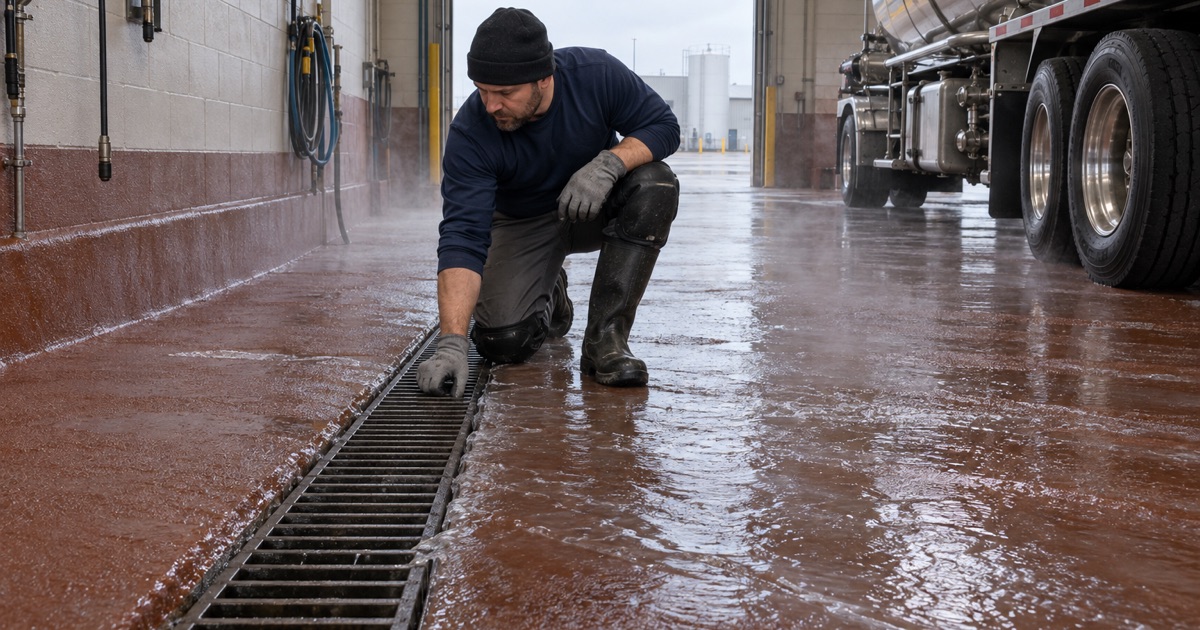
Whatever is sprayed into a tank comes back out, and in a wash bay it lands on the concrete. Hot rinse water, detergent and caustic sheet across the floor toward the drains, then the bay cools before the next trailer pulls in. That repeating cycle, far more than wheel traffic, is what a wash-bay floor has to be specified for.
Looking for epoxy-flooring closer to Winnetka? See Epoxy-Flooring Services in Winnetka.
Thermal Shock: Why a Standard Epoxy Is the Wrong Floor Here
What thermal shock does to a coated slab
Thermal shock is the stress that builds when a surface heats or cools faster than the material it is bonded to. Water near 180 degrees hitting a slab that sat at room temperature makes the top layer expand before the concrete underneath has moved, and when the bay cools the process runs in reverse. A coating that moves at a different rate than the concrete pulls at its own bond line on every cycle, and enough cycles show up as hairline cracking, blisters or sheets lifting at the edge of a drain.
One resin-flooring supplier puts the requirement plainly: the installed floor surface has to expand and contract at a similar rate to the concrete. That is a property of the material class, and adding coats does not change it. No floor is immune to thermal shock, so the real question is which system is built to tolerate it.
Where epoxy runs out
Epoxy is an excellent floor for a great many rooms, including dry warehouses, showrooms and most garages. The same supplier notes that epoxy systems typically are not as resilient above 50 degrees Celsius, about 122 degrees Fahrenheit, which is well below the wash-water figure in that shipper standard. Caustic then adds a chemical load on top of the heat. A film softened by repeated hot rinses is in a poor position to resist it, and the damage usually starts where water lingers longest, around drains and in low spots.
So for a hot washdown bay we do not quote a 100% solids epoxy as the wearing surface, however thick the build. Epoxy can still earn its place elsewhere in a facility like this, in a dry office corridor, a parts cage or a staging aisle that never sees hot water. We mark which rooms are which on the walkthrough so the cheaper system goes only where it will last.
Urethane Cement, Slope and Drains in a Wash Bay
Why urethane cement is the usual comparison
Urethane cement combines polyurethane resin with cement and aggregate, and it goes down at a far heavier thickness than a roll-applied coating. The supplier quoted above says polyurethane cement floors will tolerate temperatures up to 120 degrees Celsius, the range of boiling water and steam. That heat tolerance, together with movement closer to the concrete beneath it, is why urethane cement is the class we compare when a bay floods with hot water every shift.
It is not a free upgrade. A urethane cement system costs more to install than a coating, and the preparation under it matters just as much as under any epoxy. We will walk through both prices side by side, along with what each warranty excludes, starting with moisture.
Preparation and edges
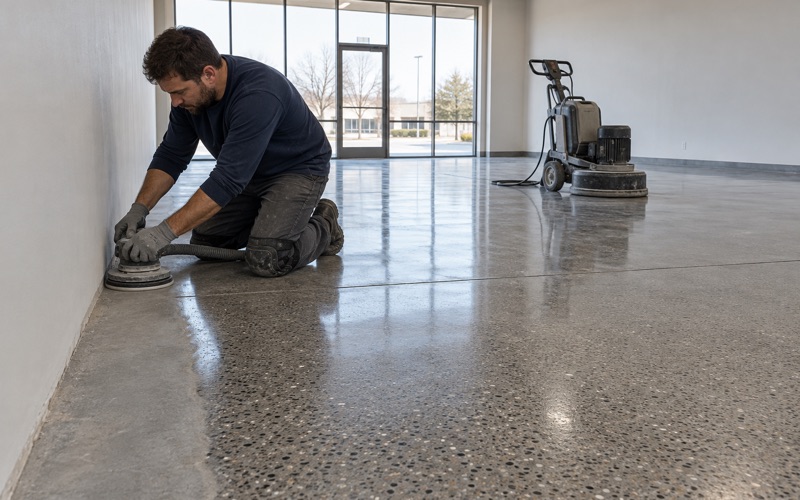
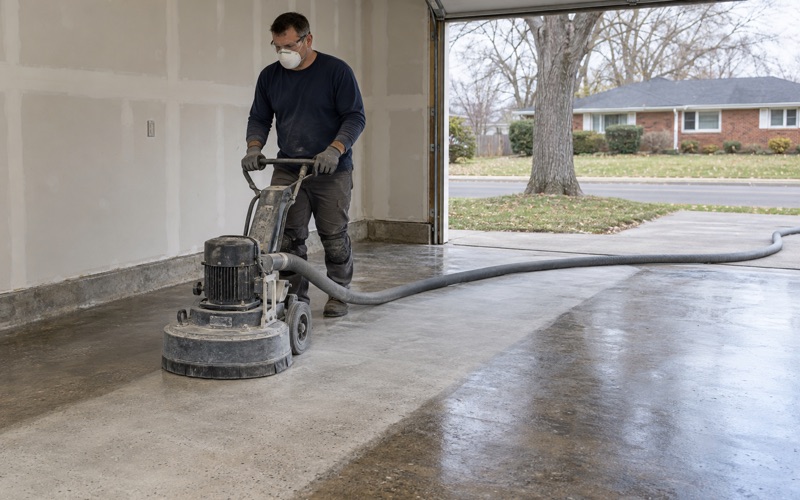
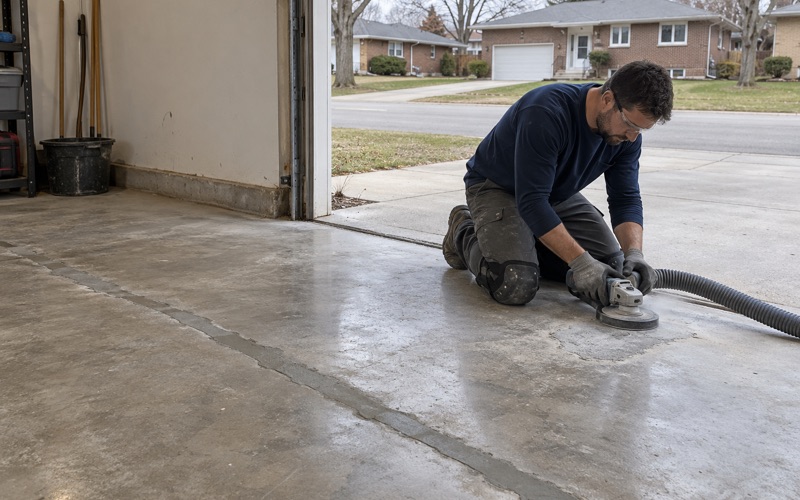
We open every slab with a diamond grinder or a shot blaster, never an acid etch, to the ICRI concrete surface profile the system calls for, and a heavy urethane cement build generally wants a coarser profile than a thin coat. Cracks, spalls and old coatings are mapped before the price is final. A bay that has been soaked in caustic for years can be soft or contaminated at the surface, and where the concrete needs repair or replacement first, we say so in writing.
Moisture is checked too. Before the price is final we test the slab, with ASTM F2170 in-situ relative humidity probes or ASTM F1869 calcium chloride testing depending on the floor, because a slab that is wet from below behaves differently from one that is only wet from above. The result goes into the proposal, along with what the warranty will and will not cover.
Edges are where hot-water floors tend to fail first. Urethane cement systems are terminated into saw-cut keyways along the perimeter, around drains and at door thresholds, so the edge is locked into the slab instead of feathered out to a lip that hot water can work under. The products we select also have to sit inside the Illinois VOC limits for floor and industrial coatings, which bind whoever applies them.
Slope, drains and coving
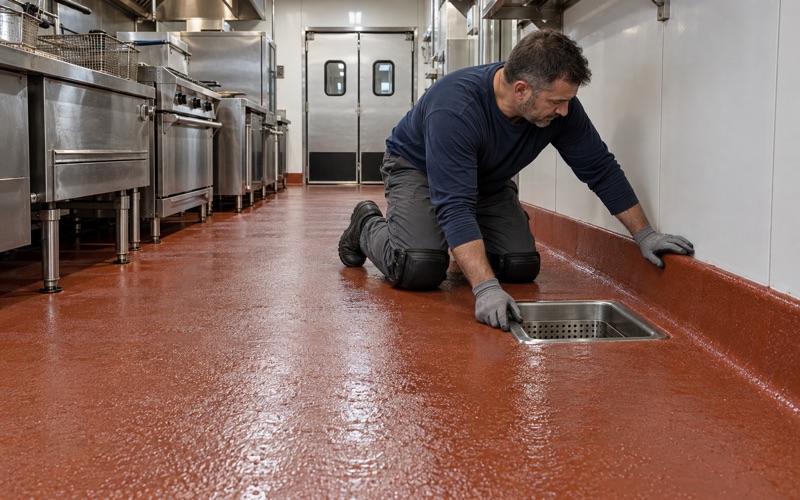
A wash-bay floor has to move water to the drains without ponding, because standing hot caustic keeps working on whatever it sits on. If an existing slab holds puddles, correcting the slope comes before the topping, not after. Where walls meet the floor in a food-related space, a coved junction keeps the joint cleanable, the same idea the FDA Food Code applies to coved floor and wall junctures in food establishments.
Grinding a wash bay produces a lot of dust, and we vacuum it at the machine rather than rinsing it toward a floor drain. That keeps the drains clear for the hot water they are actually there to carry.
Hot Washdown Across Franklin Park’s Freight Terminals
Trailer and shop washing beyond food grade
A food-grade tank wash is the sharpest example, but it is not the only hot, wet floor in a village built around freight. Trailer wash bays, steam-cleaning areas in maintenance shops and washdown zones at food-freight terminals all put heat and cleaning chemicals on concrete. The questions are the same at a smaller scale: how hot the water gets, which chemicals are used and how often the bay swings between hot and cool.
The answers sort these floors quickly. A shop that rinses with warm water once a day may do well with a thick epoxy or a polyaspartic topcoat over a properly profiled slab. A bay that sees steam or near-boiling water on every vehicle belongs in the urethane cement conversation, and we will tell you which side of that line your floor falls on.
Many of these floors already carry something: an old epoxy, a paint, or patches left by several past repairs. On a hot, wet floor, a failing coating left in place traps water under whatever goes over it, so we expect to grind the old material off rather than coat on top of it. The map of what is there now is part of the quote.
Working around a terminal that cannot stop
A wash terminal earns its living by turning trailers, so a floor project has to fit the schedule instead of halting it. We phase shop, warehouse and process floors around shifts, using overnight and weekend windows and splitting a multi-bay building so some bays stay open while others cure. Cure times follow slab temperature and dew point, not the calendar, and putting a bay back into hot service early is the fastest way to waste a new floor.
Village rules before a crew arrives
Every contractor performing work in the Village of Franklin Park must be licensed, insured and bonded. That means a $100 annual license for contractors or $250 for general contractors, on a May 1 to April 30 year with no half-year licenses, plus a $10,000 trade-specific license and permit bond and at least $1,000,000 in liability insurance.
Illinois has no state flooring license, so we check each village’s own registration, bond and insurance rules before a job is booked. We also ask the Village of Franklin Park Building Department on Belmont Avenue whether a given floor needs a permit, rather than assuming the answer either way.
- 20+ Years on Concrete
- Moisture Tested Before Pricing
- Written Itemized Proposals