
Mount Prospect Epoxy Flooring installs ESD flooring in Mount Prospect, IL, serving surrounding cities including Prospect Heights, Wood Dale, Bensenville, Schiller Park and Deerfield. With more than 20 years of concrete coating behind us, we treat an ESD floor as what it is: an electrical component of your static-control program that also happens to be a floor, and one that has to be installed, grounded and tested to prove it works.
Static-control epoxy floors carry electrostatic charge away from people and equipment to ground. They protect sensitive electronics from discharge damage and reduce the static buildup that can matter in labs, server rooms and some manufacturing areas.
The proposal names the system type, the resistance range it is designed for, the grounding layout and the testing we will perform. You get readings in writing when the floor is handed over.
Where ESD Floors Are Used
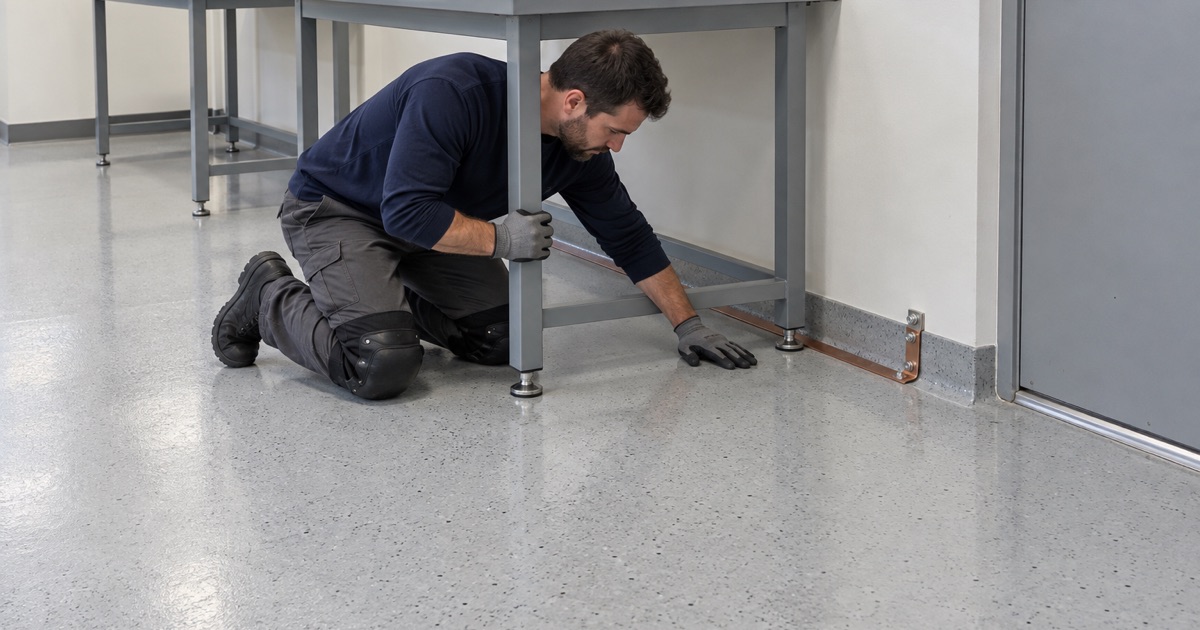
Electronics Assembly and Repair
Electronics assembly, repair benches and component storage are the classic ESD areas. A discharge too small for a person to feel can still damage a circuit board. An ESD floor, with proper footwear, keeps workers grounded as they move around the room, not just at the bench.
Server Rooms and Data Closets
Server rooms and network closets hold equipment that is expensive to replace and costly when it goes down. Static control at the floor is one layer of protection for that equipment and the people servicing it. We coordinate with IT staff to schedule work around equipment that cannot be shut down.
Labs, Clean Areas and Light Manufacturing
Laboratories, testing areas and light manufacturing spaces may need static control for instruments, materials or processes. Business parks and flex buildings in the area often hold exactly this kind of mixed-use space. We specify the floor for the activity in each room rather than one system across the whole building.
Conductive and Static-Dissipative Systems
Choosing the Resistance Range
ESD floors are classed by how easily charge flows through them to ground. Conductive floors have lower resistance and static-dissipative floors higher, and each suits different protection programs. We match the floor to the requirements your quality program or customer has set, rather than choosing a range on our own.
Grounding Grid and Ground Points
An ESD floor needs a path to ground. We lay a conductive grid of copper strips or a conductive primer under the topcoat and connect it to building ground points around the room. The layout of those ground points is drawn in the proposal and confirmed with your electrician.
Topcoat and Finish
The ESD topcoat carries conductive material through its body so the whole surface performs, not just spots near the grid. Colors are usually limited compared with a decorative floor, and the finish is chosen to stay cleanable without insulating waxes. We can add aisle lines and zone markings in compatible ESD materials.
Preparing the Slab
Removing Old Floors and Coatings
Old tile, carpet adhesive and coatings come off completely, because an insulating layer left under the system would interfere with grounding and bonding. We grind or shot blast to the profile the ESD maker calls for. Dust is collected at the machine, which matters even more near sensitive equipment.
Moisture Testing
Moisture coming up through the slab can cause any coating to blister, and an ESD floor costs too much to lose that way. We test with calcium chloride kits or in-situ relative humidity probes before the price is final. If the reading is high, a compatible moisture-mitigation primer goes down under the grounding layer.
Cracks and Joints
Cracks and joints are filled and ground flush so the conductive layers run continuously across the room. A break in the grid or topcoat can leave an area poorly grounded. We plan joint treatment to keep both the slab movement and the electrical path in check.
Testing and Handover
Resistance Testing After Cure
Once the floor cures, we measure resistance to ground and between points across the room with a calibrated meter. Readings outside the design range are found before handover, not after equipment is moved in. The results are recorded by location and given to you in writing.
Footwear and Program Fit
The floor works with ESD footwear, heel straps and grounded workstations. We review your program with you so the floor, the footwear and the procedures all fit together. A floor tested on its own but used with ordinary shoes will not deliver the protection you paid for.
Cleaning and Periodic Checks
ESD floors need cleaners made for static-control surfaces, because some common floor finishes leave an insulating film. We leave written care instructions with the handover. Periodic resistance checks by your team, compared with our baseline readings, confirm the floor is still performing.
Scheduling and Village Rules
Working Around Operations
ESD areas are often in buildings that cannot stop. We phase the work and use nights and weekends where needed, and we choose products inside the Illinois VOC limits for floor coatings.
Permits and Registration
Illinois has no state flooring license, so we confirm the village’s own registration, bond and insurance rules before booking. We ask the Building Division whether the work needs a permit rather than assuming either answer.
What Moves the Price
An ESD floor costs more than a standard coating because of the conductive materials, the grounding grid, the connections to building ground and the testing after cure. Room size, the number of ground points, the slab condition and whether the work must be phased around running equipment are the other main drivers. The proposal itemizes the grid, each coat and the testing, so the static-control portion of the cost is visible on its own.
Warranty and Performance
We explain what the coating warranty covers and excludes before the job is sold, beginning with moisture coming up through the slab. Electrical performance depends on the floor being cleaned and maintained as directed, which is why the care instructions and baseline readings are part of the handover. If your program requires periodic certification readings, we can return to retest the floor against the original baseline.
- 20+ Years on Concrete
- Moisture Tested Before Pricing
- Written Itemized Proposals