
Mount Prospect Epoxy Flooring provides concrete grinding in Mount Prospect, IL, serving surrounding cities including Prospect Heights, Wood Dale, Bensenville, Schiller Park and Deerfield. Over more than 20 years of floor work, grinding is the step we have learned never to shortcut: whatever goes down next, from a garage coating to a polished finish, can only hold as well as the surface we leave behind.
We open every slab with a diamond grinder or a shot blaster and never with an acid etch. Mechanical prep removes sealers, paint, adhesives and the weak top layer of the concrete, and it leaves a measurable profile a coating can grip.
That matters in a village where most slabs are decades old. About 70 percent of local housing units were built between 1950 and 1979, so the floors we grind often carry years of sealers, patches, carpet glue and road salt.
What Grinding Removes
Old Coatings and Paint
Peeling garage paint, worn epoxy and old floor sealer all have to come off before a new system goes down. A coating applied over them can only hold as well as the old layer does, and when that layer lets go the new floor goes with it. We grind or blast down to sound, clean concrete across the whole floor, including edges and corners worked with hand grinders.
Carpet Glue, Thinset and Mastic
Basements and commercial spaces often carry adhesive from carpet, vinyl tile or ceramic tile. Coarse diamond tooling cuts through most of it and leaves the slab ready for its next floor.
Some older black mastics deserve a test before they are ground. When an adhesive looks suspect, we stop and recommend testing rather than guessing.
Oil, Salt and Weak Surface Paste
Garage slabs soak up oil drips and the salt brine that rides in on tires through the winter. The top layer of a slab can also be weak, chalky laitance that crumbles under a coating.
Grinding removes that weak surface and much of the contamination with it. Deep oil stains may need degreasing and extra passes before the floor is ready.
Surface Profile and Why It Matters
ICRI Concrete Surface Profiles
The industry measures prepared concrete against the ICRI concrete surface profile scale, which runs from CSP 1, nearly smooth, to CSP 10, very rough. Each coating maker names the profile its product needs.
We grind to that number, not to a guess. A thin sealer and a thick broadcast system need very different profiles.
Diamond Grinding
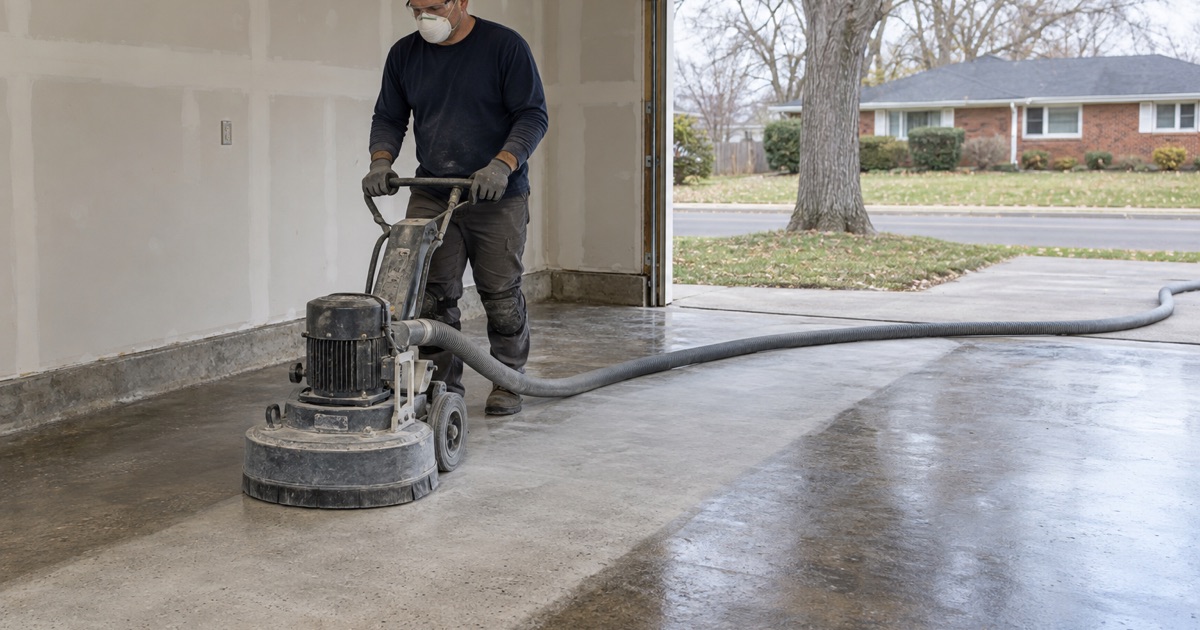
Diamond grinding uses rotating heads fitted with diamond tooling to cut the surface. It suits garages, basements and most interior floors, flattens high spots and is the first step in polishing concrete. Changing the tooling changes the cut, from aggressive coating removal to fine honing.
Shot Blasting
A shot blaster throws steel shot at the slab and vacuums it back up, leaving a uniform textured profile. It is fast on large, open commercial and warehouse floors and well suited to thicker coating systems. We choose between grinding and blasting based on the floor, the coating and the space we are working in.
Dust Control and Clean Work
Vacuums at Every Machine
Grinding produces fine concrete dust, so every grinder and blaster runs connected to a vacuum that captures the dust at the head. That keeps the air in the room and the rest of the house or building far cleaner. We never sweep dust into the air or wash grinding slurry toward a floor drain or the street.
Floor Drains and Interceptors
The village does not allow garage floor drains unless they connect to a triple basin interceptor. Even with one, a drain is no place for grinding waste. We cover drains during grinding and collect all residue for disposal off site.
Occupied Buildings
In a business that has to keep running, we section the floor and schedule grinding for nights or weekends. Dust collection and containment keep the rest of the building working while one area is prepped. At home, we protect the route through the house and tell you which days will be loudest.
Grinding for Repairs and Leveling
Lips, Ridges and Trip Edges
Slab sections often settle unevenly, leaving lips at joints and cracks. Grinding can take those edges down so the floor is smoother and safer before it is coated or polished. Large height differences may need repair or replacement rather than grinding alone, and we tell you when that is the case.
Mapping Cracks and Spalls
Grinding exposes the real condition of the slab. Once the old coating is gone, we map every crack and spall so repairs are planned and priced before the next layer goes down. If the slab needs more than repair, we say so plainly before anything is coated.
Planning a Grinding Job
Moisture Testing After the Grind
A freshly ground slab is the best surface for a moisture test, because sealers and coatings no longer mask what is coming up through the concrete. We run a calcium chloride test, an in-situ relative humidity probe or a plastic sheet test depending on the floor and the next product. The reading decides whether the next layer needs a moisture-mitigation primer, and it is part of the scope before any coating price is final.
What Moves the Price
The square footage sets the base, and what is on the floor sets most of the rest. Thick epoxy, multiple layers of paint and heavy adhesive take more passes and more tooling than a bare, sealed slab.
Access also matters. A basement reached by a narrow stair takes longer to set up than a garage with a wide door, and tight edges and corners need hand grinders.
Grinding for Other Trades
Not every grinding job ends in an epoxy floor from us. Tile, vinyl and wood installers often need old adhesive removed and a flat, clean slab before their own product goes down.
We grind to the profile and flatness their product calls for and leave the floor vacuumed and ready for them. The proposal states the target profile so the next trade knows what they are getting.
- 20+ Years on Concrete
- Moisture Tested Before Pricing
- Written Itemized Proposals