Mount Prospect Epoxy Flooring brings more than 20 years of epoxy-flooring work to Burr Ridge, and the floors we spend the most thought on here are the ones that do not look like what they are. A garage that holds a generator instead of a car, a basement room full of pumps, a utility space tucked behind a finished wall: each carries fuel, oil, water or chemicals on a slab that was poured for something gentler. We coat those floors for what actually sits on them.
Every job starts with a survey, not a color chart. We map the cracks, spalls and earlier coatings, run a moisture test as part of the scope before the price is settled, and tell you plainly if the concrete needs repair or replacement first. Nothing gets coated until that walk-through says it should be.
From there the proposal is written down in full. It names the product line, the number of coats and the finished thickness, so the floor you end up with can be measured against the paper you signed, and it spells out what the coating warranty leaves out, beginning with moisture.
A water plant built to pass for a house
The building behind the lawn
Burr Ridge offers one of the better local lessons in why you cannot judge a floor by the door in front of it. The Lake Michigan Water Reservoir and Distribution Centre was dedicated in June 1985, and a January 1987 Illinois Municipal Review profile of the village described it as designed to look like a single-family home so it would fit the residential character of its neighborhood. It sat under a cedar shake roof in a wooded area of large-acreage estates in the southeast corner of the village.
That profile said the building housed the pumping, chlorinating and monitoring equipment for the village’s entire water system. Under the lawn, it reported, lay a reservoir 207 by 138 feet and 16 feet deep, holding 3 million gallons. The village’s own water page notes that in 1984 Burr Ridge became the first community in DuPage County to provide Lake Michigan water to all customers.
Construction of the $1.5 million facility began in 1983 as part of a $3 million water system improvement project, with Frank Novotny & Associates of Willowbrook as design engineer. The same profile listed four vertical turbine pumps with a combined delivery capacity of about 6 million gallons per day, running fully automatic. Those are 1987 figures, repeated here as they were reported then.
What the garage door was hiding
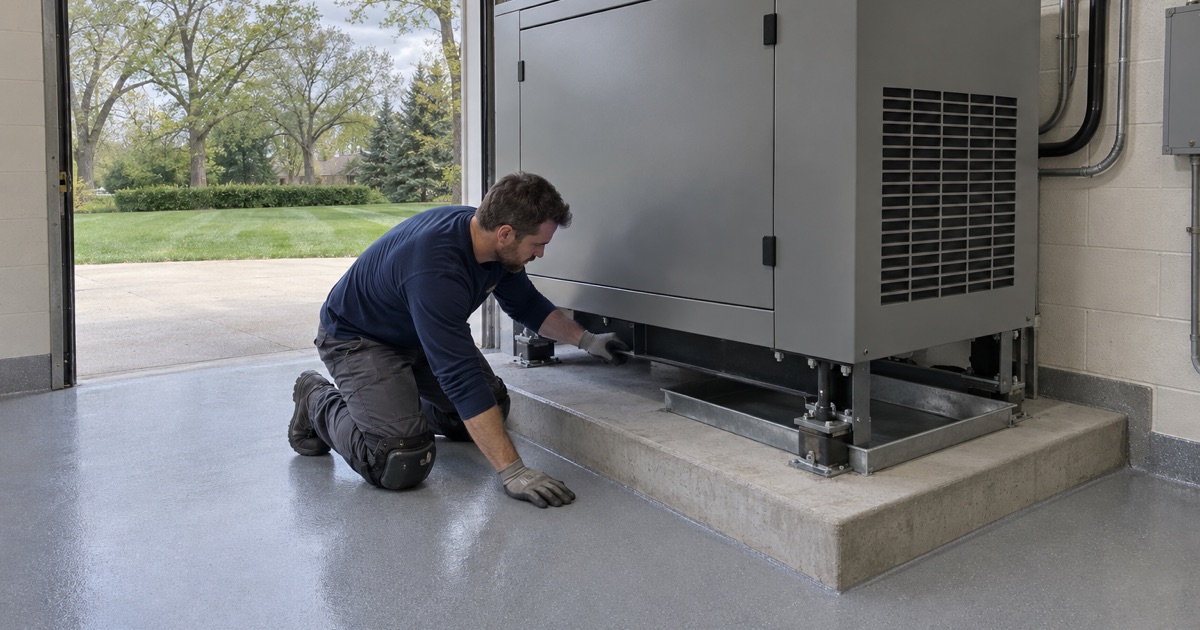
The detail that stays with us is the garage. According to the 1987 account, behind the overhead garage door was a 450-kilowatt emergency generator kept for power failures. From the street it read as a family’s two-car garage; inside, it was the machine meant to keep a whole village’s water moving when the grid went down.
We have no relationship with the village and have never worked on that building, and the equipment described in 1987 has not been re-checked since, so we make no claim about what is there now. What the story illustrates is general: in Burr Ridge, what sits behind a residential garage door is not always a car, and the floor under it has to be chosen for the real load.
Looking for epoxy-flooring closer to Justice? See Epoxy-Flooring Services in Justice.
Generator rooms: fuel, oil and vibration
What lands on a generator floor
A standby generator room collects a particular set of spills. Diesel weeps at fittings and fuel lines, lube oil drips during changes and top-offs, and coolant can leak from hoses and radiators. Bare concrete drinks all of it, and a soaked slab holds the stain and the smell long after the drip stops.
A floor drain in that kind of room is a mixed blessing. It clears washdown water, but it also gives a fuel spill a direct path out of the building. We pay attention to how the coating meets the drain body, whether a raised curb or containment lip makes sense around the unit, and whether the drain connects to an interceptor before it reaches anything else.
For these rooms we lean toward 100% solids epoxy base coats, which build a dense film without solvent, with a chemical-resistant topcoat selected for fuel and oil exposure. Polyaspartic and polyurea topcoats are options where a faster return to service matters, and urethane cement belongs in the conversation when a room sees hot fluids or heavy chemical exposure. The written proposal names which system we chose and why.
Vibration, anchors and the housekeeping pad
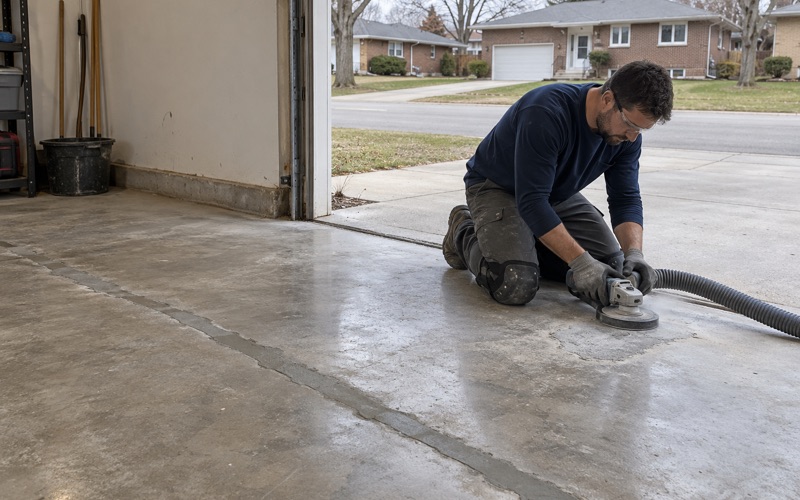
A generator does not sit still when it runs, and the slab around its mounts and anchors takes repeated stress. Cracks that start at anchor bolts or at the edges of a housekeeping pad are exactly what our crack map is meant to catch. Some cracks can be routed and filled before coating; others point to a slab problem a coating should not be asked to hide, and we say so.
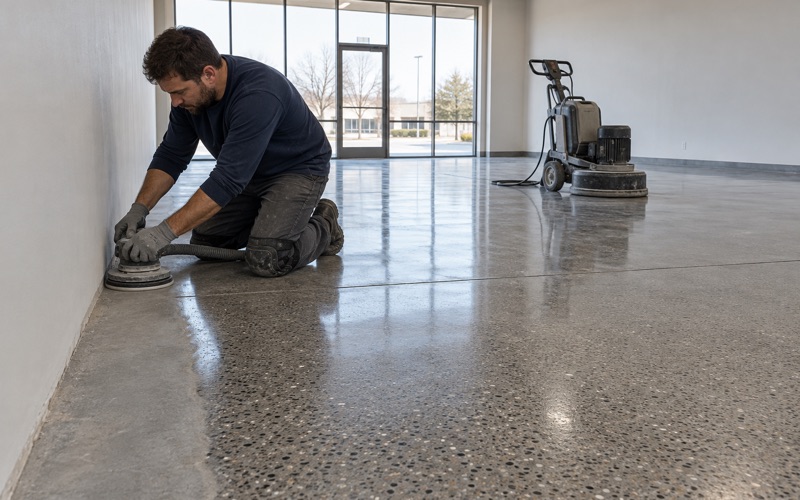
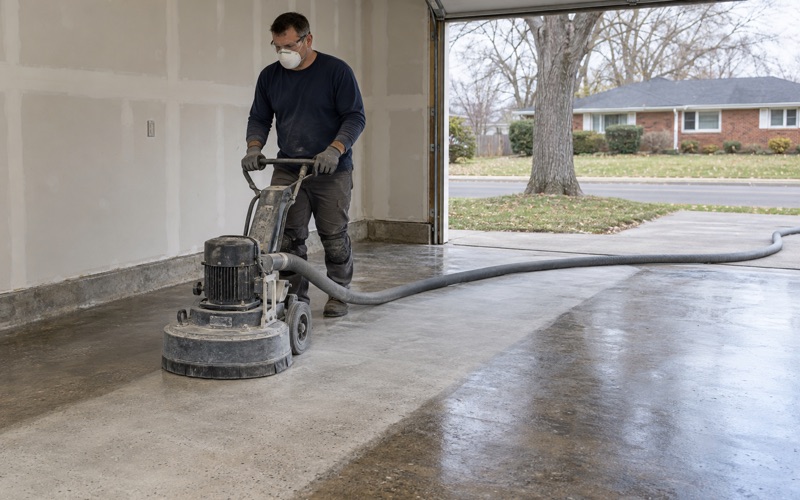
Profile matters even more here than in a plain garage. We open every slab with a diamond grinder or a shot blaster, never an acid etch, aiming for the ICRI concrete surface profile the chosen system calls for. Oil-soaked concrete has to be cleaned and tested before any primer goes down, because epoxy laid over contamination lets go in sheets.
Keeping the room usable
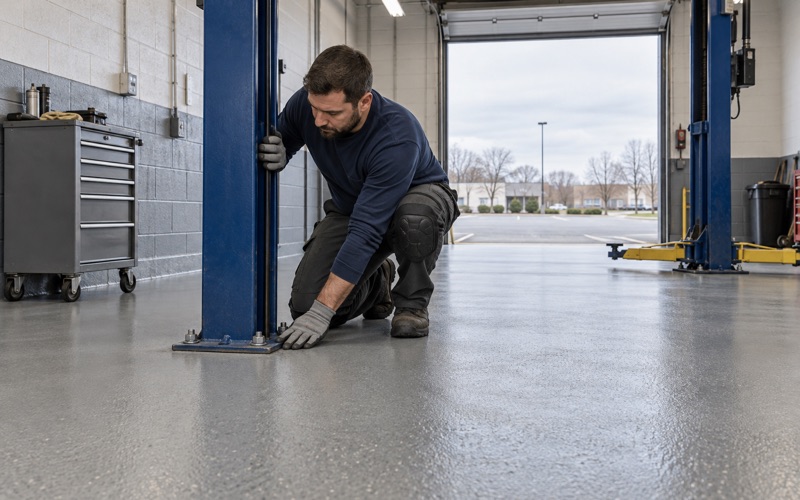
A generator room still has to be walked, serviced and inspected. We broadcast quartz aggregate into the coat where footing matters, keep the texture finer around service areas where a technician kneels, and leave the floor a light color so a fresh drip shows up instead of disappearing.
Pump and chlorination rooms behind a quiet facade
Wet floors that stay wet
Pump rooms see water constantly: seal drips, condensation on cold piping and washdown after maintenance. A coating there has to bond to concrete that may never fully dry, which is why we test before we price. ASTM F2170 in-situ relative humidity probes and ASTM F1869 calcium chloride testing give numbers we compare to the product’s published limits, and an ASTM D4263 plastic sheet test helps as a quick screen.
When the readings run high, a moisture-mitigation primer may be the right first coat, and the warranty exclusions for moisture are explained before anyone commits. A coating is not waterproofing, either. If a room has taken water, the source gets fixed and the slab gets dried before we talk about a finish.
Chlorinating equipment and chemical exposure
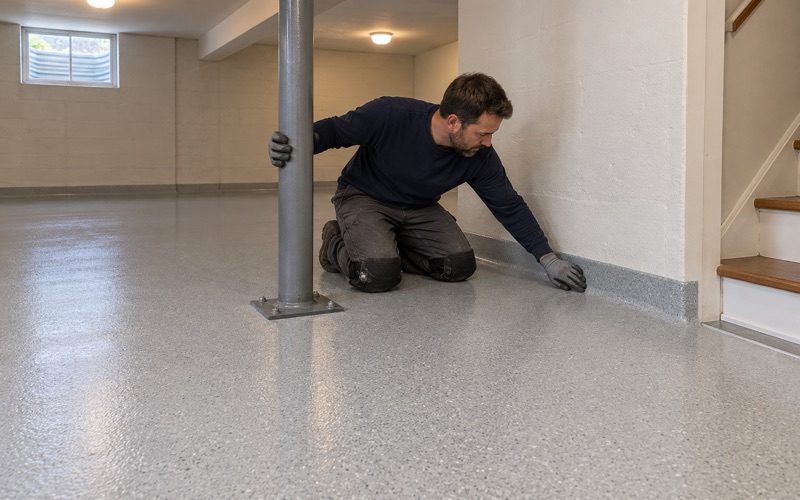
Rooms that hold treatment chemicals ask more of a floor than a garage does. Spills can be corrosive, splashes travel, and the wall-to-floor joint is where liquid sits longest. We look at coving that carries the coating up the wall, at chemical-resistant topcoats, and at how the floor slopes toward any drain.
Those are the same questions we ask in a private pool equipment room or a basement mechanical room in a large home. The chemicals are smaller in volume, but the slab is just as unforgiving when a chlorine product sits on it untreated.
Service traffic between the machines
Pump and monitoring rooms are also places where heavy parts move. A motor gets pulled for rebuild, a dolly rolls a replacement drum across the floor, and a dropped wrench lands on the same spot every maintenance visit. We build film thickness and choose an impact-tolerant system where that traffic runs, and we plan the work so equipment that has to keep running is protected and accessible while each section cures.
Utility floors in an estate village
Houses with working rooms inside
Burr Ridge is mostly owner-occupied and mostly detached, and much of its housing was built between 1980 and 2009. Houses of that era and size tend to carry the same working rooms the water plant did, only smaller: a standby generator, a boiler or mechanical room, a pool equipment space, a garage that doubles as a workshop. Whether a given slab was poured over a vapor retarder is not recorded anywhere we can look up, so we test it rather than assume it.
Garage slabs deserve their own check. The IRC R506.2.3 garage vapor retarder exception means many garage floors were never meant to have one, which changes how much moisture can push up under a coating. A lithium silicate densifier is sometimes the better answer for a room that will never see a spill worth worrying about.
Systems we match to the room
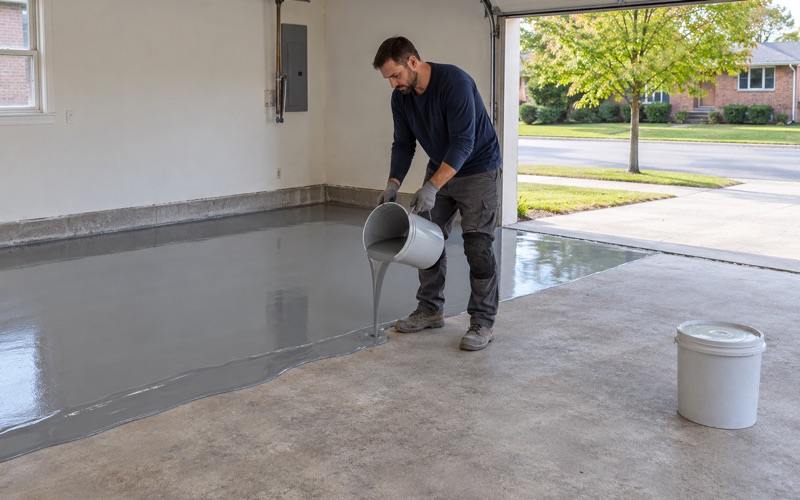
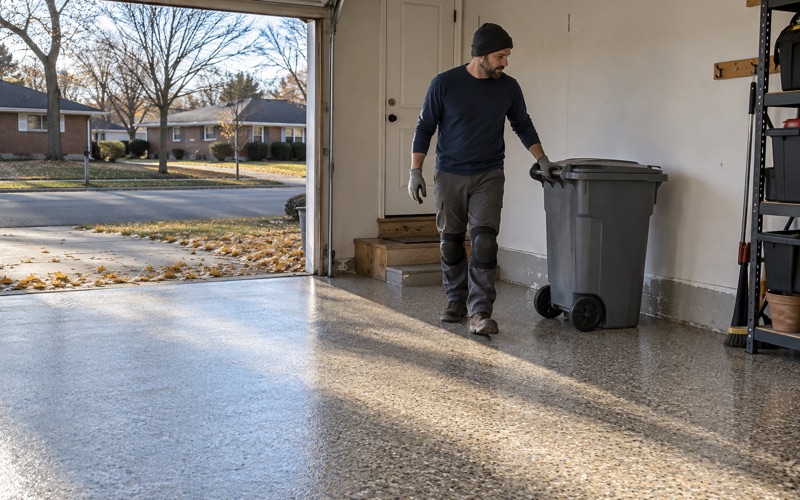
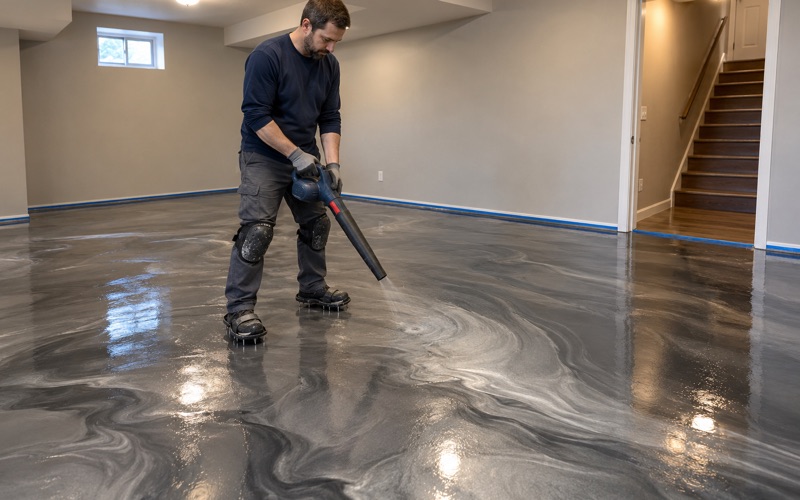
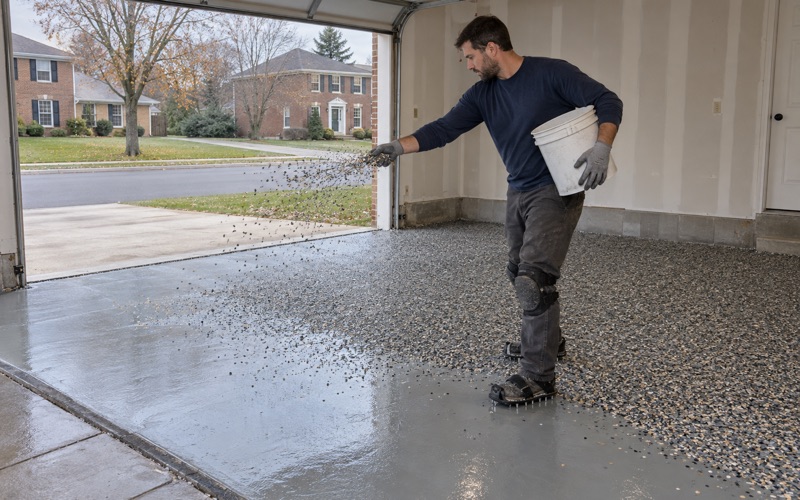
For a residential garage or workshop, a vinyl flake broadcast over an epoxy base with a polyaspartic topcoat is a common choice, and it resists hot tire pickup better than a thin store-bought kit. For a mechanical or generator room we usually skip the flake and build a heavier, chemical-resistant film. For a pump room, slip resistance and moisture tolerance come first.
Whatever the room, the survey results travel with the quote. The moisture readings, the crack map and our notes on any old coating are written into the proposal, so a homeowner can see why we picked one system over another and what we expect the slab to need before the first coat.
We also handle grinding dust carefully, collecting it with a vacuum at the machine rather than rinsing it toward a floor drain or out to the street. Products are selected inside the Illinois VOC limits for floor and industrial coatings, which bind whoever applies them. And we never sell a floor coating as radon reduction, because in Illinois that is licensed mitigation work.
Licensing, permits and paperwork in Burr Ridge
Illinois licenses no flooring or coatings contractor, so the village rules are the ones that bind. Burr Ridge requires every contractor on a permitted job to hold a village license, with a $10,000 surety bond naming the village and liability insurance of at least $1,000,000 listing the village as additional insured. We confirm those requirements before a job is booked.
The village permit page exempts finish work such as painting, hardwood refinishing, tile replacement and carpeting, but work that affects foundations, garages or patios is another matter. Rather than guess which side a coating falls on, we ask Community Development directly. Home jobs above the state threshold get a written contract and the Home Repair: Know Your Consumer Rights pamphlet before any grinding begins.
For commercial utility rooms that cannot simply shut down, we phase the work around shifts and offer overnight and weekend windows. Whether the room holds a generator, a pump skid or a family car, the floor gets specified for what really sits on it.
- 20+ Years on Concrete
- Moisture Tested Before Pricing
- Written Itemized Proposals