Mount Prospect Epoxy Flooring has done epoxy flooring for more than 20 years, and on an older floor in Bellwood the first thing we want to know is not the color you have in mind. It is what is already stuck to the slab, and whether anyone has tested it. Old resilient tile and the dark adhesive under it can change what is allowed to happen next, and the next step on every coating job we run is grinding.
That order of work is what this page is about. We open every slab with a diamond grinder or a shot blaster, never an acid etch, because a coating needs a real profile to grab. Mechanical preparation is also the exact step that federal asbestos rules single out, so on a floor with an unknown past the lab result sets the start date, and sometimes decides who should be holding the tools.
We are a coating contractor, not an abatement company, and we say that before anything else. The sections below explain how we sequence a job around that line: test the old material, abate it if the results call for that, prepare the bare concrete, and only then put down resin.
A Library That Renovated in Phases and Closed Once
The 2022 agenda at 600 Bohland Avenue
The Bellwood Public Library at 600 Bohland Avenue carried out an Interior-Entry Renovation Project in 2022. At a special meeting on July 19, 2022, the library’s board of trustees had two separate award motions in front of it: one for the renovation bids, to the lowest responsible bidders, and one for an asbestos abatement bid. The same agenda asked the board to approve closed dates from August 8 through August 30.
Those closed dates were laid out step by step. August 8-9 were staff moving days, August 10-11 were for the construction team to make changes for the mover, and August 12 was for the mover to clear the areas for asbestos abatement. Then the library closed outright from August 15-30, 2022, for the abatement itself.
Open for everything else
Frederick Quinn Corporation, the contractor on the project, lists it as a $2.5 million interior renovation that updated finishes in every space of the library and adjusted the administration, staff, circulation and technical services areas. Its project page states that the library remained in operation throughout construction, with the work done in phases. A building that stayed open through a full interior renovation still shut its doors for the abatement window, and that contrast is the point worth noticing.
We should be just as clear about what the record leaves out. The agenda never says which material held the asbestos, and nothing we read describes what flooring the library chose afterward. We had no part in the project; we cite it because it is a public, dated example of the order an older building has to follow.
Looking for epoxy-flooring closer to River Forest? See Epoxy-Flooring in River Forest.
Test the Old Floor Before Anyone Grinds It
Tile, black adhesive and why grinding changes the rules
Older resilient floor tile and the black mastic used to glue it down are the materials a floor-related asbestos survey most often samples. Under the federal asbestos NESHAP, asbestos-containing resilient floor covering and asbestos-containing mastic left in place are Category I nonfriable material. That status ends when the tile or its mastic is removed by sanding, abrading, drilling, chipping, bead blasting, cutting or grinding, or is otherwise crumbled or reduced to powder, and at that point it is regulated asbestos-containing material.
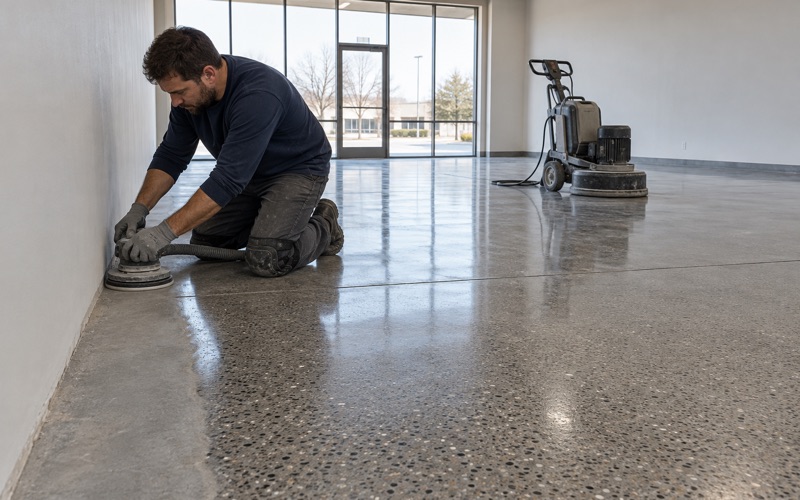
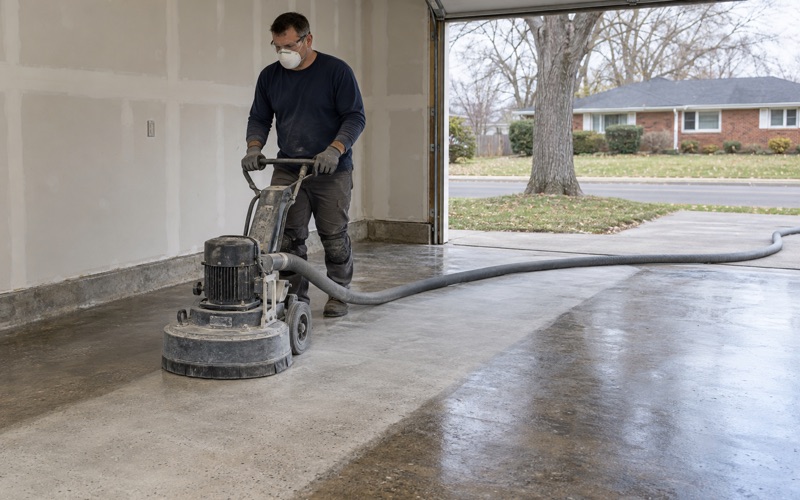
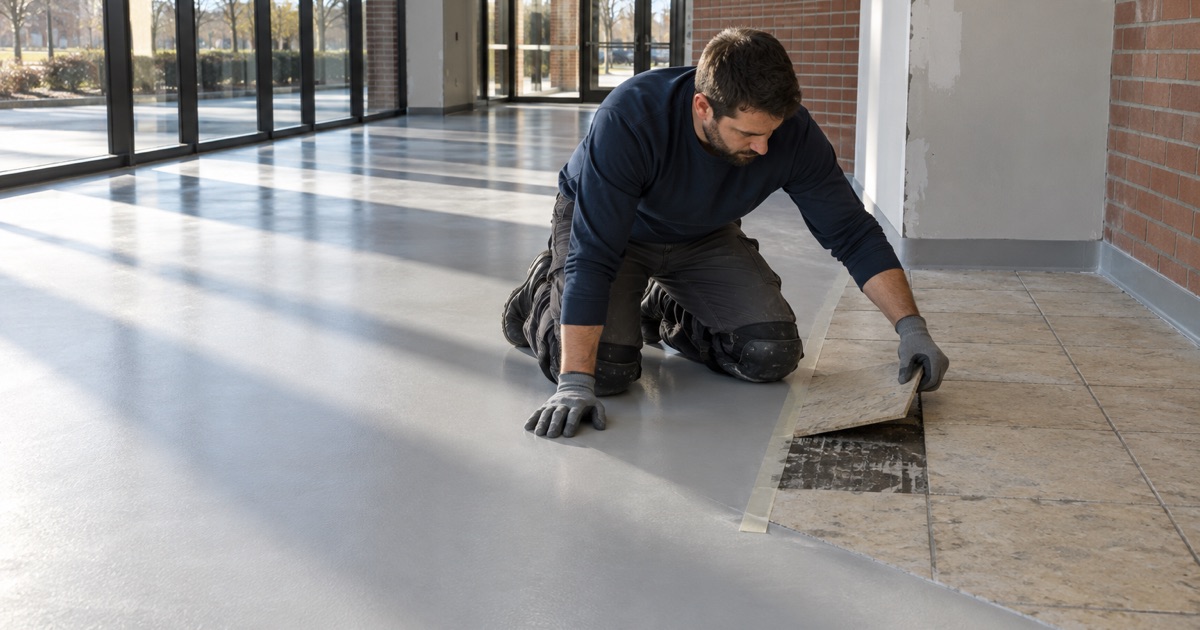
Read that list with a coating job in mind. Diamond grinding and shot blasting are how a slab is prepared for resin, and both sit squarely inside the rule. The step that gives an epoxy its bond is the same step that turns an intact old floor into a regulated one, which is why we never treat old tile and adhesive as simply something to grind through.
What a survey settles before the price is final
So before we price a floor that still has old tile on it, or that shows black adhesive where tile used to be, we ask for that material to be sampled and tested by a qualified inspector. The lab report is what tells the owner whether the tile and mastic can come up as ordinary demolition or need abatement first. Until that report exists, our quote is a draft.
A negative result is worth the short wait, because it turns a guess into a written answer the whole job can rely on. A positive result is just as valuable before anyone rents a grinder, because it decides who touches the floor next and how long the room stays out of use.
When the old floor tests positive
If the existing flooring tests positive, we stop at the edge of our trade. We do not remove asbestos and we hold no license to, so the tile and mastic go to a licensed abatement contractor the owner hires directly. Under the federal rule, mastic taken off by grinding or shot blasting has to be kept adequately wet before and during the work and disposed of under NESHAP, which is the abatement contractor’s job, not ours.
What we can do is keep the coating schedule open, walk the slab once that contractor’s work is finished and the area has been released, and quote the floor against bare concrete instead of against an assumption. Our scope starts where theirs ends, with no overlap.
Sequencing: Abatement, Then Slab Preparation, Then Resin
Grinding a slab that has been cleared
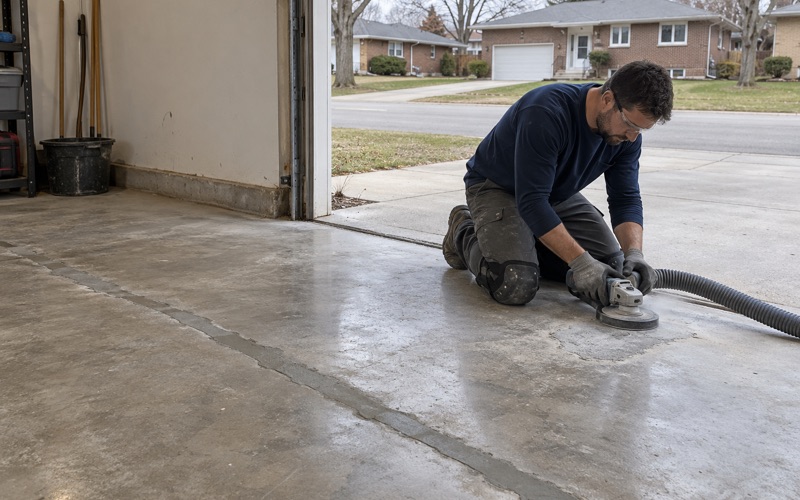
Once the old material is gone, we open the concrete with a diamond grinder or a shot blaster to a profile on the ICRI CSP scale that suits the system going down. The dust is pulled into a vacuum at the machine rather than swept around or rinsed toward a floor drain. On a slab that just came out of abatement, that matters twice: the room has been cleaned to a standard, and our work should not undo it.
This is also when we map cracks, spalls and any patches of leftover coating or adhesive residue. If the slab needs repair, or is past repair and should be replaced, we say so plainly before resin is part of the conversation. A coating bonded to failing concrete only hides the failure for a while.
Moisture testing on concrete that was covered for years
A moisture test is part of our scope before the price is final. Depending on the floor, that means ASTM F2170 in-situ relative humidity probes, an ASTM F1869 calcium chloride moisture vapor emission test, or an ASTM D4263 plastic sheet test as a first look, each read against the limits the coating maker publishes. A slab that spent years under glued-down flooring has never been seen bare by anyone on the current job, so its moisture behavior is unknown until it is measured.
A high reading does not end the project. It changes it, usually to a moisture-mitigation primer under the system or to a different system, and it goes into the written warranty terms rather than being discovered later. Moisture is the first exclusion we explain before a job is sold.
What the written proposal locks down
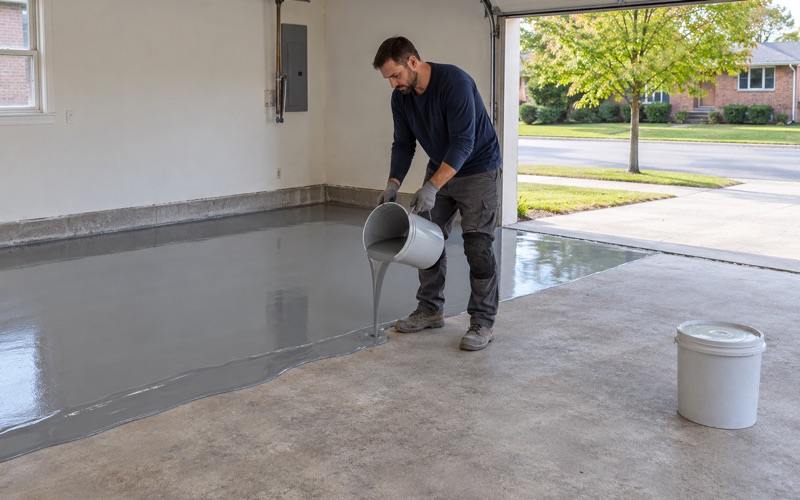
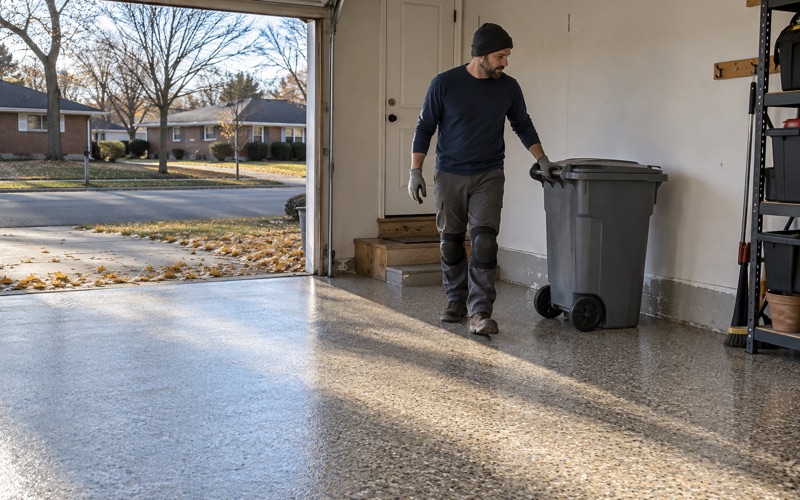
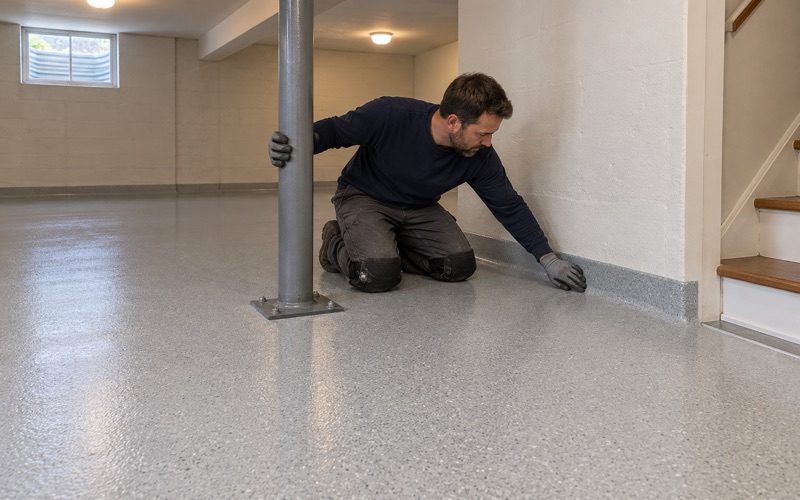
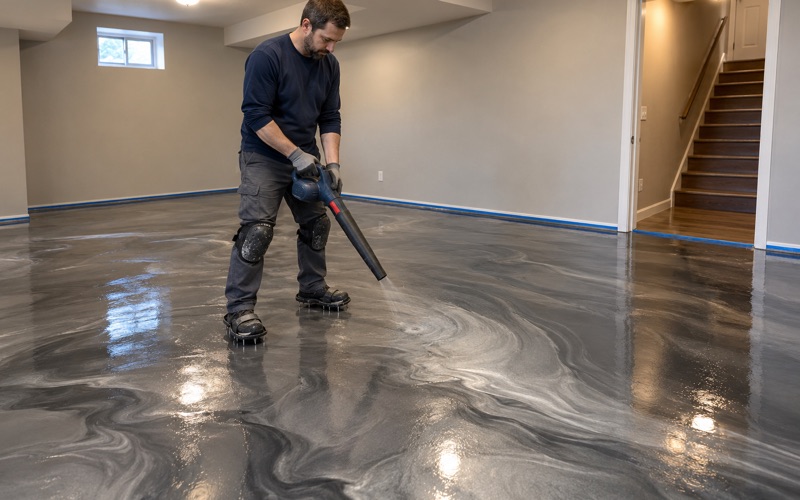
Our proposal names the product line, the number of coats and the finished thickness, so the floor can be checked against the paperwork when we leave. That might be a 100% solids epoxy with a quartz aggregate broadcast for a busy corridor, or a vinyl flake broadcast under a polyaspartic topcoat for a room that needs to reopen quickly. Either way, the system is chosen after the test results, not before.
On a home job over the state threshold, the Illinois Home Repair and Remodeling Act requires a written contract, and you receive the Home Repair: Know Your Consumer Rights pamphlet before any grinding starts. Commercial owners get the same level of written detail, because a schedule built around an abatement window has no room for a surprise.
Floor Work in a Building the Public Keeps Using
Phasing like the library did
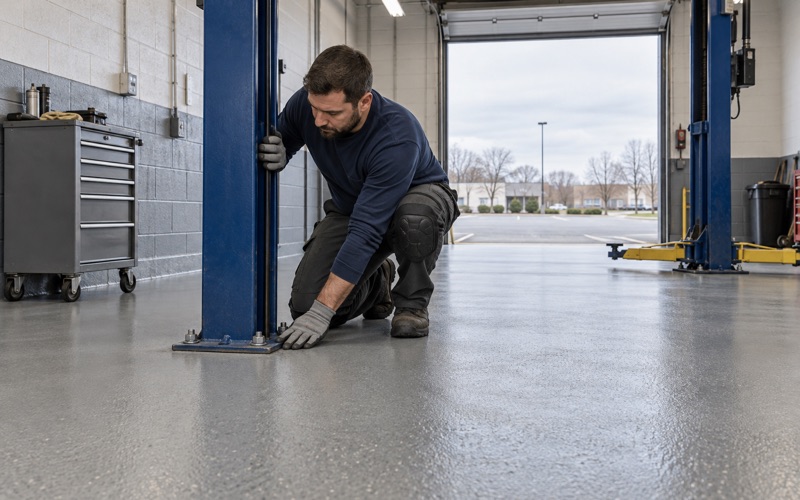
The library’s sequence is a useful model for any older building that cannot simply close: phase the work, keep the public in the areas that are finished, and save the full closure for the one step that truly needs it. We plan shop, office, warehouse and public-facing floors the same way, working around shifts and opening hours and using overnight and weekend windows when the building cannot stop.
A phased floor needs clear edges. Each section gets its own preparation, coats and cure before traffic crosses it, and the seams between phases are planned where a transition strip or a doorway hides them. Rushing a section back into service before it has cured is how a phased job ends up with scuffed, marked or soft spots.
Odor, dust and products people can work beside
When part of a building stays occupied, what drifts out of the work area matters as much as the floor itself. We select products inside the Illinois VOC limits for floor and industrial coatings in 35 Ill. Adm. Code Part 223, which bind the person applying them, and we keep grinding dust contained at the machine. Faster-curing topcoats can shorten the time a section stays closed, and we match that choice to how soon the space has to reopen.
Who signs off in Bellwood
Illinois has no state flooring license, so before booking a job we check the Village of Bellwood’s own registration, bond and insurance requirements. We also ask the village Building Department whether a coating needs a permit rather than assuming either answer. The asbestos survey, the abatement and any sign-off on that work stay with the owner and the licensed abatement contractor, and our coating work starts only after that part is closed.
- 20+ Years on Concrete
- Moisture Tested Before Pricing
- Written Itemized Proposals